
THE PERSON IN THE MIRROR
A Story About Identity, Self-Belief and the Life You Were Meant to Live
By Dharmendra Singh
Expert Community Hub Reads · Book 04
Expert Community Hub Reads · Book 04
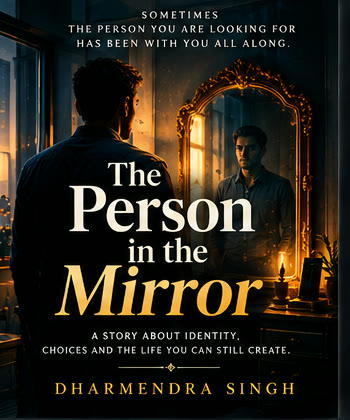
Sometimes the biggest mystery in life is the person you see every day.
An emotionally engaging story about identity, expectations, fear, and the courage to become more honestly yourself.
Estimated reading time: approximately 30 minutes
PROLOGUE · A STRANGER IN MY OWN LIFE
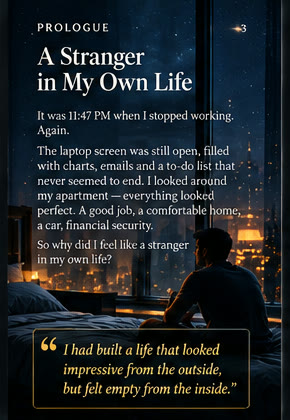
At 11:47 p.m., Rohan Malhotra closed his laptop and caught his reflection in the black screen.
For a moment, he did not recognise the expression on his own face.
It was not sadness, exactly. Sadness had a reason. This was something quieter: the look of a man who had done everything he was told would make him happy and was beginning to wonder why happiness still felt like a visitor.
Outside, Bengaluru glittered beneath a light rain. In the apartment opposite, someone was laughing. A scooter passed through the wet street. The refrigerator hummed in the kitchen. Everything was ordinary.
Rohan was thirty-six. He had a respected job, a comfortable apartment, a good salary, clothes that fit, and a calendar that stayed full. His parents described him as settled. His colleagues called him reliable. His friends joked that he had become the person everyone called when they needed a plan.
He was good at plans.
He could take a messy project, break it into steps, assign owners, track progress and deliver on time. He could solve a business problem with a spreadsheet and calm a tense meeting with a few carefully chosen words.
But he could not answer one question that had begun following him from room to room.
If my life looks right, why does it feel as if I am missing from it?
He stood and walked to the bathroom. The mirror above the sink was plain, framed in brushed steel. He had looked into it thousands of times: while shaving, checking his collar, fixing his hair before a video call.
Tonight he looked longer.
His reflection looked back with familiar eyes and an unfamiliar weariness.
“Who are you?” he whispered, half joking.
The room offered no answer.
He turned off the light and went to bed. Before sleep came, he remembered something his grandmother used to say whenever he was trying too hard to impress someone.
“Beta, don't spend your whole life polishing the window. Remember to look through it.”
At the time, he had thought it was just one of her sayings.
Now, for the first time, he wondered what he had stopped looking at.
1 / 13
A NOTE BEFORE YOU READ
This is a story about Rohan. It is also a story about the different versions of ourselves we build to be accepted, respected, safe, successful, or loved.
We all adapt. We learn how to behave at work, how to speak with family, how to avoid conflict, how to appear confident when we are uncertain. These roles are not automatically false. They help us live with other people.
The trouble begins when the role becomes so familiar that we forget there is a person underneath it.
This story is not asking you to reject who you are. It is asking you to meet yourself more honestly.
2 / 13
CHAPTER 1 · THE LIFE ON AUTOPILOT
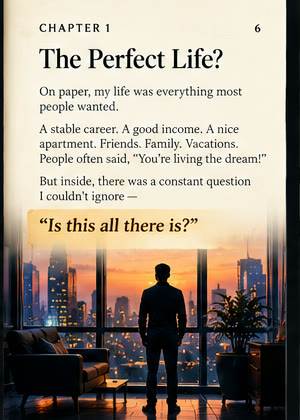
Rohan's days had a rhythm so reliable that he could move through most of them without being fully present.
Wake up. Check messages. Coffee. Traffic. Meetings. Lunch at his desk. More meetings. A quick call to his mother while walking to the parking garage. Dinner ordered through an app. One episode of a show he barely watched. Scroll until his eyes hurt. Sleep.
Repeat.
Nothing about the routine was terrible. In fact, it was the sort of life many people worked hard to build. He was not struggling to pay rent. He was not worried about losing his job. He had people who cared about him.
And still, the days felt strangely interchangeable.
One Tuesday, his manager, Kavita, called him into a meeting room.
“We want you to lead the new regional programme,” she said. “It's a bigger role. More visibility. A strong step toward director level.”
Rohan smiled. “That sounds great.”
“You don't sound excited.”
“I am. Just processing.”
Kavita leaned back. “You've earned it. You've been dependable for years. I know I can give you something difficult and you will get it done.”
Dependable. The word landed like a medal he had worn for so long that he no longer felt its weight.
“Thank you,” he said.
That evening, he told his friend Sameer over dinner. Sameer slapped the table and grinned.
“Director track! Next you'll buy a bigger car and start saying things like ‘circle back’ at home.”
Rohan laughed. “Maybe I'll finally be able to afford a holiday without checking email.”
“Then take one.”
“After the launch.”
Sameer lifted an eyebrow. “Which launch?”
“The new programme.”
“And after that?”
Rohan opened his mouth, then closed it.
Sameer softened. “I'm not telling you to quit your job. I'm asking whether you still know what you're working toward.”
Rohan gave the answer he had given himself for years: security, growth, a better future. It sounded sensible. It also sounded borrowed.
The old sketchbook
That weekend, Rohan visited his parents to help clear a storage room. His mother wanted to make space for a new cupboard. His father had already labelled boxes with the seriousness of a warehouse manager.
“Keep, donate, discard,” his father announced. “No emotional attachment to broken things.”
Rohan opened a dusty carton marked COLLEGE.
Inside were notebooks, a camera manual, old concert tickets and a sketchbook. He had forgotten the sketchbook existed. Its cover was bent, and a strip of tape held the spine together.
He opened it.
There were drawings of people on buses, a street vendor, his grandmother's hands, and the corner of a café where he used to sit with friends. The drawings were not professional, but they were alive. Each one seemed to contain a moment he had taken the time to notice.
His mother appeared at the door. “You used to draw everywhere.”
“I wasn't very good.”
“You were happy doing it.”
He turned another page. “I had more time then.”
“Maybe,” she said. “Or maybe you made time because it mattered to you.”
He felt the familiar urge to explain why life was different now. Work was demanding. Responsibilities had increased. Adults could not spend evenings sketching on café napkins.
But his mother was not asking him to abandon his responsibilities. She was simply remembering him.
On the drive home, the sketchbook lay on the passenger seat. At a red light, Rohan glanced at it and felt an unexpected tenderness toward the young man who had drawn in its pages.
He had not lost that person in one dramatic moment.
He had misplaced him through a thousand reasonable decisions.
Sometimes we don't lose ourselves. We slowly stop making room for ourselves.
3 / 13
CHAPTER 2 · THE MIRROR
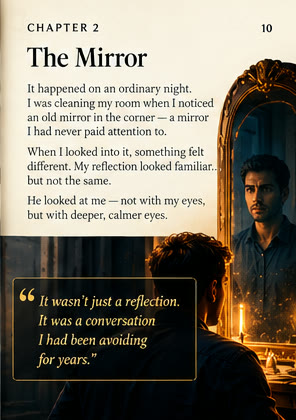
Two weeks later, Rohan returned to his late grandmother's house to help his parents prepare it for renovation. The house was full of small things that seemed to have been waiting for someone to remember them: brass bowls, folded shawls, a clock that ran seven minutes fast, and books with her notes in the margins.
In the back room, behind a stack of old trunks, he found a tall mirror covered by a faded cloth.
He pulled the cloth away.
The frame was dark wood carved with vines and small leaves. It had a hairline crack near the lower corner. He remembered it from childhood. His grandmother used to stand before it while tying her hair, humming softly as she prepared for the day.
“Take it if you want,” his father called from the hallway. “The carpenter says it's too old to sell.”
Rohan wiped the glass with his sleeve.
At first, he saw himself: an adult man in a well-cut shirt, phone in one hand, tired eyes. Then the room behind him seemed to shift—not physically, but in the way a memory can suddenly become vivid.
He saw himself at seventeen, sitting on the floor with a sketchbook. At twenty-two, laughing with friends after a terrible college performance. At twenty-seven, standing in a new office, nervous and proud. Then he saw another version: a man with paint on his fingers, smiling in a small studio. Another: a man standing on a mountain trail with a camera. Another: a man speaking honestly in a room where everyone had expected him to agree.
Rohan stepped back.
The images were gone. Only his reflection remained.
He touched the glass. It was cold.
“Long week,” he muttered.
Yet when he turned to leave, he had the unsettling feeling that the mirror had not shown him fantasies. It had shown him possibilities he had once considered and then filed away under NOT PRACTICAL.
That evening, he brought the mirror home. He placed it opposite the window in his study, where the morning light could reach it.
For several days, nothing unusual happened. He looked at it while brushing his hair or straightening his collar. He nearly forgot the strange moment in his grandmother's house.
Then, one night, after another long day, he stood before it and asked a question he had never said aloud.
“Am I happy—or am I just good at making my life look successful?”
His reflection did not move differently. It did not speak. But Rohan felt something inside him shift: not an answer, but permission to keep asking.
The next night, he returned to the mirror with another question.
“What do I actually want?”
The night after that:
“What am I afraid would happen if I admitted it?”
The mirror offered no magic solution. It simply gave him a place where he could not easily distract himself.
And that, he began to realise, was rare.
4 / 13
CHAPTER 3 · THE QUESTIONS
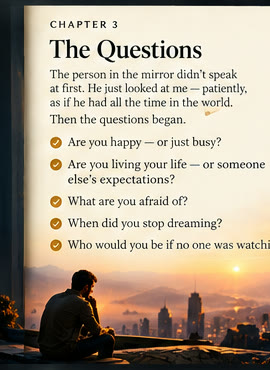
Rohan bought a notebook and placed it on the desk beside the mirror. At first, he wrote answers that sounded like interview responses.
What do I want? Growth. Balance. Meaningful work.
What am I afraid of? Failure. Uncertainty. Disappointing people.
The words were accurate but strangely empty. They were the sort of answers he could give in a leadership workshop without revealing anything important.
One night, irritated by his own vagueness, he wrote a different question:
What would I admit if I knew nobody would judge me?
He stared at the page for a long time.
Then he wrote:
I'm tired of being the person who always has it together.
The sentence looked almost childish. He nearly crossed it out.
Instead, he kept going.
I'm afraid that if I stop being useful, people will stop needing me. I'm afraid that if I change direction, everyone will think I wasted my education. I'm afraid I don't know what I enjoy anymore because I keep turning everything into a goal.
His chest tightened. The words felt too personal even though no one else would read them.
He set down the pen and walked to the kitchen. He poured water, drank half the glass, and returned to the desk.
The mirror showed a man who looked uncomfortable.
For once, Rohan did not try to correct the expression.
A conversation with Sameer
A few days later, he met Sameer for a walk. Sameer had known him since university and had a talent for noticing when Rohan was performing certainty.
“Can I ask you something?” Rohan said.
“You can ask. I reserve the right to give a useless answer.”
“Do you think I've changed?”
Sameer looked at him. “Of course. We were twenty and thought instant noodles counted as dinner. We're older now.”
“I mean… do you think I've become someone I don't really want to be?”
Sameer stopped walking. “That's a much better question.”
Rohan told him about the sketchbook, the mirror, and the strange sense that he had become disconnected from parts of himself. He left out the moments when the reflection seemed to contain other versions of him. He did not yet know how to explain them without sounding foolish.
Sameer listened carefully.
“You know what I remember about you in college?” he asked. “You could spend three hours drawing a street scene, then stay up all night helping me prepare for an exam. You were curious about everything. You were ambitious, too. But you didn't seem to believe that one part of you had to cancel out the other.”
“Maybe I grew up.”
“Maybe. Or maybe you confused growing up with narrowing down.”
Rohan looked at the pavement.
Sameer continued. “I'm not saying you should become your old self. That person had his own problems. I'm saying you should stop treating the things you loved as evidence that you weren't serious.”
The sentence stayed with Rohan all the way home.
The first honest list
That night, he made two columns in the notebook.
Things I do because they matter to me.
Things I do because I want to be seen a certain way.
The lists overlapped. He genuinely enjoyed solving complex problems at work. He liked supporting his parents. He wanted financial stability. Those were not false choices simply because other people respected them.
But he also accepted meetings because he wanted to be thought indispensable. He bought things he barely used because they signalled progress. He avoided asking for help because he wanted to appear capable. He said yes when he wanted to say no, then quietly resented people for believing him.
The discovery was not that his life was wrong.
It was that he had stopped distinguishing between what he valued and what he performed.
Self-awareness begins when you stop asking only, “How do I look?” and start asking, “What is true?”
5 / 13
CHAPTER 4 · THE OTHER ME

The mirror became a quiet ritual. Rohan would stand before it, ask a question, then write for ten minutes. Some nights he found clarity. Other nights he found only irritation, contradictions and memories he had not expected.
One Thursday, he had a difficult meeting. A junior colleague, Meera, presented an idea that Rohan thought was risky. He dismissed it too quickly. Later, he discovered that she had identified a problem the rest of the team had missed.
He could have quietly corrected the plan and moved on. Instead, he found himself thinking about how much energy he spent protecting the image of a person who was always right.
That night, he stood before the mirror and said, “Show me the person I would be if I stopped trying to impress everyone.”
The glass seemed to darken, like a window at night.
Then he saw a version of himself sitting in a modest room filled with books and sketches. The man was older by a few years, dressed simply, and smiling as he helped a young person work through a difficult problem. He looked neither rich nor poor, neither celebrated nor forgotten. He looked present.
The image changed. Another Rohan stood on a stage, speaking confidently about a project he had built. Another sat at a dinner table, listening to his partner rather than checking his phone. Another was alone in a quiet home, at peace with a life that did not need to impress anyone.
Then the images became less flattering.
He saw a Rohan who had left his job impulsively and struggled to pay rent. One who had pursued art but grown bitter when success did not come. One who had rejected every expectation and discovered that rebellion could become another performance. One who had spent years blaming his family for choices he had never honestly discussed with them.
Rohan stepped away from the mirror.
He had wanted it to show him a perfect alternate self. Instead, it showed him people—each with strengths, blind spots and consequences.
The reflection settled on his own face.
“Which one is the real me?” he asked.
The answer arrived not as a voice but as a thought he could no longer avoid:
You are not a single finished person waiting to be discovered. You are also the choices you practise.
The mask of competence
The next morning, Rohan apologised to Meera in front of the team. He acknowledged that he had dismissed her proposal before understanding it. They reviewed the idea together and found a way to test it on a smaller scale.
It was an ordinary apology. No one applauded. The project did not suddenly become perfect.
But Rohan felt lighter than he expected.
He had always thought admitting a mistake would weaken his authority. Instead, it made the conversation more useful. Meera became more confident about raising concerns. Other team members began sharing doubts earlier, before those doubts became expensive problems.
Rohan saw how his mask of competence had protected him from embarrassment while quietly making the people around him less honest.
At home, he began to notice other masks: the cheerful son who never worried his parents, the easygoing friend who never admitted loneliness, the confident professional who never said “I don't know.” Each mask had begun as a useful tool. Over time, he had forgotten how to take them off.
He wrote in his notebook:
I don't need to become less capable. I need to stop using capability to hide every other part of me.
6 / 13
CHAPTER 5 · THE TRUTH I AVOIDED
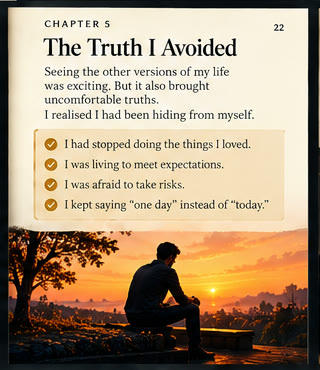
Rohan's mother called one Sunday and asked him to visit. His father had been unusually quiet since the renovation plans began. Rohan arrived with sweets and found his parents sorting photographs at the dining table.
His mother held up a picture of him at twelve, standing beside a school art display. His drawing—a street after rain—had won a small prize. His face in the photograph was bright with surprise.
“You were so proud that day,” she said.
“I remember.”
“Why did you stop?”
“I didn't stop. I got busy.”
His father looked up. “You were good at it.”
Rohan felt defensive. “It wasn't a career. I needed to focus on studies.”
“No one is saying you should have become an artist,” his father replied. “We're saying you looked happy.”
Rohan put the photograph down more sharply than he intended.
“You both wanted me to be practical. You were worried about Aditya taking risks. I thought I was doing the right thing.”
His father went still. His mother looked between them.
For a moment, Rohan wanted to take the words back. He had spent years keeping this conversation safely buried beneath respect, gratitude and the belief that good sons did not complicate things.
His father finally spoke. “We were worried. We did want you to be practical. We thought stability would protect you.” He paused. “But we did not tell you that you had to stop drawing.”
“No,” Rohan said. “You didn't.”
The truth was more uncomfortable than blame. No one had forced him to abandon every interest. He had watched the tension around Aditya and made a private decision to become the opposite: predictable, careful, easy to reassure.
His parents had contributed to the story, but he had kept repeating it long after the original fear had passed.
“I think I wanted to be the son who never caused worry,” he said.
His mother's eyes softened. “You were a child. You shouldn't have had to manage our worries.”
The room became quiet.
Rohan had expected the conversation to reveal a villain. Instead, it revealed a family of people who loved one another and had not always known how to speak about fear.
His father reached for the photograph. “I don't want you to throw away a good life just because you feel restless. I only want you to know that you are allowed to choose it. There is a difference between choosing stability and hiding inside it.”
Rohan felt his eyes sting.
On the drive home, he understood something he had resisted: the story he told himself had protected him once. It had helped him navigate grief, uncertainty and family expectations. But a story that protects you in one season can imprison you in another.
The truth beneath the goal
That night, he wrote three sentences:
I want to be respected.
I want to be free to change my mind.
I want people to love me even when I am not useful.
He read them several times. The third sentence frightened him most because he could not achieve it through performance. He could only risk being known.
He called Sameer and admitted that he had been lonely. He told Anika that he sometimes used work to avoid conversations he did not know how to have. He asked his mother to tell him more stories about his grandmother, not because he needed a lesson but because he wanted to hear her voice in the memories.
Nothing was magically fixed. Some conversations were awkward. Some people did not know what to say. But the world did not collapse when Rohan stopped pretending to have everything under control.
He had spent years trying to become someone who could never be rejected.
Now he was learning to become someone who could be known.
The hardest mask to remove is the one people have praised you for wearing.
7 / 13
CHAPTER 6 · FACING THE REAL ME
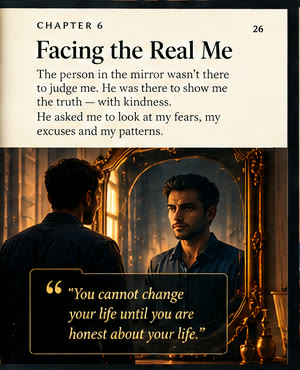
For a while, Rohan expected self-awareness to feel like relief. Sometimes it did. Other times it made him more aware of his habits, his avoidance and the small ways he disappointed himself.
He caught himself checking his phone while someone was speaking. He agreed to work he did not have capacity for. He compared his progress with people whose lives he knew only through carefully selected photographs. He judged himself for being inconsistent, then used that judgement as an excuse not to try again.
The mirror did not make him perfect. It made it harder to claim he did not notice.
One evening, after he cancelled a planned drawing session for the third week in a row, he stood before it and said, “Maybe this is just who I am. I start things and stop.”
His reflection looked tired.
Then he remembered something his grandmother had told him when he was learning to ride a bicycle: “Falling is an event, not a name.”
He had laughed at the time. Now he wrote the sentence in his notebook.
A behaviour is something you do. It is not always who you are.
He had been turning temporary patterns into permanent identities. “I'm bad at relationships.” “I'm not creative anymore.” “I'm too busy.” “I'm just not that kind of person.” Each sentence made change seem unnecessary because it made the present feel inevitable.
He began replacing labels with observations.
Instead of “I'm lazy,” he wrote, “I avoid starting when I think the result must be excellent.”
Instead of “I have no time,” he wrote, “I spend some of my free time recovering from a day in which I said yes too often.”
Instead of “I'm not creative,” he wrote, “I haven't made anything in years, and I feel awkward beginning again.”
These sentences were less dramatic, but more useful. They described problems that could be worked with.
The ten-minute promise
Rohan set a small rule: ten minutes of drawing, three evenings a week. He would not post the results. He would not buy expensive supplies. He would not turn it into a side hustle or a personal brand. The purpose was to practise paying attention to something he enjoyed.
The first drawings were stiff. His hands felt clumsy. He kept comparing them with the work he admired online. On the fourth evening, he nearly gave up.
Then he remembered the sketchbook from his parents' house. The drawings there were imperfect too. Their value had never depended on whether strangers would like them.
He continued.
He also made other small changes. He left his phone outside the bedroom. He stopped saying “yes” before checking his calendar. He began taking a short walk without audio in his ears. He told his manager when his workload was unrealistic instead of quietly working late and feeling resentful.
These were not spectacular transformations. They were small acts of self-respect, repeated often enough to become evidence.
One night, he looked into the mirror and noticed that he was standing differently. Not more handsome, not younger, not magically confident. Simply less braced for judgement.
He smiled at his reflection.
For the first time, it did not feel like he was trying to convince himself of anything.
8 / 13
CHAPTER 7 · A NEW CONVERSATION
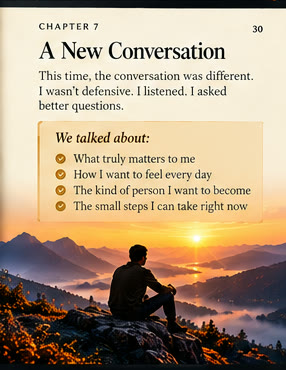
Months passed. Rohan's life did not become effortless, but it became more deliberate.
At work, he still led difficult projects. He still cared about results. He also began mentoring younger colleagues and creating space for people to disagree without being punished for it. He discovered that the best version of his professional self was not the one who always had an answer. It was the one who could help a team find the truth sooner.
His relationship with his parents changed, too. He asked questions he had never thought to ask: what they had wanted before they became parents, what frightened them when they were young, what choices they regretted. He learned that his father had once wanted to study architecture and that his mother had loved singing in college.
They were not only his parents. They were people with unfinished stories.
He called Sameer more often. He and Anika learned to talk about uncertainty without treating it as a warning that something was wrong. Some plans changed. Some expectations had to be renegotiated. Rohan discovered that being honest did not guarantee that everyone would agree with him. It simply gave the relationship a real person to respond to.
The mirror at midnight
One year after finding the old mirror, Rohan stood before it on a quiet Sunday night. The frame had been repaired; the crack near the lower corner remained visible. He had considered replacing the glass, then decided he liked the evidence of its age.
“Who are you?” he asked, remembering the first night.
His reflection looked back.
He could see the tired professional, the careful son, the friend who sometimes disappeared when overwhelmed. He could also see the person who was learning to draw again, to apologise without defending himself, to set a boundary without writing a speech in his head first.
None of those versions cancelled the others.
He had spent years searching for the one true identity that would make every decision easy. But people were not products with a single fixed feature list. They were stories in motion, shaped by values, habits, relationships, mistakes and choices.
The mirror could not tell him who he was supposed to become.
It could remind him to notice who he was becoming.
He placed his notebook on the desk and wrote:
I am not only the person I have been. I am also the person I practise being.
Then he added:
Tomorrow, I will practise honesty. I will make time to draw. I will listen without preparing my reply. I will ask for help when I need it. I will not demand that I become fearless before I begin.
He closed the notebook.
The reflection in the glass looked ordinary. That was the beauty of it.
The real work was no longer happening in the mirror. It was happening in the choices waiting for him outside the room.
You don't discover your real self once and for all. You meet yourself again through the choices you make.
9 / 13
CHAPTER 8 · THE PERSON I CHOOSE
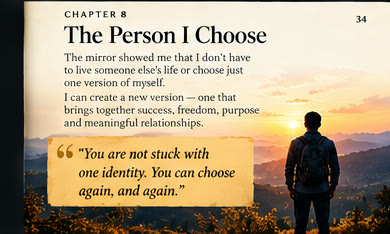
The following spring, Rohan was invited to speak at a company event about leadership. A year earlier, he would have prepared a polished talk about performance, discipline and growth. This time, he spoke about something less comfortable: the danger of becoming so good at meeting expectations that you stop asking whether they still fit.
He did not tell the audience that an old mirror had shown him alternate versions of himself. He told them about the sketchbook, the conversations with his parents, the apology to Meera, and the ten-minute promise that had brought drawing back into his life.
Afterward, a young analyst waited near the exit.
“I thought I was the only person who felt like I was acting all day,” she said. “Everyone thinks I'm confident. I'm exhausted from trying to keep it up.”
Rohan did not offer a formula. He asked her what she was afraid would happen if she let one trusted person see how she really felt.
She thought for a moment. “They might think I'm not ready for the job.”
“Maybe,” he said. “Or they might help you get better at it. You won't know until you let someone respond to the real situation instead of the version you perform.”
She thanked him and left. Rohan watched her go, aware that he had once needed someone to ask him the same question.
The real definition of confidence
He had once believed confidence meant never doubting himself. Now he thought it meant being able to face doubt without letting it make every decision.
He had once believed authenticity meant saying everything he felt. Now he understood that it also required care, timing and responsibility. Honesty was not permission to be careless with other people. It was a commitment to stop building relationships on hidden resentment and polished appearances.
He had once believed change required a dramatic leap. Now he knew that a life could change direction through ordinary acts repeated consistently: one honest conversation, one boundary, one new habit, one apology, one hour given to something that made him feel alive.
He was still ambitious. He still wanted to do meaningful work and provide for the people he loved. He had not become a different species of human being. He had simply stopped asking achievement to answer every question about his worth.
That evening, he returned home and stood before the mirror. He looked at himself for a moment, then turned away to put the kettle on.
The reflection remained behind him, exactly where it had always been.
He no longer needed it to reveal a perfect person.
He needed only to remember that the person looking back was not a finished verdict.
He was a beginning.
10 / 13
EPILOGUE · THE MIRROR WITHIN
A year can pass without changing much. A single honest question can begin changing everything.
Rohan's mirror still stood in the study. Some days he barely noticed it. Other days, he paused before it and asked himself whether the life he was building still reflected what mattered to him.
He did not always like the answers. He still caught himself performing. He still avoided hard conversations sometimes. He still had weeks when work consumed more time than he wanted to give it.
But he had stopped treating every imperfect day as proof that he had failed to change.
He could notice, return and begin again.
The mirror had never been a magical object. Or perhaps its magic was ordinary: it had given him a place to stop moving long enough to see himself without an audience.
That was the work no promotion could do for him. No compliment could do it. No relationship, no achievement, no external approval could replace the quiet responsibility of becoming honest about his own life.
The person in the mirror was not a stranger anymore.
Not because Rohan had solved every mystery about himself, but because he had learned to stay for the conversation.
Maybe that is what growing into yourself means. Not uncovering a perfect person hidden beneath every mistake, but learning to meet the whole person with courage: the capable parts, the frightened parts, the generous parts, the selfish parts, the dreams that still matter, and the habits that need to change.
You do not have to reject your past to choose differently in the present.
You do not have to know exactly who you will become before you take the next honest step.
And you do not have to become someone impressive before you deserve to be seen.
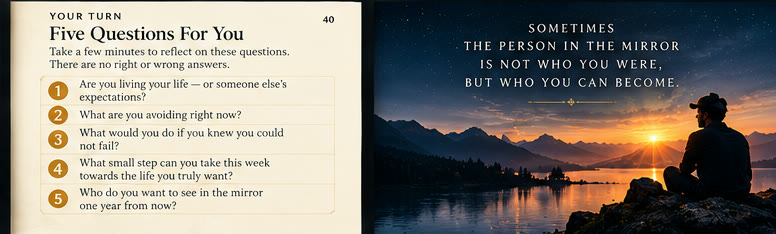
The person in the mirror is not only who you were. It is also who you can become.
11 / 13
YOUR TURN · FIVE QUESTIONS FOR YOU
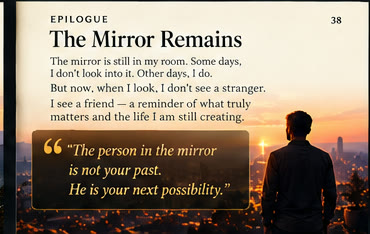
Take five quiet minutes. Write honestly. There are no perfect answers, and you do not need to share them with anyone.
YOUR SEVEN-DAY PROMISE
Complete this sentence:
Make the promise small enough to keep and meaningful enough to matter.
12 / 13
A NOTE FROM THE AUTHOR
I believe that many people spend years becoming the person their circumstances reward. We learn to be productive, dependable, agreeable, impressive or strong. Those qualities can help us build meaningful lives. But if we never pause to ask whether they still serve us, they can become masks we are afraid to remove.
This story is an invitation to look with honesty and kindness. You do not need to blame yourself for the choices you made when you were younger, more frightened or working with what you knew at the time. You can respect the person who got you here and still choose to grow beyond the habits that no longer fit.
The goal is not to become a perfect version of yourself. It is to become more present, more truthful and more intentional about the person you are practising being.
If this book leaves you with one question, let it be this:
Am I living in a way that reflects what I say matters to me?
You do not have to answer perfectly today. You only have to be willing to ask—and then let your next choice be part of the answer.
— Dharmendra Singh
Expert Community Hub
Expert Community Hub
EXPERT COMMUNITY HUB READS · BOOK 04
THE PERSON IN THE MIRROR
A Story About Identity, Self-Belief and the Life You Were Meant to Live
Sometimes the person you are looking for is the person you have been avoiding.
13 / 13