

THE LAST PERSON WHO SAW ME
A Story About Connection, Regret and the Lives We Leave Behind
Dharmendra Singh
Expert Community Hub Reads · Book 05
Expert Community Hub Reads · Book 05
Some people see your face. A few see your success. But only one person may remember who you were before the world told you who to become.
An emotional short novel about family, memory, the quiet ways people shape us, and the courage to return before it is too late.
Estimated reading time: approximately 30 minutes
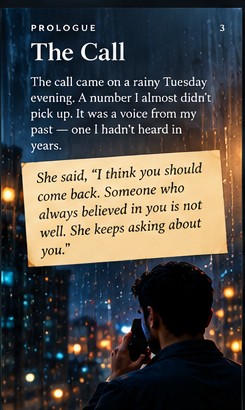
PROLOGUE · THE CALL
At 8:42 on a rainy Tuesday evening, Kabir Malhotra watched his phone ring until the screen went dark.
The caller was saved as Maa.
He was halfway through a presentation for a client in Singapore. The conference room was cold, the windows were black mirrors, and his director had just asked him to explain why the project was six weeks behind schedule.
Kabir turned the phone face down.
A minute later, it vibrated again.
He declined the call.
His mother rarely called twice. She knew his work was demanding. She had learned, over the years, to send messages that began with Whenever you have time and ended with a heart.
This time, the message was short.
Kabir, please call me when you can. It's about Nani.
He typed, In a meeting. Will call tomorrow morning.
Then he deleted it.
He typed, Is everything okay?
Before he could send it, his director called his name.
Kabir put the phone away.
The meeting lasted another hour. The client accepted the revised plan. His director thanked him for staying calm under pressure. Someone ordered dinner. The team laughed about a joke Kabir barely heard.
At 10:16 p.m., he finally called home.
His mother answered on the first ring.
“She's asking for you,” she said.
Kabir stood up. “Is Nani all right?”
“She is resting. The doctor says we should be prepared. She keeps asking when you'll come.”
“I'll come this weekend.”
There was a pause.
“Beta,” his mother said, “she may not have a weekend.”
The room around him seemed to go quiet.
Kabir looked at the dark window and saw his own reflection: expensive shirt, tired eyes, a face arranged into the expression of a man who could handle anything.
“When did this happen?” he asked.
“Her condition changed yesterday. I called you then, but you were travelling.”
He remembered the missed call. He remembered seeing it at an airport and telling himself he'd ring after landing.
“I'll book the first train.”
“Come as soon as you can.”
After the call, Kabir sat alone in the conference room. On the table lay the presentation he had spent three weeks perfecting. It was full of charts about growth, efficiency and the value of every minute.
For the first time in a long while, he wondered what his minutes were worth.
He booked the train at midnight.
He did not know that the journey would take him back to a place he had spent fifteen years avoiding—and to the last person who had ever seen him clearly.
1 / 13
A NOTE BEFORE YOU READ
This is Kabir's story. It is also a story about the people who remember the versions of us we have forgotten.
The friend who saw our courage before we had proof. The parent who noticed our fear behind a confident answer. The teacher who recognised a gift we dismissed. The grandparent who loved us without asking us to become more impressive.
Sometimes we drift away from those people without a dramatic argument. We get busy. We move cities. We postpone calls. We assume love will wait until the calendar clears.
This book is not asking you to feel guilty about being busy. It asks you to notice who matters, what you have left unsaid, and which conversations still deserve a place in your life.
2 / 13
CHAPTER 1 · A LIFE IN A HURRY
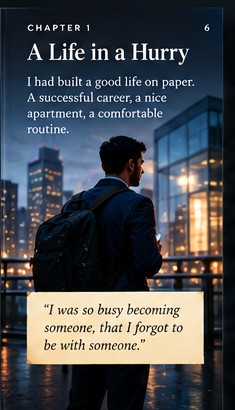
Kabir's life looked successful on paper.
At thirty-six, he was a strategy director at a technology company. He lived in a glass apartment tower in Bengaluru, drove a car he had once dreamed about, and travelled often enough to collect airport lounge memberships. His calendar was organised in fifteen-minute blocks. His inbox was rarely empty. His colleagues trusted him with difficult clients because he never appeared rattled.
He had become the kind of person he once admired.
The problem was that he could no longer remember what he had admired about that person.
His mother lived in a small city two hours from the village where Kabir had grown up. His father had died when Kabir was twenty-four. After that, his mother and grandmother had become each other's company, and Kabir had become the son who sent money, ordered medicines online and promised to visit after the next milestone.
There had always been a next milestone.
First, he needed to settle into his job. Then he needed to prove himself. Then came a promotion, a move, a bigger role, a complicated project. Each achievement opened a new door, and behind every door stood another demand.
Kabir did not think he was neglecting his family. He thought he was taking care of them.
He paid for the repairs to his mother's roof. He covered his grandmother's medical bills. He sent gifts on birthdays. When relatives praised him, he smiled and said he was lucky.
But he rarely stayed on the phone long enough to hear the stories behind his mother's questions.
“How is your food?” she would ask.
“Good, Maa.”
“Are you sleeping?”
“Enough.”
“Are you happy?”
“Of course.”
That last answer was always the quickest.
The person he used to be
At school, Kabir had been curious and restless. He filled notebooks with sketches of buildings, invented names for imaginary places and asked teachers questions that took the class away from the lesson plan. He loved taking things apart to understand how they worked. He loved stories, especially the ones his grandmother told after dinner.
His grandmother, Shanta, called him Kittu.
“Why Kittu?” he once asked.
“Because you were so small when you arrived, you looked like a question mark,” she said.
“That's not an answer.”
“Most good answers begin as questions.”
She had a way of making the world feel larger without making him feel small.
When Kabir was seventeen, he told her he wanted to study design. His father worried about money and stability. His teachers recommended engineering. Everyone had a sensible argument.
Shanta listened to them all. Then she asked Kabir, “If no one could praise you for your choice, what would you still want to do?”
He had never forgotten the question.
He had also never answered it honestly again.
He chose engineering, then management, then a career that rewarded speed and certainty. He became good at both. Over time, the boy who asked questions became the man who supplied answers.
The message he didn't send
On the train, Kabir opened his mother's chat. Their recent conversation was a string of practical exchanges.
Medicine delivered?
Yes, beta.
Electrician coming Friday.
Okay.
I'll send money for the repair.
No need, I have enough.
There was a photograph from three weeks earlier: Shanta sitting by a window, a woollen shawl over her shoulders, holding a cup of tea. Her smile was small but mischievous.
Kabir enlarged the photograph.
He remembered that day. He had been on a video call with a client while his mother walked the phone around the room. He had waved at Shanta, promised to visit soon and returned to his meeting.
He had not asked what she was reading.
He had not asked about the little wooden bird on the shelf beside her.
He had not noticed that she looked thinner.
The train rolled into darkness.
Kabir typed a message: Nani, I'm coming.
He sent it.
A minute later, three dots appeared. Then her reply arrived, written in his mother's hand through voice typing:
Bring your old questions.
Kabir read the sentence again.
For the first time that night, he cried.
We often show love by providing what people need, while forgetting to give them what they miss: our unhurried attention.

3 / 13
CHAPTER 2 · THE JOURNEY BACK
The train moved slowly through towns Kabir had not seen in years. At dawn, fields appeared beyond the window, silver with mist. Tea sellers walked along the platform. Children in school uniforms waited beside their parents. A man carried a basket of marigolds as if it contained something fragile.
Kabir watched the landscape without photographing it.
He had forgotten how much of a journey happened between the destinations.
At the next station, an elderly man sat across from him with a cloth bag on his knees. He looked at Kabir's laptop, then at the countryside.
“Work?” he asked.
“Always,” Kabir replied.
The man nodded. “My son says the same thing. He calls from another country. He tells me he is working hard for us.”
“That's good, isn't it?”
“It is good,” the man said. “I am proud of him. But sometimes I wonder if he knows we don't need him to work every minute for us.”
Kabir looked out the window.
“What do you need?” he asked.
The man considered the question. “A story. A little time. Someone to tell me what the rain smells like where he lives.”
He smiled apologetically, as though he had asked for too much.
Kabir thought of all the times he had described his work in numbers and titles because he did not know how to explain the feeling of his days.
“What do you tell him?” he asked.
“The truth, when I remember to. I tell him the mango tree flowered. I tell him his mother still saves the best piece of fish for him. I tell him his room is exactly as he left it, even though we have cleaned it a hundred times.”
The old man looked down at his hands.
“Parents are strange. We spend years teaching children to leave. Then we must learn how to love them from a distance.”
Kabir felt the sentence settle inside him.
When the train reached his town, the platform looked smaller than he remembered. The station sign had been repainted. The old bookstall was gone. A new pharmacy occupied the corner where he and his friends used to buy orange ice lollies after school.
His mother waited near the exit.
She looked older than the last time he had seen her. Her hair was mostly grey now. She wore the same blue shawl she had worn in the photograph.
Kabir hugged her.
For a few seconds, neither spoke.
Then she patted his back and said, “You've become thin.”
He laughed. “Maa, you say that every time.”
“Because every time you come, you are thin.”
He wanted to tell her he was sorry. He wanted to explain the missed calls, the projects, the constant pressure. Instead, he carried her bag to the car.
Some apologies need more than a sentence. They need a different way of living.
The house at the end of the lane
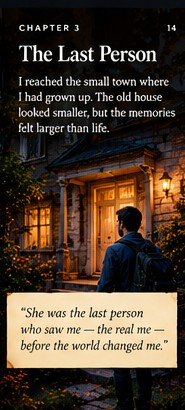
The family home stood at the end of a narrow lane lined with neem trees. The paint had faded from pale yellow to the colour of old paper. A crack ran along the veranda wall. The wooden gate still squeaked in the same place.
Inside, the house smelled of cardamom tea, old books and the faint medicinal scent that comes to rooms where someone has been unwell for a long time.
A pair of slippers sat beside the bed in the front room.
Shanta was asleep.
Kabir stood at the doorway, afraid to move. Her face looked delicate, but when she opened her eyes, the old spark appeared.
“Kittu,” she whispered.
He went to her and knelt beside the bed.
“Nani.”
She touched his cheek with a hand that felt lighter than he remembered.
“You came.”
“Of course I came.”
She studied him for a moment.
“Did you bring your questions?”
Kabir tried to smile. “I brought too many.”
“Good,” she said. “We may need them.”
He laughed, and she closed her eyes again.
His mother watched from the doorway. There was relief in her face, but also something else—an exhaustion she had carried alone for weeks.
“She has good and bad days,” she said quietly. “The doctor says we should keep her comfortable.”
Kabir nodded.
He had prepared for an emergency. He had not prepared for the slow, ordinary work of being present.
4 / 13
CHAPTER 3 · THE LAST PERSON
Over the next two days, Kabir began to understand how much he had forgotten.
Shanta remembered everything.
She remembered the time he broke a neighbour's window with a cricket ball and blamed the wind. She remembered the school play in which he forgot his line and invented a new one. She remembered how he used to sit under the dining table with a torch and read adventure stories after everyone else had gone to bed.
“You were never good at following the plot,” she told him.
“I was creative.”
“You were impatient.”
“That's one way to describe it.”
She laughed, then needed a rest.
Kabir spent hours beside her bed. At first, he tried to fill the silence with updates about work. He told her about the new product, the difficult client and the promotion he might receive next year.
She listened politely.
Then she asked, “Do you still draw?”
Kabir stopped speaking.
“No. Not really.”
“Why not?”
“Work.”
She looked at him for a long moment. “Work has become a very large word in your life.”
He tried to laugh. “It's how I pay for things.”
“Yes,” she said. “And what do you pay with?”
He had no answer.
That afternoon, she asked him to open the old wooden cupboard near the window. Inside were albums, letters, a small radio and a stack of notebooks tied with cotton string.
“Bring me the blue one,” she said.
The notebook was faded at the edges. Its cover had a sketch of a house, a tree and a crooked sun.
Kabir recognised the handwriting immediately.
His own.
At seventeen, he had written stories in the notebook. There were drawings of imaginary cities, descriptions of a train journey through mountains, and a half-finished story about a boy who could hear the thoughts of trees.
He turned the pages slowly.
“I thought these were lost.”
“I kept them.”
“Why?”
“Because you threw them away.”
“I was embarrassed.”
“You were seventeen. You were embarrassed by everything.”
He smiled.
She pointed to a drawing of a house built on a cliff above the sea.
“You told me you would build a place like this one day.”
“I was a child.”
“Of course you were. Children are allowed to imagine without presenting a business case.”
He looked down at the drawing.
For years, he had believed that growing up meant replacing imagination with practicality. He had not noticed how much of himself had been left behind in the exchange.
The person before the world changed him
That evening, Shanta asked him to read aloud from the notebook. He chose a short story about a boy who wanted to become invisible whenever adults argued.
His voice stumbled over the first paragraph. Then the sentences began to move. He remembered the rhythm of the story, the sound of his own ideas returning.
When he finished, Shanta was smiling.
“There you are,” she said.
Kabir looked up. “What do you mean?”
“I can hear you in that story.”
“You hear me every day.”
“No. I hear your reports, your plans, your polite answers. I hear the person you have learned to present.” She touched the notebook. “This is the person who used to wonder.”
Kabir felt a pressure in his chest.
“Maybe that person was naive.”
“Maybe. But he was alive to possibilities.”
He looked away.
“I can't go back to being seventeen.”
“No one is asking you to.”
“Then what do you want from me?”
“Nothing.” She smiled. “I want you to stop treating the person you were as a mistake.”
The room was quiet except for the ceiling fan.
Kabir thought about the decisions he had made. None had been foolish. He had worked hard, supported his family and built a life that many people would envy. But he had also used responsibility as a reason to avoid asking what else might be possible.
Shanta squeezed his hand.
“Listen to me, Kittu. The world will always have advice about who you should become. It will reward you for being useful, reliable, impressive. Those things are not bad. But don't let the applause become so loud that you can no longer hear yourself.”
He bowed his head.
She brushed his hair the way she had when he was small.
“You don't have to become the boy in the notebook again,” she whispered. “Just don't forget him.”
The people who truly see us don't only recognise our achievements. They remember the parts of us we stopped showing the world.
5 / 13
CHAPTER 4 · WHAT SHE SAW
On the third morning, Shanta was awake before sunrise.
“Take me to the veranda,” she said.
Kabir and his mother helped her into a chair. A thin blanket rested over her knees. The street outside was quiet. A milk seller cycled past, his metal containers clinking softly. Somewhere, a pressure cooker whistled.
Shanta looked at the neem tree.
“Your grandfather planted that.”
“I know.”
“You don't know the whole story.”
She told him how his grandfather had planted it after their first child was born. The tree had been small enough to fit inside a clay pot. He had moved it twice before finding a place where it could grow.
“He said a tree needs more than good soil,” she said. “It needs room.”
Kabir looked at the branches reaching over the lane.
“Do people need room too?” he asked.
“Especially people.”
She asked about his life. Not his salary or title. She asked whether he had friends he could call at midnight. Whether he still laughed so hard that his stomach hurt. Whether he had ever travelled somewhere without checking his email. Whether he had someone who knew when he was pretending to be fine.
He answered honestly, at first with jokes, then with silence.
“I have people,” he said. “I don't know if they know me.”
“Have you let them?”
The question landed gently, but it landed.
He thought of colleagues who knew his competence, friends who knew his jokes, relatives who knew his achievements. He had become very skilled at presenting the version of himself that needed nothing.
When someone asked how he was, he said, “Busy.”
When someone offered help, he said, “All good.”
When someone asked what he wanted, he described what was practical.
He had mistaken being admired for being understood.
The letter
Later that day, his mother brought a small envelope from Shanta's bedside drawer.
“She asked me to give you this when you came,” she said.
Inside was a letter written in Shanta's careful handwriting.
My Kittu,
If you are reading this, I may be too tired to say everything properly. So let me write what I want you to remember.
You were never special because you were the best student, the fastest runner or the most successful person in a room. You were special because you noticed things. You noticed the lonely child at school. You noticed when your grandfather was pretending his knee didn't hurt. You noticed stories in ordinary places.
Somewhere, you began to believe that being successful meant being untroubled. You became careful about what you shared. You learned to speak in answers instead of questions.
I am proud of the life you have built. I am proud of how you have looked after your mother. But I do not want you to spend the rest of your life earning permission to be yourself.
You do not need to prove that you deserve rest, friendship, joy or wonder.
If you remember only one thing, remember this: the people who love you do not need a perfect version of you. They need the real one, with his questions, his fears, his laughter and his unfinished dreams.
And if you are ever unsure where to begin, begin by telling the truth to one person who has earned it.
With all my love,
Nani
Kabir read the letter twice.
His mother sat beside him. He had not seen her cry often. She had been the steady one after his father's death, managing bills and relatives, carrying worry in a way that made it look like ordinary work.
“I think I became so focused on taking care of everyone,” he said, “that I stopped letting anyone take care of me.”
His mother wiped her eyes.
“You were trying to help,” she replied.
“I know.”
“We were proud of you.”
“I know that too.”
She took his hand.
“But pride isn't the same as wanting you to be far away.”
They sat together without trying to fix the moment.
Outside, the milk seller returned along the lane. The world continued with its small tasks. For once, Kabir did not feel the need to turn the moment into something productive.
He simply stayed.
6 / 13
CHAPTER 5 · THE UNFINISHED CONVERSATION
That evening, Kabir found his mother in the kitchen, preparing tea.
“Can I ask you something?” he said.
“You can ask anything.”
“Were you lonely after Papa died?”
She stopped stirring.
For years, he had asked about practical matters: whether she had paid a bill, whether the doctor had called, whether the house needed repairs. He had never asked what it felt like to lose the person with whom she had shared most of her adult life.
“Yes,” she said finally. “Very lonely.”
“Why didn't you tell me?”
“Because you were trying to become a man who could take care of us. I didn't want to make you feel that you were failing.”
Kabir leaned against the counter.
“I think I was afraid of failing you.”
She set the spoon down.
“Beta, you were never responsible for replacing your father. You were his son. You were allowed to be young.”
“I didn't know how to be.”
“Neither did I,” she said. “We all do the best we can with the life that arrives.”
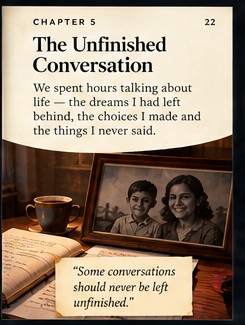
He thought of all the calls he had ended early because he didn't know what to say. All the visits he had shortened because the silence felt uncomfortable. He had believed that helping meant solving. He had not understood that sometimes people wanted a witness, not a solution.
“I'm sorry I haven't been here more,” he said.
His mother looked at him.
“I missed you,” she replied. “But I never stopped knowing you loved us.”
It was not the dramatic forgiveness he had imagined. It was better: the truth, held carefully between them.
The conversation with himself
Later, Kabir walked through the house. He paused at the doorway of his old room. The walls had been repainted, but a few pencil marks remained near the window where he had measured his height each birthday.
On the desk sat a small wooden bird. He remembered it now. He had carved it in school from a piece of soft wood, using a blunt knife and far too much confidence. One wing was uneven. Shanta had placed it on her shelf and kept it there for years.
He picked it up.
He had spent so long becoming someone the world could rely on that he had forgotten how to be someone who could be surprised.
He sat at the desk and opened his notebook. On a blank page he wrote:
What have I stopped doing because it doesn't look important?
Then:
What do I miss that I keep pretending not to miss?
Then:
Who knows the truth about me?
He stared at the questions.
There were no immediate answers. There was only a quiet feeling that he had finally asked something worth waiting for.

7 / 13
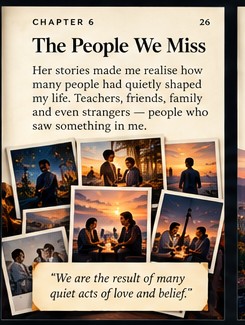
CHAPTER 6 · THE PEOPLE WE MISS
The next afternoon, Kabir went into town to buy medicines. On the way back, he passed the school he had attended as a child.
The gate was open. Children ran across the courtyard, shouting over a game of football. He almost kept walking.
Then he saw Mr. D'Souza, his old English teacher, sitting on a bench beneath the rain tree.
The teacher was older, his hair white, his shoulders narrow. But his eyes were the same.
“Kabir Malhotra?” he called.
Kabir stopped, surprised. “Sir. You remember me?”
“I remember the boy who argued that the ending of every story should be different.”
“I was a difficult student.”
“You were an interesting one. There is a difference.”
They spoke for a while. Mr. D'Souza asked about his work, and Kabir gave the polished summary he usually gave people. The teacher listened, then asked, “Are you still writing?”
Kabir almost laughed. “No, sir. That was a long time ago.”
“Why?”
“Life happened.”
Mr. D'Souza looked at him over his glasses.
“Life happened to all of us. The question is what you did with it.”
Kabir looked at the school building.
“I suppose I stopped making time.”
“Then perhaps you should start again. Not because you need to become a writer. Because you were happier when you wrote.”
“How do you know I was happier?”
The teacher smiled. “You used to stay after class to read your stories aloud. You were terrified that people would laugh at you. Then they would laugh at the funny parts, and you'd look as if someone had switched on the sun.”
Kabir remembered it so clearly that he could almost hear the classroom.
“I forgot that.”
“People forget many things when they spend too long trying to become impressive.”
They sat in silence, watching the children play.
Before Kabir left, Mr. D'Souza said, “You know, I still have the story you wrote about the city that moved every night.”
“You kept it?”
“I keep the work that reminds me why I became a teacher.”
Kabir felt the familiar pressure behind his eyes.
“Thank you, sir.”
“Don't thank me. Go and write another one.”
The call to an old friend
That evening, Kabir searched for the number of his college friend Sameer. They had once spoken almost every day. Then jobs, cities and obligations had turned the friendship into birthday messages and occasional jokes.
Sameer answered with surprise.
“Are you alive? Did you finally get fired?”
Kabir laughed. “Not yet.”
They talked for an hour. At first they traded updates. Then Sameer mentioned his father's illness, the business he had started and the difficult year he had not told many people about.
Kabir listened. He did not interrupt with advice. He did not compare the problem to something from work. He asked questions.
At one point, Sameer went quiet.
“Thanks for listening,” he said. “Most people ask how things are going, then tell me how things are going for them.”
Kabir leaned back in his chair.
“I think I've done that too.”
“You have. But you're here now.”
They agreed to speak every Sunday. Not because a calendar reminder could manufacture friendship, but because the relationship deserved more than good intentions.
Before ending the call, Sameer said, “You sound different.”
“Different how?”
“Like you're not trying to win the conversation.”
Kabir looked at the old wooden bird on the desk.
“Maybe I'm trying to hear it.”

8 / 13
CHAPTER 7 · THE SECOND CHANCE
Shanta's condition improved slightly, then worsened again. The doctor explained that recovery might be uneven. Some mornings she was alert enough to tease Kabir about his untidy hair. Other afternoons she slept through the sunlight moving across the room.
Kabir extended his leave.
His manager was surprised. “Can you really be away another week?”
“I need to be.”
“We have a launch coming.”
“I know. I've handed over the critical pieces. I'll be reachable for emergencies.”
There was a long pause.
“Take the time,” his manager finally said. “We'll manage.”
Kabir had spent years believing that everything depended on his constant availability. Some things did need his attention. Many did not. The distinction had been hidden beneath his fear of becoming replaceable.
He began to understand that being dependable did not require being endlessly available.
The story he read aloud
One evening, Shanta woke and asked for the blue notebook.
“Read me something,” she said.
Kabir chose the story about the boy who could hear the thoughts of trees. It was unfinished. The boy had discovered that the oldest tree in the village remembered every person who had ever rested beneath its branches. Kabir had written six pages, then stopped at the moment the tree began to speak.
“What happens next?” Shanta asked.
“I don't know. I never finished it.”
“Then finish it.”
“I don't think I can write like that anymore.”
“Why not?”
“Because I'm not that person.”
Shanta opened her eyes.
“You are not only one person, Kittu. You are the child who wrote the story, the man who built a career, the grandson sitting here, and all the versions of you that are still becoming. You don't have to choose one and erase the rest.”
He looked at the page.
“What if the ending is bad?”
“Then it will be a bad ending. You will have survived worse.”
He laughed, and she smiled.
He began to read the unfinished story aloud, then made up the ending as he went. The boy asked the tree what it remembered. The tree spoke of people who had argued, kissed, waited, grieved, and made promises beneath its branches. It remembered that most people were in a hurry, but the ones who stayed long enough to listen often discovered that they were not alone.
When Kabir finished, Shanta was asleep.
He closed the notebook.
He did not know whether she had heard the ending. But he had said it aloud, and the words had made room inside him.
What remains
The next morning, Shanta was awake and clear-eyed.
“Did you finish the story?” she asked.
“I did.”
“Was it good?”
“I'm not sure.”
“Good. That means you may have told the truth.”
She asked him to sit closer.
“I want you to promise me something.”
“Anything.”
“Don't make your life a monument to what you think you owe us.”
He frowned. “I don't understand.”
“Love your mother. Call her. Visit when you can. Look after the people who need you. But don't turn love into a debt you can never repay. We did not raise you so that you would spend your whole life feeling guilty for being elsewhere.”
Kabir took her hand.
“I don't want to forget you.”
“You won't.”
“How do you know?”
“Because you are here, listening. And because love isn't measured only by how often we stand in the same room. It is also measured by what we carry forward.”
She closed her eyes.
“Carry forward the curiosity. The kindness. The questions. And remember to laugh.”
He pressed her hand to his forehead.
For the first time, he understood that saying goodbye did not have to mean losing everything. Some things could become part of the way he lived.
9 / 13
CHAPTER 8 · A DIFFERENT KIND OF SUCCESS
Shanta died peacefully two mornings later, just before sunrise.
Kabir was sitting beside her. His mother held one hand; Kabir held the other. The room was quiet except for the fan and the first birds calling from the neem tree.
There was no grand final speech. No perfect sentence that made the loss feel fair.
There was only the slow realisation that the person who had kept so many versions of him alive in her memory was gone.
For days, Kabir moved through the house as if sound itself might break something. Relatives arrived. Tea was made. Stories were told. People spoke about Shanta's generosity, her stubbornness, her sharp humour and the way she could make strangers feel like family.
Kabir listened.
He realised that the last person who saw him was not simply the last person who knew his childhood. She was the person who had kept looking at him with love even as he changed, failed, achieved, withdrew and returned.
She had seen the boy he was, the man he had become, and the person he could still choose to be.
At the funeral, he placed the blue notebook beside her photograph. He did not leave it there; he took it home afterward. It belonged to the life she had helped him remember.
Returning to the city
When Kabir returned to Bengaluru, his apartment felt unusually quiet. The work messages had accumulated. His team needed decisions. The world had continued while he was away.
He answered what was urgent and scheduled what could wait.
Then he took a sheet of paper and wrote three headings:
KEEP.
RETURN TO.
LET GO.
Under KEEP, he wrote: family calls, Sunday conversations with Sameer, time for reading, honest friendships, the work he believed in.
Under RETURN TO, he wrote: drawing, writing, walking without headphones, asking questions, travelling without turning every moment into content.
Under LET GO, he wrote: the need to impress everyone, the belief that rest must be earned, the habit of saying “I'm fine” when he was not, the fear that a life without constant acceleration was a wasted life.
The list did not solve everything. It gave him a way to begin.
He asked his manager to help redistribute a few responsibilities. He made time for his mother to visit. He began writing for twenty minutes in the morning, before opening his inbox. Some days he wrote nothing worth keeping. Some days he wrote a paragraph that surprised him.
He learned to treat that as part of the work.
The new conversation
Months later, Kabir returned to his hometown. His mother had planted a small flowering shrub near the veranda. The neem tree was full of new leaves.
They sat together after dinner. She told him about a neighbour's wedding, a leaking tap and a recipe she wanted to try. Then she asked, “Are you happy?”
This time, Kabir did not answer quickly.
“Some days,” he said. “Some days I'm worried or tired. Some days I don't know what I'm doing. But I think I'm more present in my own life.”
His mother nodded.
“That sounds honest.”
“I used to think I had to make you proud.”
“We are proud of you.”
“I know. But I thought I had to keep earning it.”
She reached across the table and touched his hand.
“You were our son before you had a title. You will be our son when you have none.”
He looked toward the shelf where Shanta's wooden box now sat. Inside were her letters, the old photograph and the small things she had kept because they reminded her of someone she loved.
Kabir had once believed success meant becoming someone people noticed.
Now he wondered whether a deeper kind of success might mean becoming someone the people who loved him could still recognise.
10 / 13
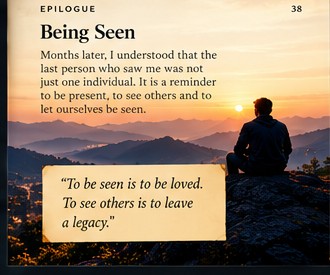
EPILOGUE · BEING SEEN
A year later, Kabir returned to the school where Mr. D'Souza had taught him.
He had written a short story about the tree that remembered people. It was not perfect. The ending had changed three times. He had nearly abandoned it twice.
But he finished it.
He gave a copy to his old teacher, who read the first page standing beside the rain tree.
“This is good,” Mr. D'Souza said.
“You don't have to say that.”
“I don't. I can say it needs work, if you'd prefer.”
Kabir laughed.
The teacher folded the pages carefully. “I'm glad you returned to it.”
“Me too.”
On the way out, Kabir passed a boy sitting alone on a low wall, drawing a strange machine in a notebook. The boy quickly covered the page when other students ran past.
Kabir stopped.
“What are you drawing?”
The boy looked suspicious. “Nothing.”
“Nothing looks complicated.”
The boy glanced at the page, then showed him the sketch. It was a machine designed to collect rainwater and turn it into clean drinking water.
“That's interesting,” Kabir said. “How does it work?”
The boy began explaining. His words came faster. His hands moved as he described pipes, filters and a small solar panel. Kabir listened without checking the time.
When the boy finished, he asked, “Do you think it's stupid?”
Kabir looked at the sketch.
“No,” he said. “I think it's unfinished. That's different.”
The boy smiled and returned to his drawing.
Kabir walked toward the gate with a feeling he could not quite name. Perhaps this was how being seen worked. Someone noticed you before you had proof. Someone asked a question and waited for the answer. Someone made room for the person you were still becoming.
That evening, Kabir called his mother. They talked about ordinary things. He told her about the boy and the drawing. She told him the flowering shrub had produced its first bloom.
Before they hung up, she said, “Nani would have liked your story.”
Kabir looked at the blue notebook on his desk.
“I think so,” he replied.
After the call, he opened a fresh page and began to write.
Not because he hoped the story would make him successful.
Not because he wanted to prove that his grandmother had been right.
Because the story was there, waiting to be told.
And he was finally there to tell it.
To be seen is to be remembered with kindness. To see others is to make room for who they are becoming.
11 / 13
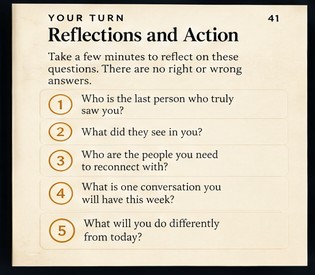
YOUR TURN · FIVE QUESTIONS
Take a few quiet minutes. There are no perfect answers.
YOUR SEVEN-DAY PROMISE
Complete this sentence:
Choose one action that is realistic: return a call, ask a deeper question, share something honest, finish a small creative project, or sit with someone without rushing to solve their problem.
12 / 13
A NOTE FROM THE AUTHOR
Many people spend years trying to become successful, useful and dependable. There is honour in that effort. We work to support our families, to create opportunities and to make something meaningful of our abilities.
But in the process, we can sometimes hide the very parts of ourselves that made life feel meaningful in the first place.
The people who truly see us often remind us of those parts. They remember our curiosity, our humour, our fears and our unfinished dreams. They love us not only for what we achieve, but for who we are while we are becoming.
If this story leaves you with one thought, let it be this: don't wait for a crisis to give your attention to the people and parts of life that matter.
Call someone. Ask a real question. Listen to the answer. Return to a small dream. Let yourself be known.
And when someone you love begins to tell you who they are, put the phone down and give them the gift of your attention.
A successful life is not only measured by what you achieve, but by the people who feel seen because you were there.
— Dharmendra Singh
Expert Community Hub
Expert Community Hub
EXPERT COMMUNITY HUB READS · BOOK 05
THE LAST PERSON WHO SAW ME
A Story About Connection, Regret and the Lives We Leave Behind
Some people see your face. A few see your success. But only one person may remember who you were before the world told you who to become.
13 / 13