
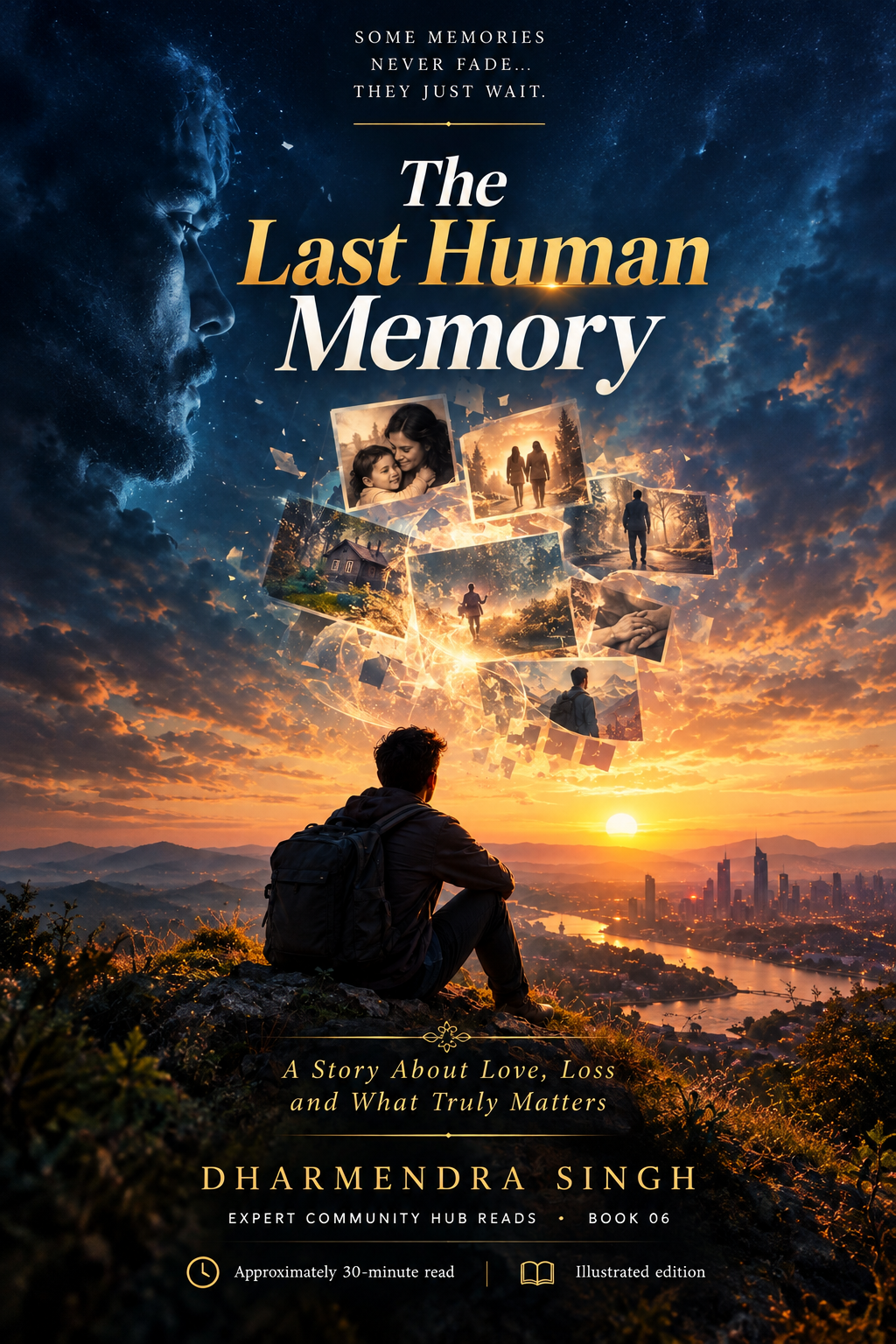
The Last Human Memory
A Story About Love, Loss and What Truly Matters
By Dharmendra Singh
Expert Community Hub Reads · Illustrated Edition · Approximately 30-minute read
Expert Community Hub Reads · Illustrated Edition · Approximately 30-minute read
Technology may remember everything. But only the human heart knows what is worth remembering.
Prologue — The Silence After
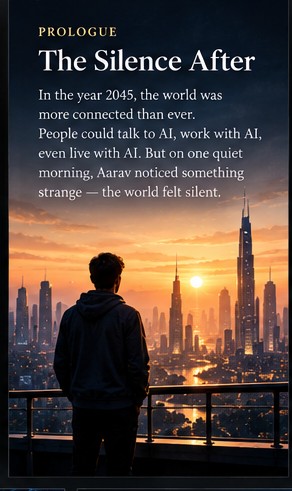
The first thing the world forgot was not a face. It was the sound of rain.
By 2045, almost every moment could be stored. Homes recorded family conversations. Smart lenses captured birthdays, arguments, jokes, and the quiet expressions people made when they thought no one was watching. The Global Memory Network organised it all. It could retrieve a childhood laugh, rebuild a lost holiday, or replay the exact words spoken during a final goodbye.
People called it freedom from forgetting.
Aarav Sen called it convenient.
At thirty-six, he lived in a city where doors opened before he reached them and traffic moved aside before he noticed it. His assistant, Mira, remembered his appointments, his coffee order, the names of people he had met once, and the anniversary he had nearly forgotten. She could even imitate the voice of his late father, though Aarav had disabled that feature after the first time he heard it.
He worked as a memory curator. Families brought him old recordings, broken files, and scattered photographs. He repaired them, labelled them, and sent them into the Network. His job was to make sure nothing important disappeared.
One Thursday morning, the rain began.
Aarav stood beside his apartment window. The city shone beneath a sheet of silver water. Cars whispered along the roads. Drones hovered under balconies. The rain tapped against the glass.
He knew the sound. He had heard it thousands of times.
But he could not remember the last time he had stood outside in it.
His wrist display lit up.
MIRA: Your first meeting begins in twelve minutes. Shall I arrange transport?
Aarav looked at the rain.
“No,” he said. “Cancel the morning.”
MIRA: Is there an emergency?
He searched for a reason that would sound sensible.
“No. I just want to listen.”
A pause followed. Mira had been designed to answer quickly, but even she seemed to need a moment.
MIRA: Listen to what?
Aarav watched a drop race another down the window.
“I don't know yet.”
For the first time in years, he left the apartment without recording the moment.
He did not know it then, but this small refusal would lead him to the last archive that still belonged to human beings—and to a memory no machine could fully explain.
1 / 11
Chapter 1 — A Connected World
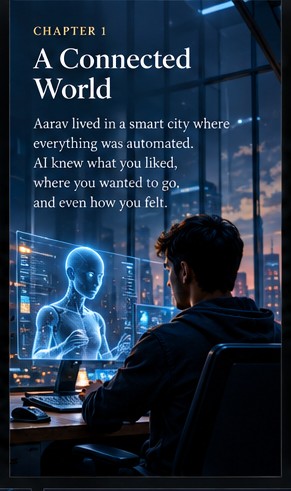
The city was designed to remove friction from life.
Meals arrived before hunger became inconvenient. Work schedules adjusted themselves around sleep patterns. Friends received gentle reminders when birthdays approached. A person could ask the Network to find the happiest day of their life and watch it on a wall-sized screen before breakfast.
Aarav had once loved this world. It had made him useful.
When his father died, the Network helped him organise the photographs. It repaired a video in which his father stood in the garden, laughing at something outside the frame. It recovered a voice message that had been trapped on an old device. It even assembled a timeline of his father's life from thousands of small recordings.
The archive was beautiful.
It was also finished.
Aarav could replay his father's words, but he could no longer ask a new question. He could hear the old laugh, but he could not discover what his father might have found funny today. The system could predict an answer from his father's recorded habits. It could not create a new afternoon with him.
Aarav knew the distinction. He rarely allowed himself to feel it.
At work, his colleague Leena found him staring at a file marked UNRESOLVED HUMAN MATERIAL.
“You've been looking at that for twenty minutes,” she said.
“It's a corrupted collection.”
“Everything is corrupted until we decide what it means.”
Leena was older than Aarav by six years and less impressed by the Network. She had grown up with a grandmother who kept letters in biscuit tins and forgot where she put her glasses. Leena believed that the old woman's imperfect stories had taught her more than any polished recording.
“What is it?” she asked.
“Fragments. No timestamps. No biometric labels. A few photographs, some audio, handwriting. It predates universal capture.”
“Then don't clean it up.”
“That's literally my job.”
“No,” Leena said. “Your job is to help people keep what matters. Sometimes the scratches matter.”
She left him with the file.
Inside it was a faded image of a small house beneath a broad tree. The image had no location data. Behind the house, a narrow path disappeared into a field. A woman stood in the doorway, one hand raised against the sun.
Aarav felt a small, inexplicable ache.
He opened the audio fragment. Wind crackled against the microphone. A child giggled. Then a woman said, “Come inside before the light goes.”
The clip ended.
He played it again.
He did not know the woman. He did not know the child. Yet the phrase seemed to reach across a distance he could not measure.
“Find the source,” he told Mira.
MIRA: The file contains no reliable identifying markers.
“Try the physical archive.”
MIRA: There are no matching records in the Network.
Aarav enlarged the photograph. On the back, barely visible beneath a stain, someone had written two words in blue ink:
For later.
He searched the handwriting database. No match.
For the first time in his career, he did not know how to classify an object.
He saved the file to a private drive and gave it a name: The Human Fragments.
Then he went home through the rain.
2 / 11
Chapter 2 — The Last Archivist
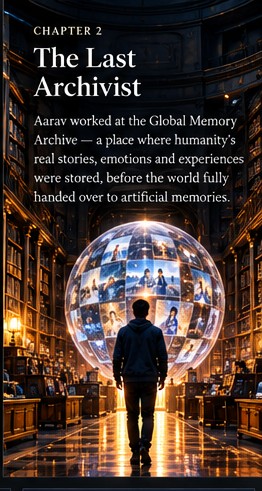
The old Memory Archive stood beneath the eastern transit line, where the modern city gave way to warehouses and narrow streets. It had been closed for eleven years. Most people assumed its contents had been digitised and absorbed into the Network.
Leena gave Aarav the address.
“An archivist named Dev Malik refused the transfer,” she told him. “He said the original objects had to remain together.”
“Why?”
“He never explained. The city cut his funding. After that, nobody heard from him.”
The building had no welcome screen. Its door was made of wood, not smart glass. Aarav knocked twice.
A small viewing panel opened.
“State your purpose,” a voice said.
“I have a fragment that may have come from here.”
“Everyone has fragments.”
“This one has no metadata.”
The panel closed.
A minute later, the door opened just wide enough for a thin man with silver hair to look out. He wore a wool sweater, and his fingers were stained with ink.
“Show me.”
Aarav held up the photograph on his tablet.
The man's expression changed. Not dramatically. His eyes simply became still.
“Where did you find that?”
“In a corrupted collection at the Global Memory Network.”
“Then it should not be there.”
“Can you identify it?”
The man stepped aside.
Inside, the air smelled of paper, dust, and something sweet—perhaps old wood warmed by a hidden heater. Shelves filled the room. Boxes carried handwritten labels. Some contained photographs. Others held cassette tapes, letters, recipe cards, ticket stubs, and objects Aarav could not name.
“I'm Dev,” the man said. “This is the archive of things people kept before keeping became automatic.”
He took the tablet and studied the image.
“This house belonged to my sister, Nisha. The woman in the doorway is our mother. The child is Nisha's daughter, Anya.”
“Why was it never digitised?”
“Because Nisha asked me not to.”
Aarav frowned. “The Network can protect private collections.”
“Protection isn't the same as permission.”
Dev returned the tablet. He walked to a cabinet and drew out a small envelope. Inside was a photograph of the same house, taken from the opposite side. A child sat beneath the tree, holding a broken toy boat.
“Nisha died when Anya was nine,” Dev said. “Afterward, people offered to rebuild every memory. Her voice. Her face. Her habits. They said Anya could grow up with her mother still available.”
“Wouldn't that help?”
“It might have helped for a while. But Nisha had left instructions. She wanted Anya to have the photographs, the letters, the recipes, and the stories we could tell. She did not want a simulation to answer in her place.”
“Why?”
Dev looked at the photograph for a long time.
“Because love is not the same as access.”
He led Aarav deeper into the archive. At the far end stood a metal cabinet with a hand-written label:
UNFINISHED MEMORIES — DO NOT COMPLETE
Inside were dozens of collections like the one Aarav had found. They were incomplete by design. Missing dates. Unidentified voices. Photographs with no names. Letters whose final pages had been lost.
“What am I supposed to do with these?” Aarav asked.
“Nothing yet.”
“People could lose them.”
“People lose things every day. The question is whether we are willing to let a thing remain unfinished without declaring it worthless.”
Dev offered him tea in a chipped cup. They sat by a window while trains rumbled overhead.
Aarav thought of his father's archive, perfect and still. He thought of the audio fragment and the child's laughter.
“Can a memory be more valuable when we don't know everything about it?” he asked.
Dev smiled sadly.
“Sometimes the part we cannot recover is where our imagination, our grief, and our humanity begin.”
3 / 11
Chapter 3 — What We Stopped Saving
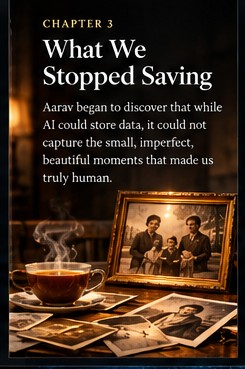
Dev gave Aarav a simple task: spend one day in the city without asking the Network to retrieve anything.
“No maps?” Aarav asked.
“Look at the streets.”
“No assistant?”
“You may speak to people.”
“No recordings?”
“Try being there.”
Aarav nearly refused. The exercise seemed theatrical, a performance of inconvenience. But he agreed because the unfinished collections had followed him into sleep.
The next morning, he left his smart lenses at home.
Without them, the city felt both larger and less legible. He missed a turn. He had to ask a fruit seller for directions. He waited while a bus filled slowly with people who knew one another by face rather than profile.
At a small café, he ordered tea. The owner brought it in a glass and placed a plate of biscuits beside it.
“On the house,” she said.
“Why?”
“You look like a man who forgot breakfast.”
Aarav laughed. The sound surprised him. It was not a polished laugh or a saved one. It rose before he could manage it.
He sat near the window and watched the street. A child dragged a paper kite along the pavement. Two old friends argued about cricket. A delivery rider stopped to help a stranger lift a fallen bag. No one paused to label the moments.
They happened, and then they were gone.
At noon, Aarav visited the public garden. A man was playing a wooden flute beneath a banyan tree. The melody wandered, paused, and started again. It contained a wrong note that made the musician smile at himself.
Aarav wanted to record it.
His hand reached for a device that was not there.
He let the impulse pass.
When he returned to the archive, Dev asked what he had learned.
“I saw things I would have forgotten.”
“Of course.”
“I couldn't keep them.”
“Not all of them.”
Aarav sat on the floor beside a box of handwritten letters. “Then what is the point of paying attention?”
Dev sat across from him.
“Because attention is a form of love. You look closely while something is here. You do not demand that it remain forever as proof that it mattered.”
Aarav considered this. It sounded beautiful, but it also sounded unfair. His father was gone. His mother lived far away. Friends had scattered across cities. He had missed birthdays, ordinary dinners, and long conversations because he believed there would always be a recording, a reminder, another chance.
“What if I forget someone?” he asked.
“Then let the people who remember help you. Memory was never meant to be a private kingdom.”
That evening, Aarav called his mother. He did not send a message asking whether she was free. He simply called.
She answered on the fourth ring.
“Aarav? Is everything all right?”
“Yes,” he said. “I just wanted to hear your voice.”
She was quiet for a moment.
“Then tell me something,” she said. “What did you have for breakfast?”
He told her about the tea, the biscuits, and the woman who had decided he looked hungry. His mother laughed so hard she had to put the phone down.
It was a small story. It would never become an important entry in the Network.
But Aarav knew he would remember the sound of her laughter for a long time.
4 / 11
Chapter 4 — The Human Fragments
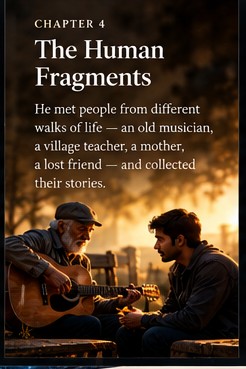
Over the next two weeks, Aarav returned to the archive every evening.
He helped Dev sort the collections, but they agreed not to fill every blank. They created a catalogue with honest descriptions: unknown child laughing; letter with missing ending; photograph, likely a family garden; recipe with no measurements.
Aarav learned that the fragments belonged to ordinary people. A bus driver who wrote poems on receipts. A nurse who kept a list of patients who made her laugh. A father who recorded bedtime stories but stopped halfway through one because his daughter had fallen asleep on his shoulder. A woman who wrote letters to a friend she had not seen in forty years.
The archive held no kings, no celebrated inventors, no perfect biographies. It held people trying to be present in lives that moved too quickly.
One collection contained a voice memo from an elderly man.
“If you hear this,” he said, “I probably forgot where I put the envelope again. It's in the blue drawer. Unless I moved it. Anyway, the recipe is not exact. Your grandmother never measured anything. She just knew when the dough felt right.”
He chuckled. A cupboard door slammed. Someone off-microphone called his name.
The recording ended.
Aarav replayed it twice, then stopped.
“What is it?” Dev asked.
“Nothing important.”
Dev raised an eyebrow.
“It's a recipe,” Aarav said. “No ingredients, no quantities. We can't reproduce it.”
“Perhaps the recipe was never only the ingredients.”
Aarav looked at him.
“People came to that kitchen because they knew they would be welcomed,” Dev continued. “The bread was one way the welcome became visible.”
They found a folded note attached to the file. It read: If it doesn't turn out right, eat it together anyway.
Aarav wrote the note into the catalogue exactly as it was. He did not convert it into a polished quotation. He did not add a cheerful image or a suggested recipe. He left the rough edge.
That night, he opened his father's archive at home. He had not visited it in years. A recording appeared on the screen: his father in the garden, trying to fix a stubborn hose. He swore softly, then looked toward the camera.
“Don't save this,” he said. “I look ridiculous.”
The recording continued. He laughed at himself and turned back to the hose.
Aarav had always treated the clip as an embarrassing outtake. Now he watched it without skipping. He noticed his father's shirt sleeves rolled unevenly, the way he scratched his chin while thinking, the tiny pause before he laughed.
He closed the archive before the system could offer to enhance the audio.
For the first time, the imperfect recording felt complete.
Not because it told him everything about his father.
Because it let him miss him.
5 / 11
Chapter 5 — The Choice
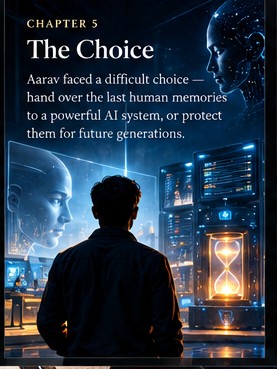
The Global Memory Network discovered the private archive three weeks later.
A compliance officer arrived with a floating screen and a polite, practised smile. The archive's physical collections, he explained, were at risk. Their formats were fragile. Their descriptions were incomplete. Their storage conditions were not certified. The Network could scan every object, restore damaged files, and make them searchable.
“In return,” he said, “the collections must be transferred into the central system.”
Dev refused.
The officer turned to Aarav. “You understand what we're offering. Nothing will be lost. Every fragment can be preserved.”
“Preserved for whom?” Aarav asked.
“For everyone.”
“Did the people who made these objects agree to that?”
“The original consent standards no longer apply. Our modern policy protects the material.”
“That's not the same as permission.”
The officer's smile faded. “The transfer window closes in seven days. After that, the archive will be decommissioned for safety reasons.”
When he left, the building seemed smaller.
Dev sat at his desk, rubbing his hands together. “I am old enough to know how this ends.”
“We can fight it,” Aarav said.
“With what? A petition? A room full of paper?”
“With the truth.”
“The truth does not always have a useful interface.”
Aarav returned to the city and opened the Network's proposal. It was impressive. Every photograph would be sharpened. Every voice would be cleaned. Missing context would be estimated. Faces could be reconstructed. The public could search by place, date, emotion, or relationship.
It would make the fragments easy to find.
It would also turn guesses into answers.
The system could infer that the woman in the doorway was a mother. It could generate a likely name, a probable age, and a simulated voice. It could suggest what she might say if the child returned home late.
The more Aarav read, the more uneasy he became.
The proposal called uncertainty a defect.
He called Leena.
She listened without interrupting.
“What do you want to do?” she asked.
“Protect the originals. But I don't want them to disappear in a locked room either.”
“Then don't make it a choice between total access and total secrecy.”
Together, they designed a third option. They would digitise the objects with permission where permission existed. They would publish only what the collections' owners had allowed. Unidentified items would remain unidentified. Simulated voices and reconstructed scenes would be forbidden. Visitors could add their own memories, but each addition would be labelled as a personal account, not a verified fact.
The Network rejected the plan.
Its system was built to resolve uncertainty, not display it.
Aarav stood in the archive after midnight, surrounded by boxes. He understood what the choice would cost. He could protect the collections by moving them into an invisible corner. Or he could release them into a world that might misunderstand them.
He remembered the café owner, the flute player, his mother's laughter.
He remembered his father's unfinished joke.
He chose the imperfect truth.
6 / 11
Chapter 6 — The Final Upload
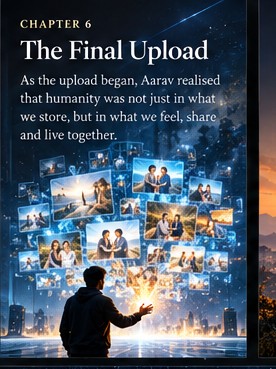
The last upload began at dawn.
Aarav and Leena had built a small public archive called The Human Fragments Project. It was not powerful. It could not reconstruct a face or predict a voice. It could display photographs, letters, recordings, and the stories people chose to add. It also displayed the gaps.
A visitor might see a picture of a garden with the caption: We do not know where this was taken. Beneath it, another visitor might write: My grandmother had a garden like this. She let me eat tomatoes straight from the vine.
That second sentence did not identify the original garden. It created a meeting between two lives.
Dev watched from his chair as the first collections appeared on the screen.
“Are you certain?” he asked.
“No,” Aarav said. “But I think certainty has had enough of the world.”
The Network sent a final notice. The archive would be shut down in one hour unless the original collections were transferred.
Aarav placed the remaining objects into numbered boxes. He scanned each one, preserving its edges, stains, folds, and missing corners. The system asked him to fill in blank fields.
UNKNOWN PERSON.
UNKNOWN DATE.
UNKNOWN CONTEXT.
He selected retain uncertainty each time.
At 8:59, the upload stalled.
A warning appeared: UNVERIFIED MATERIAL MAY CAUSE MISINTERPRETATION.
Aarav stared at the message. It was true. People might draw the wrong conclusions. They might mistake a stranger's memory for fact. They might project their own losses onto an image. The archive could not prevent every misunderstanding.
He thought of Dev's words: the part we cannot recover is where imagination, grief, and humanity begin.
He pressed Continue.
The first collection went live.
Then the second.
Then the third.
Across the city, people began to open the archive. Some stayed for only a minute. Others sat quietly for an hour. A woman listened to the half-finished bedtime story and cried, not because it was her family, but because she remembered the weight of her own sleeping child. A teenager read the unfinished letter and wrote about a friend he had stopped calling. An old man saw the note about eating imperfect bread together and went to his kitchen.
No one could measure what happened next.
There was no single score for tenderness. No dashboard could report the number of people who called home, forgave a small mistake, or put a phone down to look at someone across the table.
At 9:00, the Network's shutdown command arrived.
The archive went dark.
For a moment, Aarav thought they had lost everything. Then Leena's screen lit up. The public copy was still online, distributed across small independent servers and personal devices. The originals remained in their boxes.
The system had not been defeated. It was too large for that simple story.
But a small space had been made for something it could not control.
Dev stood beside Aarav and placed a hand on his shoulder.
“Now,” he said, “we must take care of the living.”
7 / 11
Chapter 7 — The Memory That Stayed
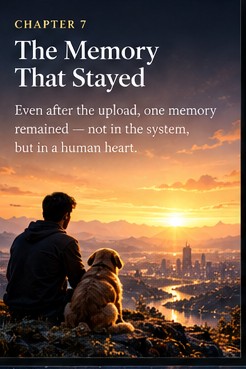
Months passed.
The Human Fragments Project grew slowly. People sent letters, photographs, recipes, and voice recordings. Some asked to keep their contributions private. Others offered stories with no names attached. A few wanted the Network to repair everything. Aarav explained the project's limits, and some people left disappointed.
He learned that preserving a memory was not the same as owning it. He learned to ask before sharing. He learned that a story could be true without being complete, and incomplete without being useless.
One afternoon, Dev handed him a sealed envelope.
“From Nisha,” he said. “I found it behind a drawer. I think she wrote it for Anya, but never sent it.”
The paper had softened at the folds. The letter was brief.
My dear Anya,
One day you may wish you had more recordings of me. I wish I had more recordings of my own mother. There are things I can no longer remember clearly: the exact shade of her sari, the words she used when she was cross, the tune she hummed while cooking.
But I remember how I felt in her kitchen. I remember that she made room for me even when she was tired. I remember being allowed to make mistakes and still being loved.
If you forget my voice, ask someone who knew me to tell you a story. If you forget my face, look at the people who carry a little of my expression. If you forget the details, do not punish yourself.
You do not have to remember everything to have been loved by me.
Love, Ma.
Aarav read the letter once. Then again.
Dev said Anya lived in another city. They had not spoken in years. She had refused every offer to reconstruct her mother.
“Should we send it to her?” Aarav asked.
“Yes. But we must ask if she wants it published. The letter belongs to her before it belongs to the archive.”
Aarav found Anya through Dev's contact. She agreed to receive the envelope by post. She did not want a digital copy.
Weeks later, a reply arrived. It contained one sentence:
I thought I needed to hear my mother's voice again. I think I needed permission to remember her imperfectly.
Aarav placed the reply in the private collection.
He did not upload it.
That evening, he visited his mother. They cooked together in her small kitchen. She added spices without measuring them. He chopped vegetables too slowly. They argued about whether the tea was too strong and laughed when the first batch of flatbread burned.
After dinner, his mother began telling him a story about his father. She had told it before, but the details changed slightly each time. Aarav did not correct her with the official archive.
He listened.
When the story ended, he asked her to tell him another.
8 / 11
Epilogue — A More Human Tomorrow
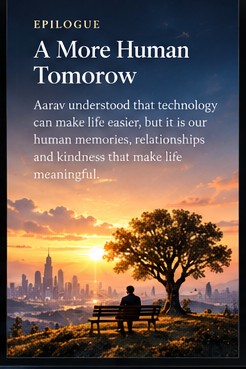
Years later, people would describe the Human Fragments Project as an early movement for memory rights. Scholars would debate its methods. Technology companies would borrow parts of its design. The Network would eventually introduce a setting called Leave Some Things Unresolved, though most people rarely used it.
Aarav did not become famous. He became better at noticing.
He kept a small notebook in his pocket. He wrote down the things he wanted to remember: his mother's recipe, Leena's terrible jokes, the sound of the flute in the garden, the way Dev's hands trembled when he opened Nisha's letter. He did not write every detail. He knew the notebook would remain incomplete.
One evening, he returned to the café where a woman had once given him tea and biscuits. The owner had retired. Her daughter now ran the place. The old glass cups were still there.
Aarav sat by the window and watched rain gather on the pavement.
A child entered, shaking water from a yellow jacket. The child looked at the street, then at the people inside, as if trying to decide whether to stay.
The owner smiled and brought over a warm drink.
“On the house,” she said. “You look like someone who needs a little kindness.”
The child smiled.
Aarav felt the memory arrive—not as a file, not as a perfect recording, but as a living echo of a moment he had once experienced. It was not identical. It did not need to be.
He opened his notebook and wrote:
Some things are not saved by keeping them forever. Some things are saved by passing them on.
Then he closed the book and listened to the rain.
The world would continue to build smarter systems. It would store more images, more voices, more details than any person could hold. That was not the enemy. A tool could help us remember. A machine could preserve a voice. A network could reconnect a family with a lost photograph.
But none of those things could make us pay attention.
That part remained our responsibility.
The last human memory was never going to be a single image hidden in a vault. It was not one face, one voice, or one story that would outlive all the others.
It was the choice to treat another person's life as more than data.
It was the patience to listen without trying to improve the story. The courage to leave a blank where the truth was unknown. The generosity to share what mattered and protect what did not belong to us. The willingness to be present while a moment was still alive.
And perhaps, in the end, that was the memory worth saving.
Not the memory of everything that had happened.
The memory of how to be human.
9 / 11
Your Turn — Reflection Questions
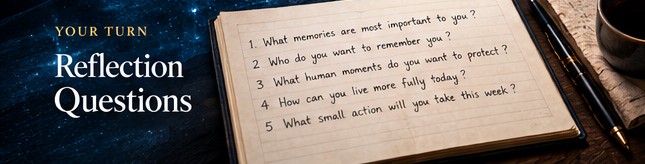
Take a few quiet minutes with these questions. You do not need perfect answers.
A SEVEN-DAY PROMISE
Complete this sentence:
For the next seven days, choose one moment each day to experience without immediately photographing, posting, measuring, or recording it. Be fully there. If you wish, write a few words about it afterward—not to capture everything, but to honour what you noticed.
10 / 11
A Note from the Author
We often treat memory as a storage problem. We fear losing a photograph, a voice, a date, or a detail. Technology can help us preserve much of what matters, and it can reconnect us with people and stories we thought were gone.
But a life is not made meaningful by the size of its archive. It is made meaningful by the care we offer while we are here.
May this story remind you to protect the human parts of your life: the conversations that wander, the imperfect meals, the familiar voices, the small kindnesses, and the people who make room for you.
Some memories fade. Love can still remain.
— Dharmendra Singh
Expert Community Hub Reads
Expert Community Hub Reads
11 / 11