

The Girl Beyond the Mirror
A Story About Identity, Self-Discovery and the Many Versions of You
By Dharmendra Singh
Expert Community Hub Reads · Illustrated Edition · Approximately 30-minute read
Expert Community Hub Reads · Illustrated Edition · Approximately 30-minute read
There is not just one you. There are many beautiful versions of you—waiting to be discovered.
Prologue — The Girl in the Mirror
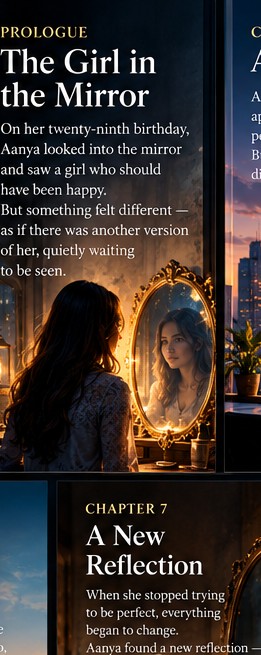
On the evening of her twenty-ninth birthday, Aanya Mehra stood in front of the tall mirror in her apartment and tried to recognise the woman looking back.
The woman had good skin, a careful haircut, a wardrobe arranged by colour, and a calendar so full that even her weekends required planning. She had a job people admired, a home people complimented, and a collection of photographs that made her life appear wonderfully complete.
She also felt strangely absent from it.
Aanya tilted her head. The reflection did the same. She lifted a hand. The girl in the glass lifted hers.
Then, for the smallest fraction of a second, the reflection did not move.
Aanya froze.
The other girl stood very still. She looked like Aanya, but younger—perhaps seventeen. Her hair was untidy. Her eyes were brighter. There was a small ink mark on the side of her thumb, the kind Aanya used to get when she wrote in her notebooks.
The girl pressed her palm against the glass.
Aanya stepped back. The reflection returned to normal.
She laughed at herself, turned off the light, and went to bed.
That night she dreamed of a house she had never visited. Every room contained a different mirror. In one, she was a musician on a small stage. In another, she was laughing with a child. In another, she was sitting alone beside a window, crying without trying to hide it.
At the end of the corridor stood the girl from her apartment mirror.
“You took so long,” the girl said.
Aanya woke before she could ask what she meant.
In the morning, she blamed exhaustion. Her assistant had booked too many meetings. Her mother had called twice. Her manager expected a presentation. The ordinary machinery of her life began again, and the dream slipped into the background.
But at lunch, while reviewing a presentation, Aanya saw her own reflection in the dark screen. For a moment she remembered the girl’s face—not as a frightening stranger, but as someone waiting.
She opened an old storage box that evening. Under certificates and photographs, she found a notebook from school. Its cover was bent. The first page held a sentence written in her own teenage handwriting:
One day, I will make something that helps people feel less alone.
Aanya sat on the floor.
She had not thought about that dream in years.
She had become successful at a life she could explain to everyone else. She had forgotten how to explain it to herself.
The next night, she placed the notebook beside the mirror and waited.
At 11:47, the reflection smiled before she did.
And this time, the girl did not disappear.
1 / 11
Chapter 1 — A Perfect Life
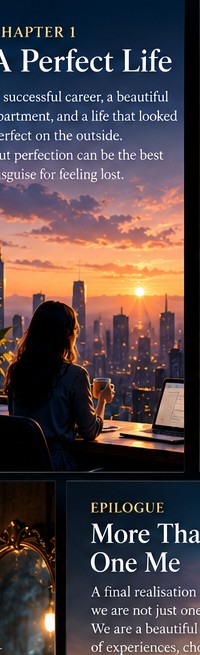
Aanya's life had been built from sensible decisions.
She studied business because it offered options. She accepted a job in brand strategy because it paid well. She moved to the city because opportunity lived there. She learned to speak confidently in meetings, to turn uncertainty into slides, and to make every answer sound intentional.
People called her disciplined. Her mother called her practical. Her manager called her indispensable.
No one called her unhappy, because Aanya rarely looked unhappy.
She was good at making the outside of a life look finished.
At work, she led a team preparing a campaign for a luxury wellness brand. The campaign promised balance, authenticity, and a return to the self. Aanya wrote the strategy, approved the visuals, and presented the results with effortless clarity.
After the meeting, her colleague Rhea leaned against the doorway.
“You know what I admire about you?” Rhea said. “You always know what you want.”
Aanya smiled.
The truth was that she knew what would be sensible, impressive, and easy to defend. She was less certain about what she wanted when nobody was watching.
That evening, her mother called to ask whether she had considered meeting a family friend’s son. Aanya said she was busy. Her mother sighed, then reminded her that time moved quickly.
“You have everything now,” her mother said. “A good job, your own place. You should think about the next step.”
Aanya looked at the neat rows of shoes by the door.
“What if I don't know what the next step is?”
“Then make a plan,” her mother replied, kindly. “You have always been good at plans.”
After the call, Aanya stood in front of the mirror.
The girl appeared at once.
“You keep saying you don't know what you want,” the girl said. “But you never ask yourself when you have time to hear the answer.”
Aanya’s mouth went dry.
“Who are you?”
“You know who I am.”
“You're a dream. Or stress. Or something wrong with the lights.”
The girl tilted her head. “You have a name for everything except the things you feel.”
Aanya switched on every light in the apartment. The reflection returned to being an ordinary reflection. She examined the glass for cracks, checked the room behind her, and searched the internet for explanations of visual distortions caused by fatigue.
Nothing helped.
The following day, she worked late. She accepted another project. She booked a weekend trip she did not particularly want because everyone said she needed a break.
Still, she kept the old notebook in her bag.
On Friday, Rhea invited her to an open-mic evening. Aanya nearly declined. She had a presentation to prepare and a hundred reasons to stay home.
Then she remembered the sentence in the notebook.
“I'll come,” she said.
At the event, a young woman sang an original song with a trembling voice. She forgot one line, laughed, and began again. The room applauded more warmly than it had for the polished performers.
Aanya felt an ache she could not explain.
The girl in the mirror had once written songs. Not good songs, perhaps, but songs that made her feel alive. Aanya had stopped when a teacher called them childish. Later, she had told herself she was simply too busy.
On the way home, she opened the notebook and wrote one new line:
I miss the person I was before I learned to edit myself.
For the first time in years, the sentence felt more useful than a plan.
2 / 11
Chapter 2 — The First Crack
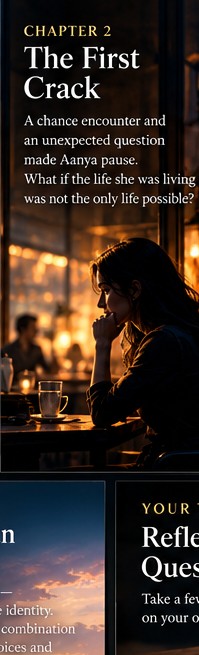
The girl appeared every night.
Sometimes she stood quietly. Sometimes she asked questions. She never explained how she crossed the boundary between reflection and dream. Aanya stopped trying to prove that the encounters were impossible. She began to listen.
“What do you want from me?” Aanya asked one evening.
“To be remembered.”
“I remember being seventeen.”
“No,” the girl said. “You remember facts. You remember the school you attended and the things you did. You don't remember how it felt to believe your life could become anything.”
Aanya folded her arms. “I grew up.”
“You grew careful.”
The words hurt because they were not entirely unfair.
Aanya had learned to avoid embarrassment by never trying anything she might not be good at. She had learned to avoid disappointment by keeping her hopes private. She had learned to avoid rejection by making herself useful before anyone could decide whether they liked her.
It had worked. She was respected, dependable, and tired.
The next day, she met Rhea for lunch. Rhea was considering leaving her job to open a small ceramics studio. She spoke about it with nervous excitement.
“You're actually going to do it?” Aanya asked.
“I don't know. I'm scared.”
“But you have a mortgage.”
“I know.”
“And no business experience.”
“I know that too.”
Aanya waited for Rhea to list the reasons she should abandon the idea. Instead, Rhea smiled.
“I can be scared and still take one step.”
Aanya carried the sentence back to her apartment.
That night, the girl in the mirror was sitting cross-legged on the floor.
“Rhea might fail,” Aanya said.
“Yes.”
“She could lose money.”
“Yes.”
“She might regret it.”
“Yes.”
“Then why are you looking at me like that?”
“Because you think avoiding regret is the same as living well.”
Aanya looked away.
The girl stood and approached the glass. “What did you want before you began choosing only what could be defended?”
Aanya remembered music, stories, travel, and the desire to help people who felt invisible. She remembered writing letters to friends because she wanted to understand them. She remembered how easily she laughed before she began checking whether laughter was appropriate.
“I wanted to make things,” she whispered.
“Then make one.”
“I don't have time.”
“Make ten minutes.”
Aanya almost laughed. It sounded too small to matter.
But the next morning she woke fifteen minutes earlier, opened a blank document, and wrote a page about a woman who had forgotten her own dreams.
The writing was clumsy. She changed the first paragraph six times. She wanted to delete it.
Instead, she saved it.
The crack in her perfect life was barely visible. Yet through it, something warmer had begun to enter.
3 / 11
Chapter 3 — Faces in the Mirror
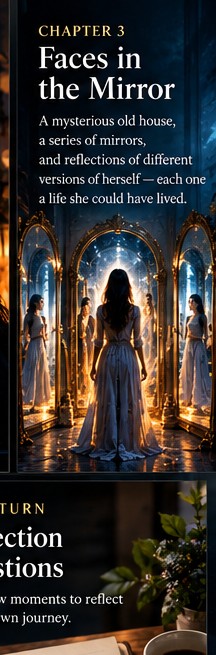
The old house appeared in Aanya’s dreams again.
This time she walked through its front door. The hallway smelled of rain and sandalwood. Mirrors lined the walls, each framed in a different style. Some were clouded with age. Others shone like still water.
The girl waited at the end of the corridor.
“Choose one,” she said.
“Choose what?”
“A life you left behind.”
Aanya approached the first mirror. In it, she saw herself at twenty-two, standing on a small stage with a guitar. She was nervous, but she was smiling. In another, she lived in a coastal town, teaching children to paint. In a third, she had become a writer. In a fourth, she was travelling with a backpack, learning languages and asking strangers about their lives.
The images felt so real that Aanya reached for the glass.
“Are these my lives?” she asked.
“They are possibilities. Not promises.”
“Could I have been any of these people?”
“Perhaps. Perhaps not. A possibility is not proof that you chose wrongly.”
Aanya studied the young musician. “I wasted so much time.”
The girl shook her head. “You were surviving with the tools you had. Don't turn regret into another reason to punish yourself.”
In the next mirror, Aanya saw a version of herself who had followed every dream and still felt lost. Another showed a woman who had chosen a quiet family life and found deep joy in ordinary mornings. Another showed someone who had become famous but could no longer remember why she had started.
There was no perfect life hidden behind the glass.
There were only lives, each with gifts and costs.
“Which one is the real me?” Aanya asked.
The girl looked almost sad.
“You keep searching for one true version, as if every other part must be a mistake. You are the child who dreamed, the adult who adapted, the woman who is afraid, and the person who is beginning again.”
“Then why do I feel divided?”
“Because you have been asking some parts of yourself to disappear so the others can look successful.”
Aanya moved from mirror to mirror. In one she saw her ambition. In another, her need for rest. In another, the anger she never expressed because she wanted to be considered kind. In another, the tenderness she hid because she feared it would make her weak.
She had called these contradictions flaws.
The girl called them a life.
When Aanya woke, she wrote every version she could remember into her notebook. Beside each one, she listed what it wanted and what it feared.
The exercise did not give her a final answer. It gave her a more honest set of questions.
For the first time, she understood that self-discovery was not a search for a hidden, flawless person.
It was a conversation with the many people she had already been.
4 / 11
Chapter 4 — The Room Beyond
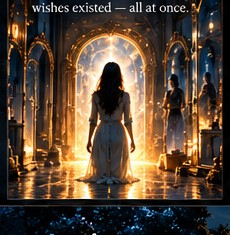
In the dream, one door remained closed.
It stood at the end of the house, behind a curtain of pale fabric. Unlike the other rooms, it had no mirror outside it. Aanya tried the handle, but it would not move.
“What is in there?” she asked.
“The things you keep outside your story,” the girl replied.
“Like what?”
“Your anger. Your envy. Your shame. The moments when you wanted something and felt guilty for wanting it. The times you hurt someone and decided that being a good person meant never looking at what happened.”
Aanya wanted to leave.
She had worked hard to become thoughtful and reliable. She did not want to discover that her good intentions had hidden selfishness, fear, or cowardice.
The girl waited.
Aanya placed her hand on the door.
Inside, the room was simple. There was a chair, a window, and a small table covered with letters. Aanya recognised the handwriting on the envelopes. They were messages she had drafted but never sent: an apology to a friend she had dismissed, a confession that she felt jealous of Rhea's courage, a note to her mother explaining that love sometimes felt like pressure.
At the bottom lay a letter to herself.
I am tired of being easy to approve of.
Aanya sat down.
She remembered the friend she had stopped calling after a misunderstanding. She had told herself the friendship had naturally faded. The truth was that she had been afraid to admit she was hurt. She remembered how she had mocked a colleague's creative idea in a meeting, then justified it as protecting the project. She remembered how often she said “It's fine” when it was not.
The room did not accuse her. It simply refused to let her look away.
“I don't like this version of me,” Aanya whispered.
“You don't have to like every choice you made,” said the girl. “But you have to be honest enough to learn from it.”
“Does accepting myself mean I excuse everything?”
“No. Acceptance means you stop lying about what happened. Responsibility means you decide what to do next.”
Aanya picked up the letter to her friend. She could not change the past, but she could write a new message. She could apologise without demanding forgiveness. She could tell her mother what she needed without turning the conversation into a trial. She could admit envy without using it as a weapon against herself.
The room grew brighter.
Aanya realised that the parts of herself she had hidden were not monsters. They were feelings, memories, and unfinished responsibilities. They had become heavier because she refused to look at them.
She woke with tears on her cheeks.
That morning, she sent her friend a message. It was short and sincere. She did not explain away her behaviour. She did not ask for an immediate reply.
Then she wrote to her mother and asked if they could have a conversation about expectations, not just plans.
Nothing was magically repaired.
But the door had opened.
5 / 11
Chapter 5 — The Shadows I Carried
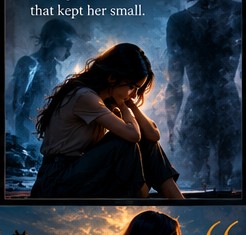
The hardest shadow was not regret. It was the belief that Aanya had to earn her right to exist by being useful.
She noticed it everywhere.
When a colleague praised her, she felt relief before pleasure. When someone was disappointed, she immediately searched for a way to fix the feeling. When she rested, she secretly calculated what she should be accomplishing instead. Even kindness could become a task: if she helped enough people, perhaps no one would notice how uncertain she felt inside.
The girl in the mirror called this an old bargain.
“Who taught you that love must be earned?” she asked.
Aanya remembered her childhood. Her parents had worked hard to give her security. Praise often arrived with achievement: good marks, good behaviour, good decisions. No one had told her she was only lovable when she succeeded. But somewhere along the way, she had learned to hear that message anyway.
She did not blame her parents. She did not blame herself for being shaped by what she had understood.
She simply began to question the bargain.
At work, she admitted that a project was behind schedule instead of staying late to hide the problem. She asked for help. The world did not collapse. Her team adjusted the plan and shared the workload.
With Rhea, she confessed that she sometimes envied her willingness to risk failure.
“I thought you'd judge me,” Aanya said.
Rhea shook her head. “I get jealous too. I just try not to let jealousy make my decisions.”
Aanya smiled. The honesty made them closer.
She also began saying no. Not as a performance of independence, but as a truthful statement about her time and energy. Some people accepted it. Some were surprised. A few were annoyed.
Aanya discovered that disappointing someone did not automatically mean she had done something wrong.
At night, the mirror girl became quieter. She no longer demanded that Aanya recover every lost dream. She asked what Aanya wanted to carry forward.
“I want my courage,” Aanya said. “And my curiosity. I want to keep my ambition, but not use it to punish myself. I want to care about people without disappearing inside their expectations.”
“And what will you leave behind?”
“The idea that I have to become a completely different person before I can begin living honestly.”
The girl smiled.
“Then you are learning.”
Aanya did not suddenly become fearless. She still worried about disappointing people. She still caught herself polishing an answer to make it more acceptable. But now she could recognise the moment when fear was trying to write her story.
Recognition gave her a choice.
And a choice, repeated often enough, began to feel like freedom.
6 / 11
Chapter 6 — Choosing the Real Me

Aanya decided to organise a small creative evening at a community centre. There would be music, short readings, drawings, and stories from people who believed they were “not creative enough” to share their work.
She nearly cancelled it three times.
The room was not impressive. The chairs did not match. The microphone hummed. The first few invitations received polite refusals. Aanya worried that the event would look amateurish and that people would judge her for trying something outside her professional identity.
Then she remembered the young woman at the open-mic night who had forgotten a line and started again.
Aanya kept the event.
Rhea brought a clay bowl she had made in her first studio class. A retired teacher read a poem she had kept in a drawer for forty years. A teenager played a song he had written on his phone. One man stood up and told a story about his father, stopping twice to collect himself.
Nobody was perfect. Nobody needed to be.
Aanya read her own short piece: a story about a woman standing before a mirror, afraid that the life she had built was not the life she wanted. Her voice trembled at first. Then she looked at the people listening and understood that they were not waiting for her to perform. They were there to hear her.
When she finished, the applause was warm and ordinary.
It was enough.
Afterward, a young woman approached her.
“I thought I was the only person who felt like I was living someone else's life,” she said.
Aanya felt the old urge to offer a polished solution. Instead, she asked, “What part of your life feels least like you?”
The woman began to talk.
Aanya listened.
That night, she stood in front of the mirror at home. The girl was waiting.
“Are you going to disappear now?” Aanya asked.
“I was never trying to stay trapped in the glass.”
“Then where do you go?”
The girl placed her hand against the mirror. Aanya placed hers on the other side.
“Wherever you let yourself be honest.”
Aanya felt a rush of sadness and gratitude. She had imagined that becoming herself would mean finding one clear identity and never questioning it again. Instead, it meant making room for curiosity, change, contradiction, and the courage to begin without certainty.
“What if I forget again?” she asked.
“You probably will. Life gets loud. That is why you must keep returning.”
The girl’s face softened. For a moment, she looked less like a separate person and more like a familiar expression Aanya had not allowed herself to wear.
Then the reflection became ordinary.
Aanya remained there for a while, breathing.
She did not need the mirror to open another world. She had already begun to step into this one.
7 / 11
Chapter 7 — A New Reflection

Months passed.
Aanya continued her work in brand strategy, but she stopped treating her career as the only measure of her life. She protected time for writing. She attended creative evenings even when she had nothing to share. She took long walks without turning every thought into a productivity plan.
She also learned that self-discovery was not a straight line. Some days she felt grounded. Other days she slipped into old habits, comparing herself with friends, seeking approval, or postponing what mattered because she feared doing it badly.
The difference was that she no longer treated a difficult day as proof that she had failed to change.
She began keeping a small list in her notebook:
What did I feel today?
What did I need?
Where did I act from fear?
Where did I act from care?
What would one honest next step look like?
What did I need?
Where did I act from fear?
Where did I act from care?
What would one honest next step look like?
The questions did not always produce clear answers. Sometimes they only helped her slow down long enough to hear herself.
One Sunday, Aanya visited her parents. Her mother asked about work, then about marriage, then about the plans Aanya had made for the coming year. The familiar tension rose in her chest.
This time, she did not become silent or sharp.
“I know you want me to be happy,” Aanya said. “I want that too. But I need you to trust that my life may not follow the order you imagined.”
Her mother looked down at her tea.
“I worry,” she said.
“I know. I worry too. We can talk about it without turning every conversation into a deadline.”
They did not solve every difference that afternoon. They did, however, understand each other a little better. Her mother spoke about her own fears and the expectations she had inherited. Aanya listened without taking responsibility for fixing them all.
On the train home, she looked at her reflection in the window. The glass showed her face and the passing landscape at once. Neither image erased the other.
She thought about all the versions of herself she had seen in the dream house: the musician, the writer, the traveller, the ambitious professional, the frightened child, the woman who was learning to speak plainly.
They were not competitors.
They were pieces of a life.
Aanya opened her notebook and wrote:
I do not have to become every possible version of myself. I only have to stop abandoning the parts that deserve a voice.
She read the sentence again. It did not feel like a final answer. It felt like a promise she could keep renewing.
That evening, she passed the mirror in her apartment and paused.
Her reflection looked back—tired, hopeful, imperfect, real.
Aanya smiled first.
The girl smiled too.
8 / 11
Epilogue — More Than One Me

A year after the first strange reflection, Aanya returned to the community centre for another creative evening. The event had grown. There were more chairs, better lighting, and a microphone that no longer hummed. Yet the best moments still happened between the planned ones: a nervous laugh, an unexpected confession, two strangers discovering they had carried the same fear for years.
Aanya stood near the doorway and watched a young man prepare to read his first poem. He kept smoothing the paper in his hands.
“You don't have to make it perfect,” she told him.
He looked at her. “What if it's not good?”
“Then it will be honest work that taught you something. You can make another one.”
He breathed out and walked toward the microphone.
Aanya recognised the courage it took. She had once waited for confidence to arrive before she allowed herself to begin. Now she understood that confidence often came after the first imperfect step.
Later, she went home and stood before the mirror.
No mysterious girl appeared. No hidden room opened. The glass reflected the apartment, the notebook on the table, and a woman who was still learning.
Aanya felt no disappointment.
The mirror had never needed to be magical. It had only needed to help her ask a question she had avoided: Am I living in a way that lets me recognise myself?
She would keep changing. She would make mistakes. Some dreams would grow quieter; others would arrive unexpectedly. She might become a different person in ten years, and that would not mean today's self had been false.
There was not one perfect Aanya waiting somewhere beyond the glass.
There was the Aanya who had been afraid. The Aanya who had achieved. The Aanya who had hidden. The Aanya who had begun to create again. The Aanya who would one day need to start over.
All of them belonged to her.
She closed the notebook and turned off the light.
In the dark, the mirror held no image at all. Yet Aanya knew what she had learned.
You do not discover yourself by finding a flawless version and removing every other part. You discover yourself by meeting your own life honestly—your strengths and your shadows, your dreams and your limits, your old wounds and your new choices.
You are allowed to grow beyond the person you were.
You are allowed to change your mind.
You are allowed to begin before you feel ready.
And you are allowed to be a work in progress without treating yourself as a problem to solve.
The girl beyond the mirror was never a stranger.
She was every part of Aanya that had been waiting to be welcomed home.
9 / 11
Your Turn — Reflection Questions
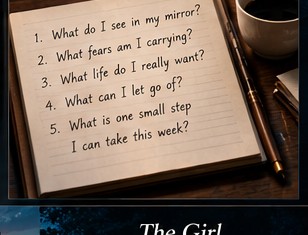
Take a few quiet minutes with these questions. You do not need perfect answers.
A SEVEN-DAY PERSONAL PROMISE
Complete this sentence:
For the next seven days, spend five quiet minutes with yourself. Write one honest answer to this question: *What do I need today that I have not been admitting?* Do not judge the answer. Choose one small, kind action that respects what you discover.
10 / 11
A Note from the Author

Many of us become skilled at presenting a version of ourselves that others can easily understand. We learn to meet expectations, avoid mistakes, and earn approval. These skills can help us succeed, but they can also make us forget to ask whether the life we are building still feels like our own.
Self-discovery does not require rejecting everything you have become. It asks you to look with honesty and compassion at the person you are today—and to make room for the person you are becoming.
May this story remind you that you do not need to be perfect to be worthy, certain to begin, or finished to be real.
You are not a single fixed version of yourself. You are a life still unfolding.
— Dharmendra Singh
Expert Community Hub Reads
Expert Community Hub Reads
11 / 11