
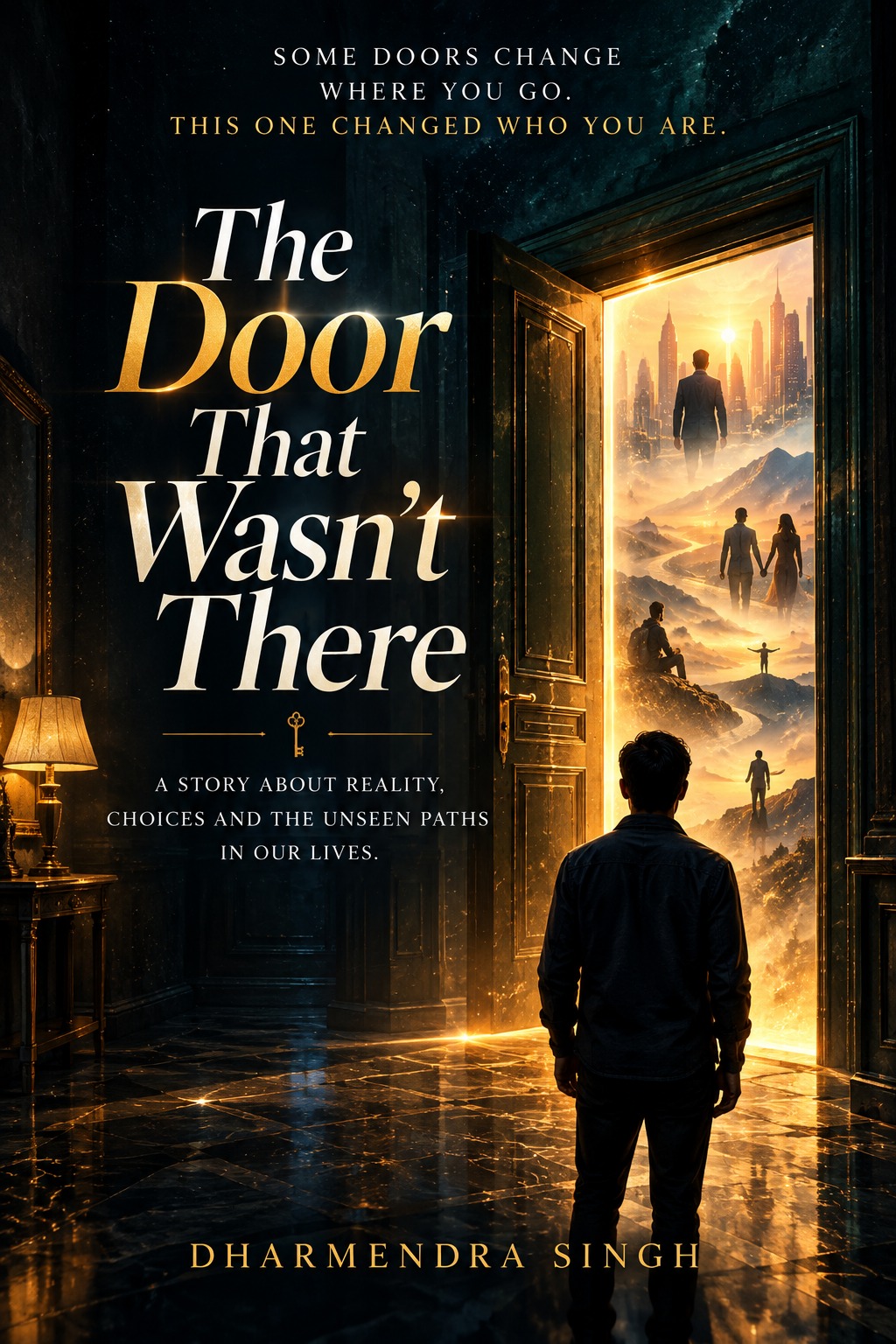
THE DOOR THAT WASN'T THERE
A Story About Reality, Choices and the Unseen Paths in Our Lives
Dharmendra Singh
Expert Community Hub Reads · Book 03
Expert Community Hub Reads · Book 03
Some doors change where you go. This one changed who you were.
An atmospheric story about the lives we imagine, the choices we regret, and the courage to become who we still can be.
Estimated reading time: approximately 30 minutes
PROLOGUE · ROOM 17
At 11:43 p.m., Rohan Sen found a door in a hotel corridor where no door had been before.
He knew because he had walked past that wall twice already.
The hotel stood above a narrow street in a hill town, its old stone exterior shining beneath the rain. Rohan had arrived that afternoon for a two-day product strategy meeting. The meeting had ended late, dinner had been forgettable, and his mind was still replaying a disagreement with his director.
He was thirty-four. He was good at solving problems for a living. Give him a confused team, a delayed product, a customer complaint or a spreadsheet full of contradictory numbers, and he could usually find a way forward.
But lately, he had begun to suspect that he had become very good at solving the problems other people gave him—and strangely poor at hearing the questions he asked himself.
The corridor smelled of damp wood and jasmine from a vase near the stairs. A wall lamp flickered. Somewhere below, a television murmured through a closed door.
And at the far end stood a door.
Dark green, almost black, with a brass handle worn smooth by hands. It had no room number. Only a small symbol carved at eye level: a circle crossed by a single line.
Rohan stopped.
He turned to look behind him. Empty corridor. Elevator doors shut. A framed landscape hung crooked on the wall.
He took out his phone and photographed the door.
The screen showed a blank wall.
He lowered the phone. The door remained.
Rohan tried again. The camera showed the wall, the lamp, the crooked painting. No door.
He checked the time. 11:43.
He should have called reception. He should have returned to his room, locked the door and blamed the late hour.
Instead, he stepped closer.
The brass handle was cold. Beneath the smell of damp wood, he noticed something else: the faint scent of old paper, coffee and the cedar cupboard in his childhood home.
Then a sound came from the other side.
A piano.
Not a recording. Not music drifting from another room.
Someone was playing the tune his mother used to hum when he was a child. A tune his older brother, Aditya, had learned by ear on an old keyboard.
Rohan's hand froze.
The piano stopped.
A voice spoke from beyond the door, soft as a thought.
“Rohan. You took your time.”
He had not heard that voice in eleven years.
It belonged to Aditya.
And Aditya was dead.
1 / 13
A NOTE BEFORE YOU ENTER
This is a story about Rohan. But it may remind you of someone you know.
Someone who has done what was expected, collected the milestones, and kept moving. Someone who wonders about the path not taken. Someone who has postponed a part of themselves until the right time arrives.
Maybe that person is you.
This story does not suggest that every unchosen path would have been better. It does not promise that life can be changed without sacrifice. It asks something more difficult:
Can you learn from the life you imagined without abandoning the life you still have?
2 / 13
CHAPTER 1 · THE LIFE THAT FITTED
Before the door, Rohan's life was ordinary in all the ways people admired.
He was a product manager at a fast-growing technology company in Bengaluru. He earned well, lived in a modern apartment, and had a career that seemed to move in the correct direction. His calendar was full. His messages were answered. His future was mapped into goals, promotions and investment plans.
People called him disciplined.
His father called him sensible.
His colleagues called him dependable.
No one called him happy. Not because they thought he was unhappy, but because happiness was not a question anyone in his circle remembered to ask.
Rohan did not hate his life. That was the confusing part.
There were good people in it. There were weekend breakfasts, restaurants with menus he barely read, a gym membership he used often enough, and friends who sent him jokes at midnight. He had even begun seeing someone named Anika, a thoughtful architect who laughed with her whole face and listened as if the person speaking was the most interesting person in the room.
Yet some evenings, after closing his laptop, Rohan would stand at the window and feel that he had arrived at a destination he had never consciously chosen.
He had done what he was supposed to do.
Study well. Find a good job. Work hard. Be responsible. Build security. Keep moving.
The trouble was that the instructions had never included a moment to ask what kind of life all that movement was meant to create.
The photograph in the drawer
On the Friday before his work trip, Rohan searched a drawer for a passport-sized photograph. Beneath old cables and warranty cards, he found an envelope with his name written in his mother's handwriting.
Inside was a photograph.
He and Aditya were standing beside a river, both sunburned, both grinning. Aditya was twenty-five and Rohan was nineteen. Their father had taken the picture after a long argument that had nearly ruined the day.
Aditya wanted to make documentary films. Their father wanted him to join the family business, which had supported the household for decades.
“You can't build a future on daydreams,” their father had told him.
Aditya had replied, “A future isn't much good if it doesn't feel like yours.”
The argument lasted for weeks. Eventually Aditya left anyway. For a few years, he travelled, filmed people and places, and sent home stories that arrived with postcards. He filmed a woman who ran a school under a tree, a fisherman who could read the weather from the colour of the water, and a village where the power went out every evening but no one stopped gathering outside to talk.
Rohan envied him, though he never admitted it.
He had wanted to travel too. He had wanted to learn music, to make things, to do work that left room for curiosity. But he was the younger son who watched the tension Aditya's choices caused. He saw his mother's worry and his father's silence. When Aditya died in a road accident while returning from a remote village where he had been filming a school, Rohan's private uncertainty hardened into a promise.
He would be the dependable one.
He would not add to the family's worries.
He would choose the safe road.
He put the photograph back in its envelope. Then, after a moment, he took it out again and placed it on his desk.
The question Anika asked
That evening, Anika called from her studio.
“Are you packed?”
“Almost.”
“You sound distracted.”
“Work is messy. A few things came up.”
“Things always come up.”
“That's why they pay me.”
She laughed. “Fair enough. Are you excited about the trip?”
“It's a work trip. Excitement might be a strong word.”
“You always say that. Even when you're going somewhere new.”
“I'm practical.”
“No,” she said gently. “Sometimes you're just careful.”
He laughed as if it were a joke. Anika didn't press him.
They had been seeing each other for several months. She never demanded that he become a different person. She simply asked questions that made him aware of the person he was already becoming.
Once, she'd asked what he would do if money and other people's expectations were taken out of the equation.
“That's not a realistic question,” he'd replied.
“Maybe,” she'd said. “But your answer was very fast.”
After the call, Rohan sat by the window. Across the street, a young man was teaching someone to ride a bicycle. The learner wobbled, nearly fell, then tried again. The teacher ran alongside, laughing.
Rohan watched them for longer than he intended.
He had spent years making his life stable. He had never asked whether he was making it alive.
A life can fit the expectations of everyone around you and still feel strangely unfamiliar from the inside.
3 / 13
CHAPTER 2 · THE DOOR
The next evening, Rohan turned the brass handle.
The door opened without a sound.
Beyond it was not another hotel room.
It was a small, warmly lit studio. Rain moved across a wide window, but beyond the glass lay a city he did not recognise. A piano stood beside a bookshelf. A camera rested on a desk. On the wall hung photographs of places he had once pinned to a map: the deserts of Rajasthan, the forests of the northeast, the fishing villages of Kerala.
There was a half-finished cup of coffee on the desk. A coat hung over a chair. The room felt lived in, not imagined.
And at its centre stood a man.
He was Rohan, but older by perhaps ten years. His hair was longer. There were lines around his eyes. He wore a faded shirt and held a camera in one hand.
The older Rohan looked at him with a tired, almost amused expression.
“You took your time,” he said.
Rohan stumbled back. “What is this?”
“A question,” the man replied. “You just haven't learned how to ask it yet.”
“Who are you?”
“You know who I am.”
Rohan stared at the camera, then at the photographs. “This is impossible.”
“Probably.”
“Am I dreaming?”
“Does it matter?”
“Yes!”
The older man smiled. “That's the first honest thing you've said tonight.”
Rohan looked toward the open door. The corridor was still there behind him. He could leave.
Instead, he stepped inside.
The room smelled of coffee and rain. The piano tune had stopped, but a note seemed to linger in the air.
“Where am I?” he asked.
“In one of the lives you could have lived.”
Rohan felt a cold line move down his back.
The man gestured toward the photographs. “You could have travelled. You could have made films. You could have taken risks. You could have failed at all of them.”
“Why are you showing me this?”
“Because you keep talking about your life as if it has already been decided.”
The older Rohan set the camera on the desk.
“You think your choices are behind you. They're not. Some are. Some doors close. Some roads disappear. But you still have choices in front of you, and you keep treating them as if they don't count because they're not the dramatic ones.”
Rohan looked at the city beyond the window. “Is this real?”
The older man shrugged. “Is the regret real?”
That silenced him.
The rule of the room
Rohan walked to the window. Far below, people crossed a bridge in the rain. The city looked familiar in the way dreams sometimes do: he knew it without having seen it.
“Can I go back?” he asked.
“You never left.”
“Can I stay here?”
“For how long?”
Rohan turned. “I don't know.”
“That's the problem with imagined lives,” the older man said. “They have no bills, no ordinary Tuesdays, no difficult conversations. You see the highlight reel. You don't see the cost.”
He picked up the cup of coffee and found it empty.
“Every life has a price. This one cost you some things. Another would have cost you others.”
“Then what is the point of this place?”
“To let you look.”
“Look at what?”
“What you miss. What you fear. What you still want. And what you've been telling yourself you can no longer choose.”
The older man moved toward a second door, pale blue, with chipped paint around the handle.
“Come on,” he said.
Rohan hesitated.
“Are there rules?”
“Only one.”
“Which is?”
“You can look at a life. You can't live it for free.”
Before Rohan could ask what that meant, the older man opened the blue door.
4 / 13
CHAPTER 3 · THE OTHER LIVES
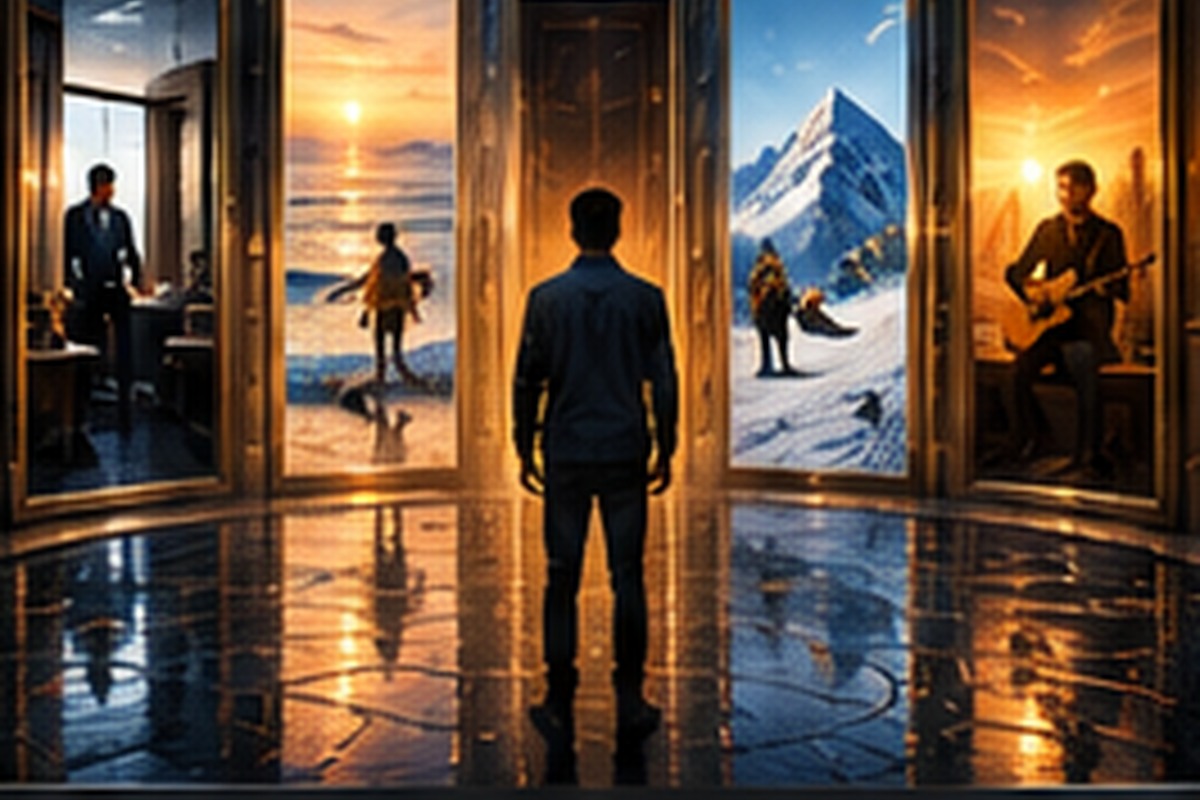
Beyond the blue door was a classroom.
Sunlight spilled over small desks. A younger version of Rohan stood at the front, explaining something to a group of children. The children were laughing. On the wall, colourful drawings showed planets, rivers and impossible machines.
“What life is this?” Rohan whispered.
“The one where you became a teacher.”
“I never wanted to be a teacher.”
“Not consciously,” said the older man. “But you loved explaining things. You loved the moment when someone understood something they had thought was beyond them.”
Rohan remembered tutoring a neighbour's son in mathematics during college. He remembered the boy's frustration, the long silence, and then the sudden change in his face when a difficult problem finally made sense.
He had forgotten that feeling.
In the classroom, the other Rohan knelt beside a student and helped her redraw a diagram. He looked tired. His shirt was creased. A stack of marking papers sat on his desk. Yet when the child understood, his face lit up.
“Does he earn much?” Rohan asked.
The older man smiled. “Is that your first question?”
Rohan felt embarrassed.
“No,” he said. “I suppose it isn't.”
They stepped back into the studio.
The next door opened onto a small room filled with sketches, instruments and unfinished projects. A younger Rohan sat cross-legged on the floor, laughing with friends. A guitar rested against a chair. Half-painted canvases leaned against the wall.
“The artist?” Rohan asked.
“The person who made things without asking whether they would improve his career.”
“That sounds irresponsible.”
“Does it?”
Rohan looked away.
In the room, the other Rohan was trying to play a tune on the guitar. He missed a chord, laughed, and began again. No one was evaluating him. No one was asking whether the practice would lead to a measurable outcome.
Rohan remembered the guitar he had bought at twenty-one. He had practised for three months, then stopped when a demanding project began. He'd promised himself he would return to it after the project, then after the promotion, then after the next move.
The guitar was probably still at his parents' house.
“Did this version of me become a musician?” he asked.
“No. He still works in an office. He plays badly on weekends. Sometimes he paints. Sometimes he forgets for months. The difference is that he doesn't need every interest to become a career before it earns a place in his life.”
Rohan stared at him.
“That's a life?”
“Of course.”
The next door opened onto a modest office. A man who looked like Rohan stood before a whiteboard, talking to two colleagues. There were plans, notes and diagrams. It was the life of an entrepreneur, building something small but entirely his own.
In this life, Rohan's business had nearly failed twice. He had borrowed money, lost sleep and learned how to apologise to a client. He had also built a product he believed in, hired a small team, and discovered the strange satisfaction of taking responsibility for something from beginning to end.
“Would I have succeeded?” Rohan asked.
The older man didn't answer immediately.
“Eventually, the business became sustainable. But not before he made mistakes that cost him money and friendships.”
“So it wasn't easy.”
“No life is easy just because it looks exciting from the outside.”
Another door opened onto the coast. Rohan saw himself with a camera, standing on a beach before sunrise. He was alone, but not lonely. He had spent months travelling and documenting people whose lives rarely appeared in the news. He had learned to wait for the right light, the right moment, the right permission.
Then another room: Rohan caring for their father through an illness, spending ordinary afternoons at home. In this life, he had chosen a job with fewer demands and a smaller salary. There were moments of frustration and financial worry. There were also long conversations, shared meals and stories he had never heard in the life he was living now.
Not every life looked better.
One version had followed his dream and discovered that travelling full-time made him feel rootless. Another had started a company that failed. In one, he had married someone he loved deeply but grown apart from her. In another, he had remained single and found meaning in friendships and community.
Rohan turned to the older man.
“Which one is the right life?”
“That's the question that keeps you trapped,” the man said.
He moved toward a window that had appeared in the wall. Through it, Rohan saw countless versions of himself, each walking down a different street, making a different choice.
“You imagine every unchosen path as a perfect life because you don't have to live its difficulties,” the older man said. “You see the freedom of the artist, not the uncertainty. You see the courage of the entrepreneur, not the sleepless nights. You see the beauty of the traveller, not the loneliness of being far from home.”
Rohan felt anger rise in him. “Then why show me any of this? To make me regret everything?”
“No.” The older man came closer. “To help you stop using regret as an excuse.”
The weight of every choice
On a small table lay a notebook. Rohan opened it.
Every page held a sentence that began with:
If only I had…
If only I had studied music.
If only I had taken the scholarship abroad.
If only I had told my father I wanted something different.
If only I had travelled with Aditya one last time.
If only I had asked him more questions about his films.
If only I had been less afraid.
He turned the pages faster. The notebook seemed endless.
“What am I supposed to do with all of this?” he asked.
The older man placed a hand on the notebook.
“Grieve what you lost. Learn from what you chose. And stop pretending that the life you have is no longer open to you.”
Rohan looked up.
“You can't live every possible life,” the man said. “But you can bring something from the lives you imagine into the life you're living.”
The room grew quiet.
For the first time, Rohan understood that the door was not offering him a way to go back.
It was asking him to look forward.
Every choice closes some doors. But the life you have chosen still contains doors you have not tried.
5 / 13
CHAPTER 4 · THE PRICE OF ANOTHER LIFE

The older Rohan led him through a narrow passage. At the end was a door made of pale wood. A small brass plate carried no name.
“What is behind this one?” Rohan asked.
“Something you asked for.”
The door opened onto a house filled with warm light.
Rohan heard laughter from the kitchen. A woman stood at the counter, chopping vegetables. A little boy ran through the hallway wearing one sock and carrying a toy spaceship. The woman looked up and smiled at Rohan with a familiarity that made his chest tighten.
“You're late,” she said. “Your son has been waiting to show you something.”
Rohan could not move.
He had never met this woman. He had no son.
But in the room, the other Rohan knew where the cups were kept, knew the boy's favourite story, knew which floorboard creaked near the stairs. He belonged there.
“What life is this?” he whispered.
“A life in which you made different choices about love,” said the older man.
Rohan watched the boy pull his father's hand toward a bedroom. On the wall were drawings, photographs and a paper rocket. The other Rohan sat on the edge of the bed and listened to an elaborate explanation of a game involving planets, monsters and a secret code.
The boy was talking too fast. The father listened anyway.
Rohan felt a sharp ache—not because he wanted this exact life, but because he recognised the tenderness of it. He could imagine loving a child like that. He could imagine the ordinary exhaustion, the school mornings, the worry, the pride.
He could also imagine the life he already had, with its own possible loves and commitments.
“Could I have had this?” he asked.
“Possibly.”
“Why didn't I?”
“Because life is not a single-choice puzzle. One decision led to another. Some choices were yours. Some were shaped by chance, by timing, by other people. You cannot know exactly what would have happened.”
Rohan watched the boy hug the other version of himself.
“Can I stay?” he asked.
The older man shook his head.
“Why not?”
“Because this isn't yours to take. It is a life, not a display window.”
The sentence stung. Rohan felt suddenly ashamed of how easily he had treated these rooms like shops, each one offering a better version of himself.
He had wanted to compare them. To choose the best one. To escape the uncertainty of his own life by finding proof that another path would have been superior.
But each room held real people, real costs, real responsibilities. They were not prizes.
“Then what am I meant to learn?” he asked.
The older man looked through the doorway.
“That longing is information, not an instruction. It tells you something matters. It doesn't always tell you what to do.”
Rohan repeated the sentence silently.
Longing is information, not an instruction.
Maybe he did not want another life. Maybe he wanted more tenderness in this one. Maybe he did not need to become a full-time traveller; he needed to stop treating every trip as a reward he had to earn. Maybe he did not need to quit his job; he needed to reclaim some time for making things, for listening, for being more than useful.
The room began to dim.
“Wait,” Rohan said. “What about the things I really did lose?”
The older man's face softened.
“Some losses don't become lessons neatly. Some remain losses. You don't have to pretend they're good because you learned something afterward.”
Rohan thought of Aditya.
For years, he had treated grief like a responsibility. He had tried to honour his brother by becoming reliable, safe and successful. He had never considered that Aditya might have wanted him to be a little less afraid.
“I miss him,” Rohan said.
“I know.”
“I never got to tell him that I admired him.”
The older man looked directly at him.
“Then tell him now.”
“How?”
“Say it. Write it. Let the truth exist, even if the person you want to hear it is no longer here.”
For the first time that night, Rohan cried without trying to stop himself.
The room did not vanish. No music swelled. No hidden answer appeared.
The older man simply sat beside him until the tears slowed.
6 / 13
CHAPTER 5 · THE CONVERSATION
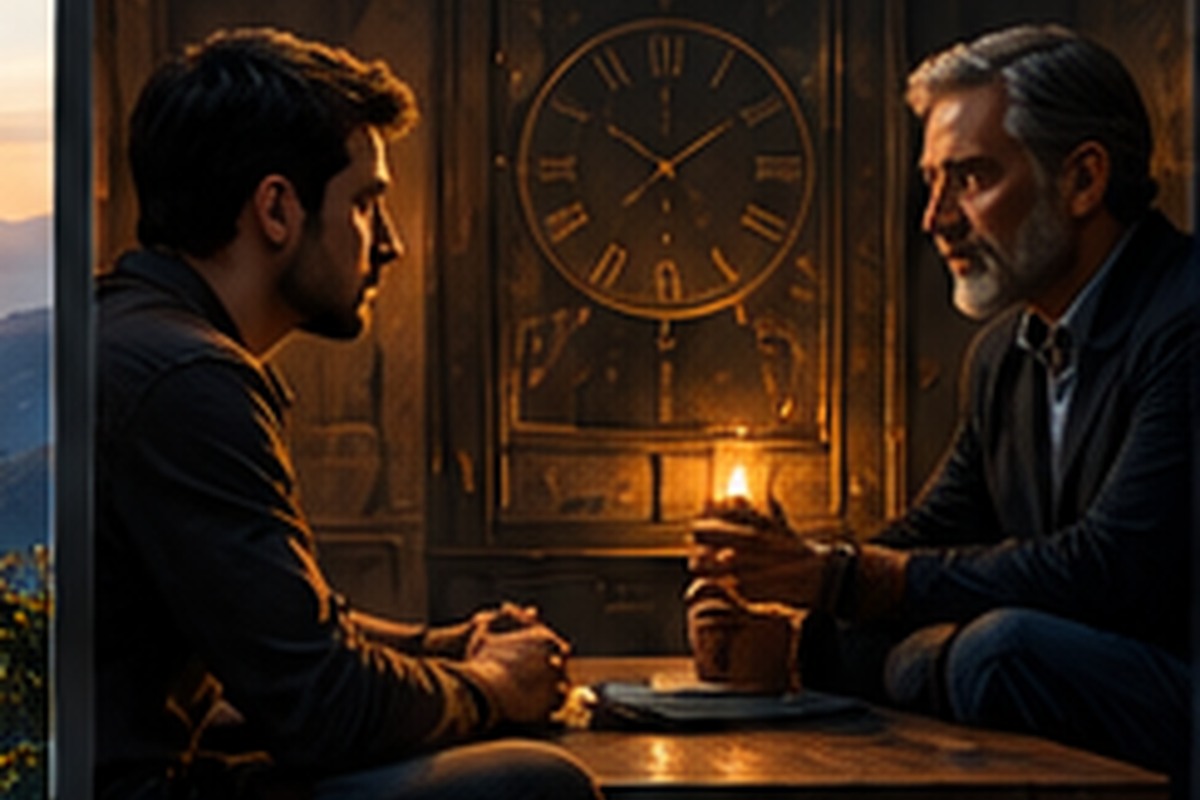
The piano began again.
Rohan knew the tune. His mother had played it badly on an old keyboard when he was a child. Aditya used to tease her, then sit beside her and play it properly.
“Why did you stop?” Rohan asked the older version of himself.
“Stop what?”
“Making things. Travelling. Trying.”
The older man looked toward the photographs.
“I didn't stop all at once. I postponed things. I waited for the right time. I told myself I was being responsible. Then the years passed, and postponement became an identity.”
Rohan thought of the sketchbooks he had left at his parents' house. The guitar gathering dust in a cupboard. The trips he saved to a list and never booked.
“I can't change the past,” he said.
“No.”
“I can't bring Aditya back.”
“No.”
“Then what can I do?”
The older man pulled a chair close.
“Tell me what you miss.”
Rohan expected the answer to be a place, a career or an adventure.
Instead, he said, “I miss who I was when I was with him.”
The words surprised him.
“With Aditya, I wasn't the responsible one. I wasn't the person who always knew what to do. I was just his little brother. I could be foolish. I could change my mind. I could want something without explaining how it would be useful.”
He stopped. His throat tightened.
“After he died, I thought I had to become someone who never made a mistake. Someone our parents could depend on. I thought if I chose the safe path, at least I wouldn't give them another reason to worry.”
The older man listened.
“You loved your family,” he said. “You still do. But somewhere along the way, you decided that being responsible meant being silent about what you wanted.”
Rohan wiped his eyes.
“I don't know how to start again.”
“You don't have to become the person you were at nineteen. You only have to stop abandoning the parts of yourself that still matter.”
“What if I fail?”
“You will fail at something. Everyone does.”
“What if I waste time?”
“You already know what it feels like to spend time on things that don't matter to you.”
Rohan laughed through his tears.
The older man leaned forward.
“Listen. You don't need to prove that the other lives were better. You don't need to punish yourself for the choices you made when you were scared, grieving or trying to protect people. You made the best decisions you could with what you understood then.”
He paused.
“Now you understand a little more. What will you do with that?”
Rohan looked at the camera on the desk.
“I'll take photographs.”
“Good.”
“And I'll learn to play the guitar again.”
“Good.”
“I'll talk to Anika honestly. I don't want to keep pretending that I'm fine just because my life looks fine.”
The older man nodded.
“And?”
Rohan took a breath.
“I'll stop waiting for my life to become perfect before I start living it.”
The room grew quiet.
The older man smiled—not triumphantly, but with the relief of someone who had been waiting a long time for a friend to arrive.
The edges of the room began to fade.
Rohan stood quickly. “Wait. Will I see you again?”
The older man smiled.
“You see me every time you imagine a different life.”
“And what are you?”
“I'm the part of you that still believes a choice can change things.”
The piano stopped.
The door was behind him again.
7 / 13
CHAPTER 6 · THE DOOR THAT WASN'T THERE

Rohan stepped back into the hotel corridor.
The green door clicked shut behind him.
He turned.
There was only a wall.
No handle. No brass symbol. No trace of a frame.
He stood there until the wall lamp stopped flickering.
At breakfast, he asked the receptionist whether the hotel had a room seventeen on his floor.
“No, sir,” she said. “Your room is fourteen. The rooms on this floor end at sixteen.”
“Has there ever been a door at the end of the corridor?”
She looked at him with polite concern. “Only the service wall.”
He almost laughed. Perhaps he had dreamed the whole thing. Perhaps the late hour and the rain had created a story out of grief and exhaustion.
Then he reached into his pocket.
There was a small brass object in his hand.
A key.
He could not explain it.
He kept it.
The first choice
Back in Bengaluru, Rohan did not announce a life transformation. He did not resign. He did not sell his car, move to the mountains or post a quote about following dreams.
Real life was more complicated than a movie montage.
He had responsibilities, rent, family commitments and a job that mattered to him in some ways. He did not want to throw away the stability he had worked hard to create. He wanted to understand how to live inside it differently.
So he began with one phone call.
He called his father.
“Papa, do you remember Aditya's camera?”
“Of course.”
“Do you still have it?”
There was a pause.
“Yes. It's in the cupboard.”
“Could I borrow it?”
“What for?”
“I want to learn how to use it.”
His father was quiet for a moment.
Then he said, “Your brother would have liked that.”
Rohan closed his eyes.
“Maybe,” he replied. “I'd like to find out.”
The letter
That evening, Rohan sat at his kitchen table and wrote a letter to Aditya.
He told him about the promotion, the apartment and the things he had done to become the dependable son. He told him about the guitar, the photographs, the trips that never happened. He admitted that he had been angry at Aditya for leaving, even though he knew Aditya had not chosen to die.
He wrote:
I thought if I made safe choices, I could protect everyone from pain. I know now that life doesn't work that way. I wish I'd asked you more questions. I wish I'd told you that you were brave. I wish we'd had one more ordinary afternoon together.
He stopped and stared at the page.
For a long time, he had believed that moving forward meant leaving grief behind. Now he understood that he could carry grief without allowing it to make every decision.
He folded the letter and placed it beside the old photograph.
Nothing magical happened. The room stayed quiet.
But he felt a little less divided.
The difficult conversation
A few days later, he met Anika at a small café near her studio. He had planned the conversation in his head several times and rejected every version because none sounded sufficiently clear.
“I've been thinking about the way I live,” he began.
Anika put down her cup.
“That sounds serious.”
“It is. I keep telling myself I'll do things later. I'll travel later. I'll make time for people later. I'll figure out what I want later. And I think I've started treating the people I care about as if they'll always be waiting when I'm ready.”
Anika watched him carefully.
“Are you telling me you don't want a relationship?”
“No. I'm telling you I don't want to pretend I'm more certain than I am. I like you. I want to see where this goes. But I need to get better at being honest, instead of hiding behind work whenever something feels difficult.”
She was quiet for a moment.
“That's the first time you've said something that sounds like you,” she replied.
He smiled, nervous and relieved.
They did not solve the future that afternoon. They talked about what they wanted, what frightened them, and what each of them needed to feel respected. The conversation was imperfect. There were silences. They disagreed about some things.
But neither of them used busyness as an escape.
That felt like a beginning.
The first photograph
Rohan borrowed Aditya's camera the following weekend. His father showed him how to open the case, clean the lens and load the battery. He told stories about the places Aditya had visited. For once, the stories did not end in a warning about risk.
Rohan took the camera outside.
At first, he photographed buildings, trees and strangers waiting at bus stops. Most of the pictures were bad. He learned to adjust the light, wait for a moment, and look at ordinary things from a different angle.
He began to notice how much he usually missed.
A woman holding a child's hand at a crossing. A shopkeeper watering plants before opening. A man sitting alone on a bench, smiling at a voice message. Sunlight catching dust in a narrow lane.
The world had not become more beautiful.
He had become more available to it.
8 / 13
CHAPTER 7 · THE LIFE HE COULD STILL CHOOSE

Over the next few months, Rohan's life changed in ways that were almost invisible to other people.
He still worked hard. He still wanted to grow. He still had difficult days and deadlines that arrived at the worst possible time. But he began to notice when he was saying yes out of fear rather than purpose.
At work, he asked which tasks genuinely required him and which had become habits. He delegated two recurring responsibilities and stopped attending meetings where he had nothing useful to contribute. He negotiated clearer priorities with his manager. Not every request disappeared. Some opportunities passed him by.
He learned that boundaries were not magic words. They were decisions that sometimes came with trade-offs.
He also learned that he had been using the word responsible to describe two very different things.
One meant caring for the people and commitments that mattered.
The other meant never disappointing anyone, never changing direction, never admitting uncertainty.
The first was love.
The second was fear dressed in respectable clothes.
The guitar in the cupboard
When he visited his parents, Rohan found the old guitar beneath a stack of blankets. It was dusty and slightly out of tune. One string had rusted. He took it to a repair shop and brought it home.
The first week, his fingers hurt. The second week, he could manage two chords. By the third, he was playing the same four bars badly enough that Tara—his cousin's daughter, who was visiting for the weekend—declared the guitar a public safety issue.
Rohan laughed.
He had forgotten that learning something could be worthwhile even when no one was impressed.
He began to play for fifteen minutes after dinner. Some days he forgot. Some days work ran late. But when he missed a week, he no longer called the whole effort a failure. He simply began again.
A different kind of ambition
Rohan did not stop caring about his career. He stopped treating his career as the only place where his life could prove its value.
He began mentoring younger colleagues, especially those who were afraid to ask questions. He remembered how much he had loved helping people understand difficult ideas, and he made room for that part of himself at work.
He and Anika took a short trip to the coast. They walked before sunrise, ate at a small restaurant, and spent an afternoon doing almost nothing. They talked about their families, the futures they imagined and the lives they were afraid of living by accident.
One evening, Anika asked him, “Do you ever wish you'd made different choices?”
“Of course,” he said.
“Then what changed?”
He thought for a while.
“I used to believe that if I found the right past, I'd finally know what to do. Now I think the past can tell me what matters, but it can't make the next choice for me.”
Anika nodded.
“That sounds harder.”
“It is.”
“And better?”
He looked at the sea, where the last light rested on the water.
“Yes,” he said. “I think so.”
The photograph of his father
Months later, Rohan visited his parents. His father had placed Aditya's old camera on the dining table.
“I cleaned it,” he said. “Your mother found the bag.”
Rohan picked it up carefully.
His father watched him for a moment. “You know, after your brother died, I spent years thinking about what I should have done differently.”
Rohan looked at him.
“I wanted him to be safe. I wanted him to have a stable life. I thought I was helping him by steering him toward what I understood.” His father looked down at his hands. “I loved him. But love can become fear when we're not careful.”
Rohan sat beside him.
“I was afraid too,” he said.
His father nodded.
Neither of them tried to make the conversation neat. They let it be unfinished.
Before leaving, Rohan took a photograph of his father sitting by the window, sunlight touching the side of his face. His father looked up just as the shutter clicked.
“Did you get it?”
“I think so.”
“Show me.”
The photograph was imperfect. The light was uneven. His father's eyes were half closed.
But Rohan loved it.
It was not a picture of the life he could have had.
It was a picture of the life he was in.
9 / 13
CHAPTER 8 · THE LAST DOOR

A year after the night at the hotel, Rohan returned to the hill town.
He told himself it was for a short break. He had work to finish and messages to answer, but he left the laptop at home. He packed the camera, a notebook and a book he had been trying to read for months.
The hotel looked smaller in daylight. The paint was peeling near the entrance. A new café had opened across the street. The jasmine in the lobby had been replaced by a bowl of polished stones.
At check-in, he asked the receptionist whether the hotel had changed its room numbering.
She smiled. “Not in years.”
That evening, he walked the corridor.
The wall was still there.
He stood beneath the flickering lamp and looked at the blank plaster. He took the brass key from his pocket. He had carried it for a year, though it opened nothing he knew.
He pressed it gently against the wall.
Nothing happened.
He laughed at himself.
Perhaps he had dreamed the whole thing. Perhaps the door had been a way his mind found to say what it could not say directly. Perhaps there was no answer worth chasing.
He put the key away and turned to leave.
Then he noticed the framed landscape on the wall. It was the same painting he'd seen that night, still hanging slightly crooked.
He straightened it.
Behind the frame, scratched into the wall, was the small symbol: a circle crossed by a line.
Rohan touched it with his fingertips.
He did not wait for a door to appear.
He did not ask to see another life.
Instead, he opened his notebook and wrote:
I cannot live every life. I can live this one with more honesty.
He wrote beneath it:
I can keep the curiosity without keeping the regret.
Then he closed the notebook.
The final dream
That night, he dreamed of the studio again.
The older version of himself stood beside the window, camera in hand. He looked neither younger nor older than before. The photographs on the wall had changed. Some were places Rohan had visited in the past year. Others were ordinary moments: Anika laughing over a burnt dinner, his father asleep in a chair, a friend standing in the rain, a guitar resting beside an open window.
“Did I choose the right life?” Rohan asked.
The older man smiled.
“You keep asking a question no one can answer.”
“Then what should I ask?”
“What are you choosing now?”
Rohan looked at the photographs.
“I don't know if I'm doing enough.”
“Enough for whom?”
Rohan laughed softly. “You always do that.”
“Do what?”
“Answer a question with another question.”
“It's a useful habit.”
They stood together in silence.
After a while, Rohan said, “I still wonder about the other lives.”
“Of course you do.”
“I don't think that will ever stop.”
“Maybe it doesn't need to. Wondering is not the problem. Forgetting to live because you're wondering is.”
The older man held out the camera.
Rohan took it.
“What happens now?” he asked.
“Now you go back.”
“To the hotel?”
“To your life.”
The studio lights dimmed. Somewhere, the piano began to play.
Rohan woke just before sunrise.
For a moment he lay still, listening to the rain. Then he got up, made coffee and went outside with his camera.
The hills were covered in mist. The road was quiet. A shopkeeper was lifting a shutter. A woman was walking a dog. Somewhere a child laughed.
Nothing extraordinary happened.
Rohan took a photograph anyway.
10 / 13
EPILOGUE · THE DOORS STILL OPEN
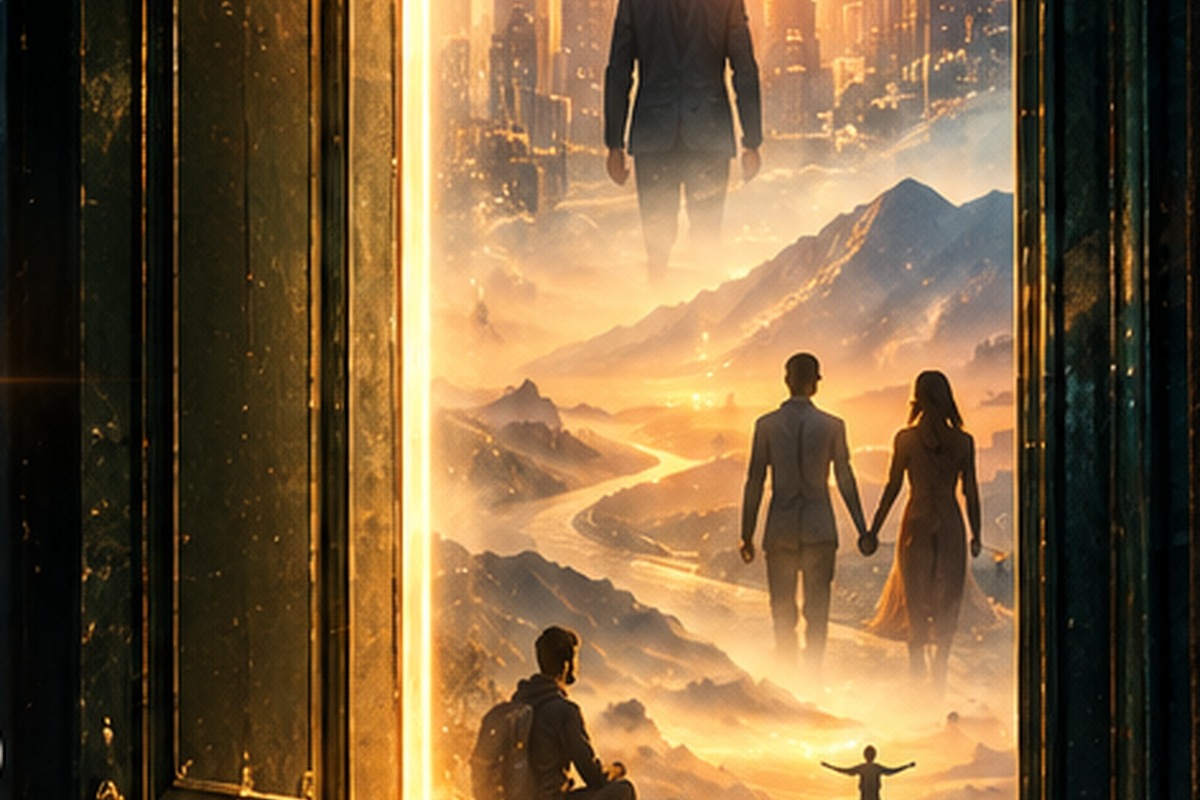
We all carry invisible doors.
Some lead to choices we never made. Some lead to conversations we avoided. Some lead to skills we stopped practising, places we never visited, relationships we were afraid to begin, or truths we were not ready to face.
It is natural to wonder about them.
What if I had chosen differently?
The question can teach us. It can help us understand our values and recognise what we miss.
But if we live inside it for too long, it becomes a room without windows.
You cannot live every version of your life.
You cannot undo every decision.
You cannot know whether the road not taken would have been easier, happier or more meaningful. Every road contains uncertainty. Every life asks something of us.
And the lives we imagine are incomplete stories. We see the exciting career but not the stress, the freedom but not the loneliness, the romance but not the difficult conversations. We compare our whole life—with its bills, disappointments and ordinary Tuesdays—to an imagined life from which we have removed every inconvenience.
That is not a fair comparison.
But the longing itself may still contain a message.
If you envy the traveller, perhaps you need more wonder.
If you envy the artist, perhaps you need to make something without asking whether it will be profitable.
If you envy the person who speaks honestly, perhaps you need to have a conversation you've been avoiding.
If you envy the person who seems free, perhaps you need to examine which commitments are meaningful and which you have accepted only from fear.
Longing is information, not an instruction.
You do not have to copy another life. You can learn what it reveals about your own.
Not every dream must become a career.
Not every regret can be reversed.
Not every door should be opened.
The point is not to chase every possibility.
It is to notice which possibilities still matter—and have the courage to meet them.
Your present life is not a locked room. You can learn, repair, reconnect with neglected parts of yourself and make new choices. You can start a small project, make an honest apology, ask for help, change a habit, set a boundary, or take one step toward something you thought you had left behind.
You do not need a mysterious door to begin.
You need a moment of honesty.
You need the willingness to choose.
And sometimes, you need the courage to accept that a door has closed—then turn around and notice the ones that remain.
Sometimes the door you are looking for isn't a way out of your life. It's a way back into it.
11 / 13
YOUR TURN · FOUR QUESTIONS
Take a few quiet minutes. Write honestly. You don't need perfect answers.
YOUR NEXT STEP
Complete this sentence:
Keep your answer realistic. A meaningful beginning can be small.
12 / 13
A NOTE FROM THE AUTHOR
We often treat our lives as if the important choices have already happened—as if the past has written the final version of who we are.
But the past is not the whole story.
Our experiences shape us, and some losses cannot be undone. Still, we have room to respond, to learn, to reconnect with neglected parts of ourselves and to make new choices.
I hope Rohan's strange encounter reminds you not to spend so much time imagining another life that you overlook the possibilities inside the one you have.
You do not have to become someone else.
You can begin by listening to the person you already are.
The next door may not appear by magic. It may begin with one honest choice.
— Dharmendra Singh
Expert Community Hub
Expert Community Hub
EXPERT COMMUNITY HUB READS · BOOK 03
THE DOOR THAT WASN'T THERE
A Story About Reality, Choices and the Unseen Paths in Our Lives
Some doors change where you go. This one changed who you were.
13 / 13