
You may be capable of helping many people, but trying to speak to everyone can weaken your message. Learn how to identify your best-fit clients and make your marketing more relevant without turning away every other opportunity.
You have knowledge that could help students, professionals, business owners, freelancers, coaches, and people starting from scratch.
So you try to speak to all of them.
Your posts cover every problem. Your bio lists every skill. Your offer promises to help anyone who wants to improve.
You are trying not to miss an opportunity.
But here is the problem: when your message is meant for everyone, the right person may not recognize that it is meant for them.
You can be capable of helping many people without marketing to all of them at once.
Choosing a best-fit audience is not about rejecting everyone else. It is about making your message clear enough that the people you are best equipped to help can recognize themselves.
The hidden cost of trying to help everyone
Imagine reading two messages.
The first says: “I help people grow, succeed, and unlock their potential.”
The second says: “I help independent coaches create a clearer process for turning enquiries into client conversations.”
The first message may appeal to many people. But it is difficult to know what service is actually being offered.
The second message gives a particular audience a concrete reason to pay attention. A coach who struggles with follow-up can immediately decide whether the topic is relevant.
Specificity does not guarantee a sale. It makes understanding easier.
When your message is too broad, you may attract enquiries from people whose needs, expectations, budgets, or circumstances do not match your service. You spend time explaining what you do, adjusting your offer for every conversation, and wondering why interest does not turn into good client relationships.
A clearer audience gives your content and offers a more useful direction.
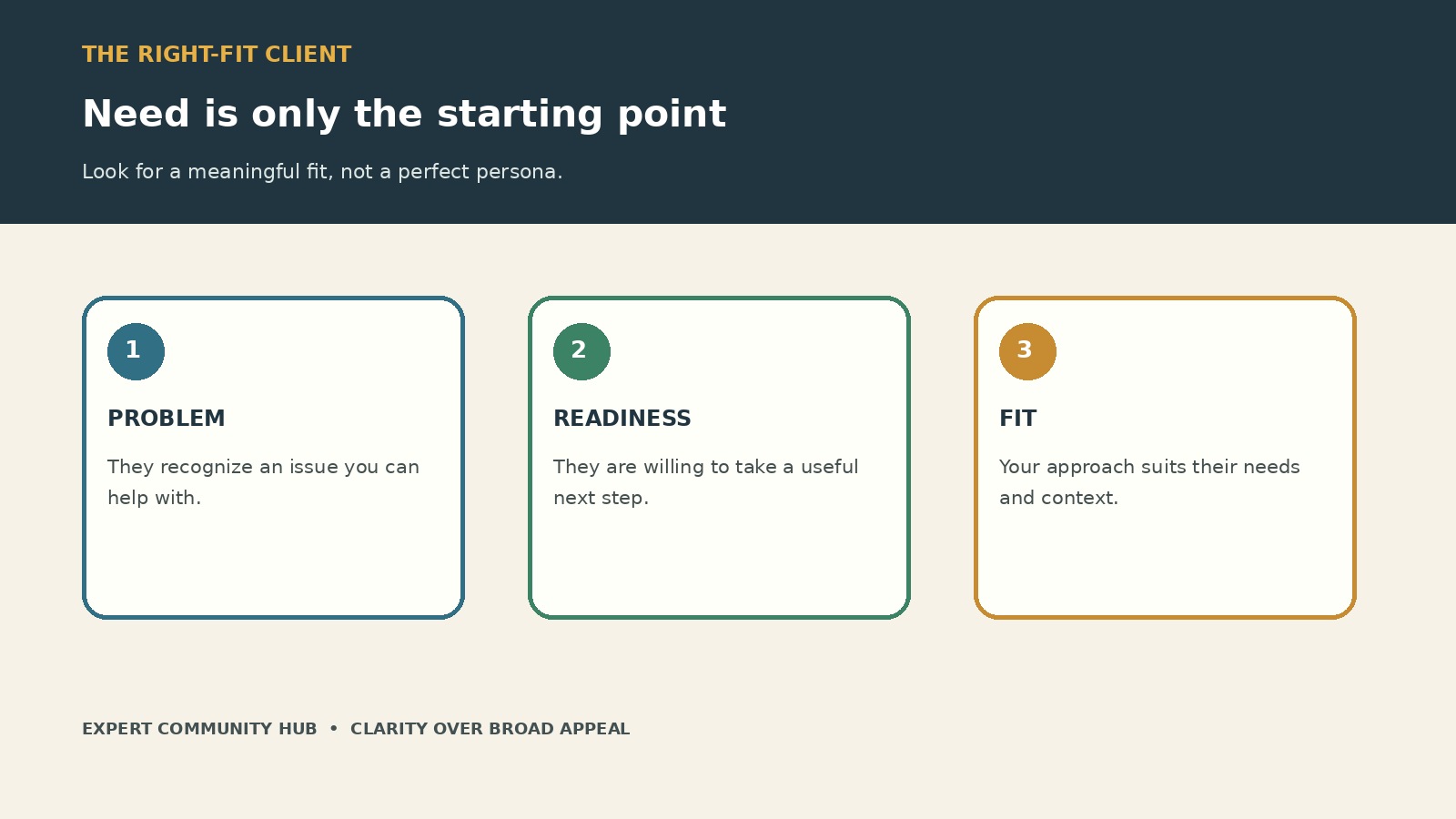
Need alone does not make someone your ideal client
Many people may benefit from what you know. But not every person with a problem is a good fit for your particular service.
A best-fit client usually has several things in common with the people your approach serves well:
- They have a problem your service is designed to address.
- They understand—or are willing to explore—the kind of help you provide.
- Their expectations are compatible with your process.
- They can participate in the work required.
- The scope and investment are appropriate for their circumstances.
These are not judgments about a person's worth. They are ways to assess whether a working relationship is likely to be useful and sustainable for both sides.
The FIT Framework
Use this three-part framework to identify your best-fit clients.
F — Find the situation they are in
Describe the situation rather than relying only on demographic details.
Instead of defining your audience solely as “people aged 25–45,” consider the work they are trying to do, the obstacle they face, and the stage they have reached.
For example: “Independent consultants who receive enquiries but do not have a consistent follow-up process.”
That description gives you useful content topics and helps you recognize relevant conversations.
I — Identify the progress they want
What are they trying to change?
They may want to clarify their offer, communicate their expertise, improve a workflow, learn a skill, or make a better decision.
Use the audience's own language where possible. Listen to questions, review feedback, and notice recurring problems instead of assuming you already know what everyone wants.
T — Test whether your service fits
Ask whether your service can realistically help with that problem.
Consider your expertise, delivery method, scope, resources, and the effort required from the client. Be clear about prerequisites and limitations.
If the person needs something you do not provide, it is better to say so than to promise a fit that does not exist.
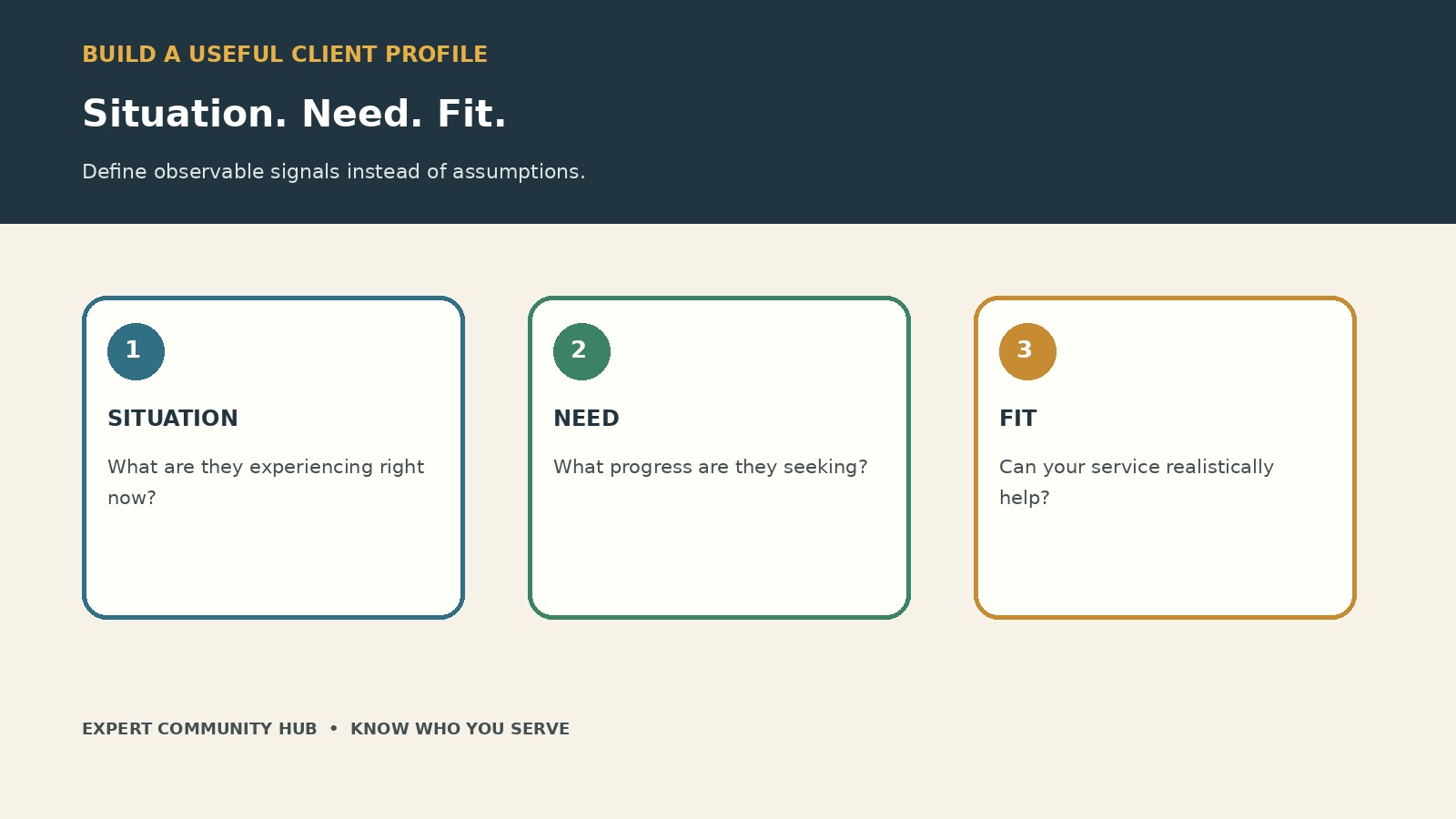
Create a one-page ideal-client profile
You do not need a complicated avatar with dozens of personal details. Start with five practical questions:
1. What situation are they in? Describe their current context in plain language.
2. What problem do they want to address? Focus on the issue they recognize, not only the solution you want to sell.
3. What have they already tried? This can reveal their expectations, frustrations, and existing knowledge.
4. What would make your service a good fit? Identify the needs, readiness, and circumstances your process is designed for.
5. Who is not a fit right now? Note the problems outside your expertise, unrealistic expectations, or situations where another solution would be more appropriate.
Keep the profile grounded in real conversations. Treat it as a working hypothesis, not a permanent label. Your best-fit audience may become clearer as you serve clients and learn from the results.
What if you can help several different audiences?
You do not have to choose one audience for the rest of your life.
You may have expertise that serves several groups. The practical question is whether those groups share a problem and a clear reason to choose your offer.
If they do, one core message may serve them well. If their needs are substantially different, separate content paths or offers may be easier to understand.
For example, a consultant who helps both independent coaches and small business owners improve enquiry follow-up may use a shared framework, then create examples specific to each group.
The principle is simple: keep the central promise clear, and adapt the details where the audience's situation genuinely differs.
Let your marketing help people self-select
Once you have a clearer audience, use that knowledge in your marketing.
In your headline: Name the people or situation you help.
In your content: Address the problems they recognize and show how you think about solutions.
In your offer: Explain the process, scope, and expectations so people can evaluate whether it fits.
In your calls to action: Invite interested people to take a relevant next step, such as reviewing a guide, attending a workshop, or asking a question.
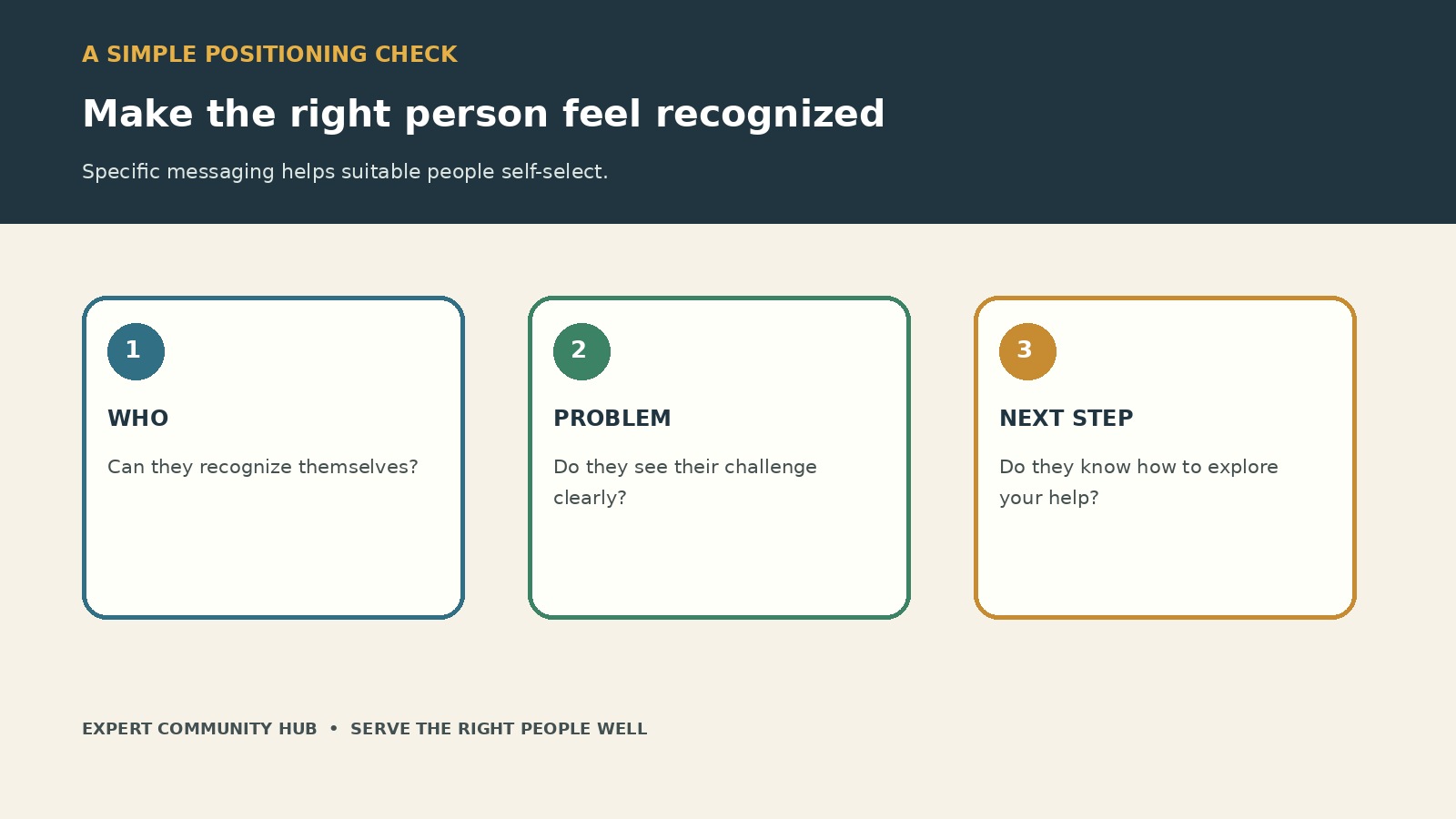
Specific messaging can help suitable people recognize themselves. It can also help others realize that your service is not what they need. Both outcomes save confusion.
Your 20-minute ideal-client reset
Set aside 20 minutes and choose one service you want to promote.
Minutes 1–5: Write down the three most common problems your best clients bring to you.
Minutes 6–10: Describe the situation those clients share. Focus on observable needs and challenges, not assumptions about their personality.
Minutes 11–15: Write one sentence using this structure: “I help [audience in a specific situation] address [problem] so they can work toward [realistic progress].”
Minutes 16–20: Compare the sentence with your current bio or offer page. Make one edit that helps the right person understand your work more quickly.
Then ask a trusted person in your target audience whether the message feels relevant and clear. Their feedback may reveal a gap you have overlooked.
Your ideal client is not a box
Do not use an ideal-client profile to make rigid assumptions about people. Two clients with similar problems may have very different preferences, budgets, or working styles.
Use your profile to guide your message, not to stereotype individuals. Stay curious. Ask questions. Update your understanding as you learn.
The purpose of focus is not to shrink your potential. It is to make your expertise easier to recognize and your service easier to evaluate.
Your turn
Who gets the most value from the work you do—and what do they have in common beyond age, location, or job title?
Share your thoughts in the comments. Your answer may help another coach or consultant find a clearer audience.
Your next step
If you are a coach, consultant, or knowledge-based professional, Expert Community Hub can help you explore how to clarify your audience, communicate your expertise, and build a more structured approach to client acquisition.
You do not need to help everyone at once. Start by serving the people you understand well, with a problem you are equipped to address, and a message they can recognize.
Written for coaches, consultants, and knowledge-based entrepreneurs by Expert Community Hub.