
You share tips, teach generously, and get engagement—but few enquiries follow. Learn how to connect free content to a useful next step without making every post a sales pitch.
You give away useful advice. People thank you. They save your posts. Some even tell you how helpful your content is. But very few ask about your services.
If this sounds familiar, it can feel confusing.
You are doing what the marketing advice tells you to do: educate your audience, share value, publish consistently, and build trust.
Yet your content seems to create learners—not clients.
You might wonder whether you should stop sharing so much for free, post more often, or make your content more promotional.
Before changing everything, look at the journey you are offering your audience.
Helpful content creates value. A clear next step helps interested people decide what to do with that value.
Your content does not need to become a constant sales pitch. It needs to connect what you teach with the problem you can help solve and a relevant way to continue.
The hidden frustration: people learn from you but never move forward
Imagine someone regularly watches your videos about marketing. They learn useful tips and appreciate your explanations.
But they do not know whether you offer consulting. They do not understand who your service is designed for. They cannot tell how working with you differs from continuing to learn from free posts.
So they keep watching.
This is not necessarily a sign that they are taking advantage of you. They may simply be doing what your content invites them to do: consume information.
If every post ends with another tip, another checklist, or “follow for more,” the audience has little reason to consider a different next step.
The problem may not be that you give away too much. It may be that the path from learning to getting help is unclear.
Three reasons helpful content may not lead to enquiries
1. Your content solves small problems, but your offer is invisible
A post might explain how to write a headline or plan a week of content. That is useful. But readers may not realize you can also help them build a complete client-acquisition process.
Connect individual tips to the larger problem you solve. Explain when a quick tip is enough—and when a person may benefit from deeper guidance.
2. Your audience does not recognize itself in your message
General advice can attract a broad audience. But potential clients need to recognize their own situation.
Instead of speaking only about “business growth,” address a concrete challenge faced by the people you serve. Specificity helps suitable readers understand why your expertise may be relevant.
3. You never invite people to take the next step
You may avoid calls to action because you do not want to sound pushy. That concern is understandable.
But a respectful invitation is not pressure. It simply tells interested people what is available.
You might invite them to download a resource, attend a workshop, ask a question, or explore a service page. The invitation should match the topic and the level of interest.
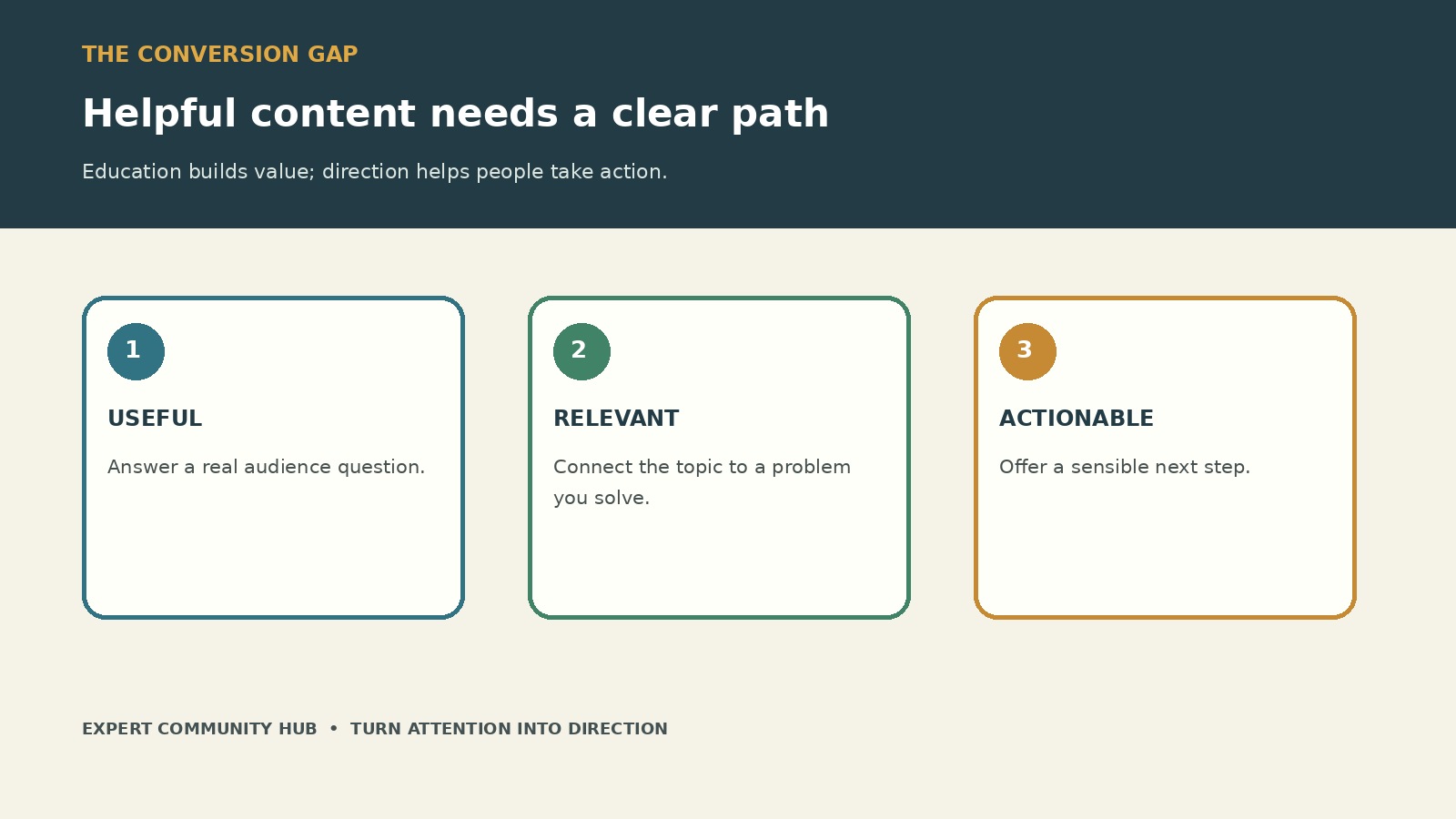
The Content-to-Client Bridge
Use this four-part framework to connect useful content with your service naturally.
1. Teach one useful thing
Answer a real question your audience asks. Share a method, explain a mistake, or help readers understand a problem more clearly.
Do not make the content artificially incomplete just to force people to buy. Deliver genuine value.
2. Connect the lesson to the bigger problem
Explain where the tip fits into the wider challenge.
For example, a post about writing a better social media call to action might explain that calls to action work best when the audience, offer, and next step are aligned.
This helps readers understand your thinking rather than simply collect isolated tricks.
3. Show how your process helps
Describe how you approach the broader problem. You might share a short example, outline your process, or explain what you would review first.
Use real evidence where possible. Be clear about the context of any examples and avoid implying that every client will get the same result.
4. Invite a relevant next step
Give readers one clear option.
If they need more education, offer a relevant guide or workshop. If they are exploring a solution, invite them to learn about your service. If they have a specific question, encourage them to ask it.
The next step should be easy to understand and appropriate for the reader—not a demand to buy immediately.
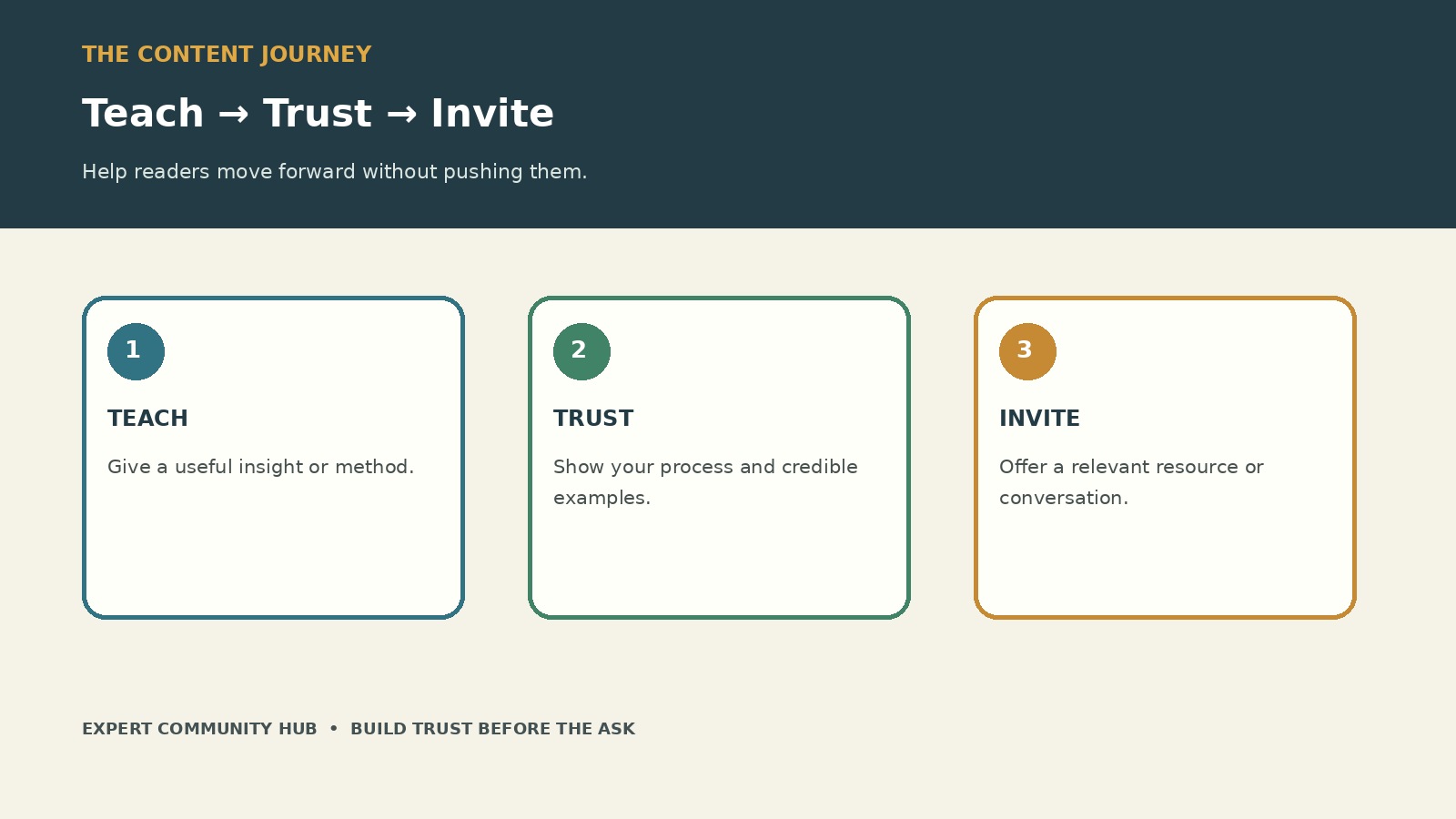
Example: turn a helpful post into a useful pathway
Imagine you help independent coaches improve their client acquisition.
The free post: “Three reasons potential clients stop replying after an enquiry.”
Teach the three reasons and offer a practical improvement.
The connection: Explain that follow-up is one part of a larger process that includes clear positioning, a relevant offer, and an organized way to track conversations.
The resource: Offer a simple follow-up checklist that readers can use immediately.
The service invitation: Explain that people who want help reviewing their full enquiry-to-client process can learn about your consulting or coaching service.
Each step has a purpose. The post helps. The resource supports implementation. The service offers deeper assistance for people who need it.
Not everyone will continue—and that is fine. Your job is to make the path clear, not to force every reader along it.
Match the call to action to the content
A common mistake is using the same generic invitation at the end of every post.
Instead, consider what the reader is likely ready for.
- Early awareness: Ask a thoughtful question or share a related beginner resource.
- Problem recognition: Offer a checklist, guide, or workshop that helps them assess the issue.
- Solution exploration: Explain your process, show a relevant example, or invite a conversation.
- Ready to decide: Provide clear information about the service, requirements, pricing, and enrollment process.
These are not rigid stages. People move at different speeds. The point is to offer a useful next step rather than asking for a major commitment before the reader understands the fit.
Audit your last five posts
Open your five most recent posts and ask:
- Did each post address a problem relevant to the people I want to serve?
- Did it demonstrate how I think or work?
- Did the reader have a clear way to continue, where appropriate?
- Did I explain my offer somewhere in my overall content?
- Can a new visitor understand who I help and how to learn more?
Do not add a sales pitch to every post simply to tick a box. Some posts are valuable because they teach, build trust, or start a conversation. Look at the overall pattern.
If your content is helpful but your service is difficult to find, improve your profile, service page, pinned post, or resource links before increasing your publishing workload.
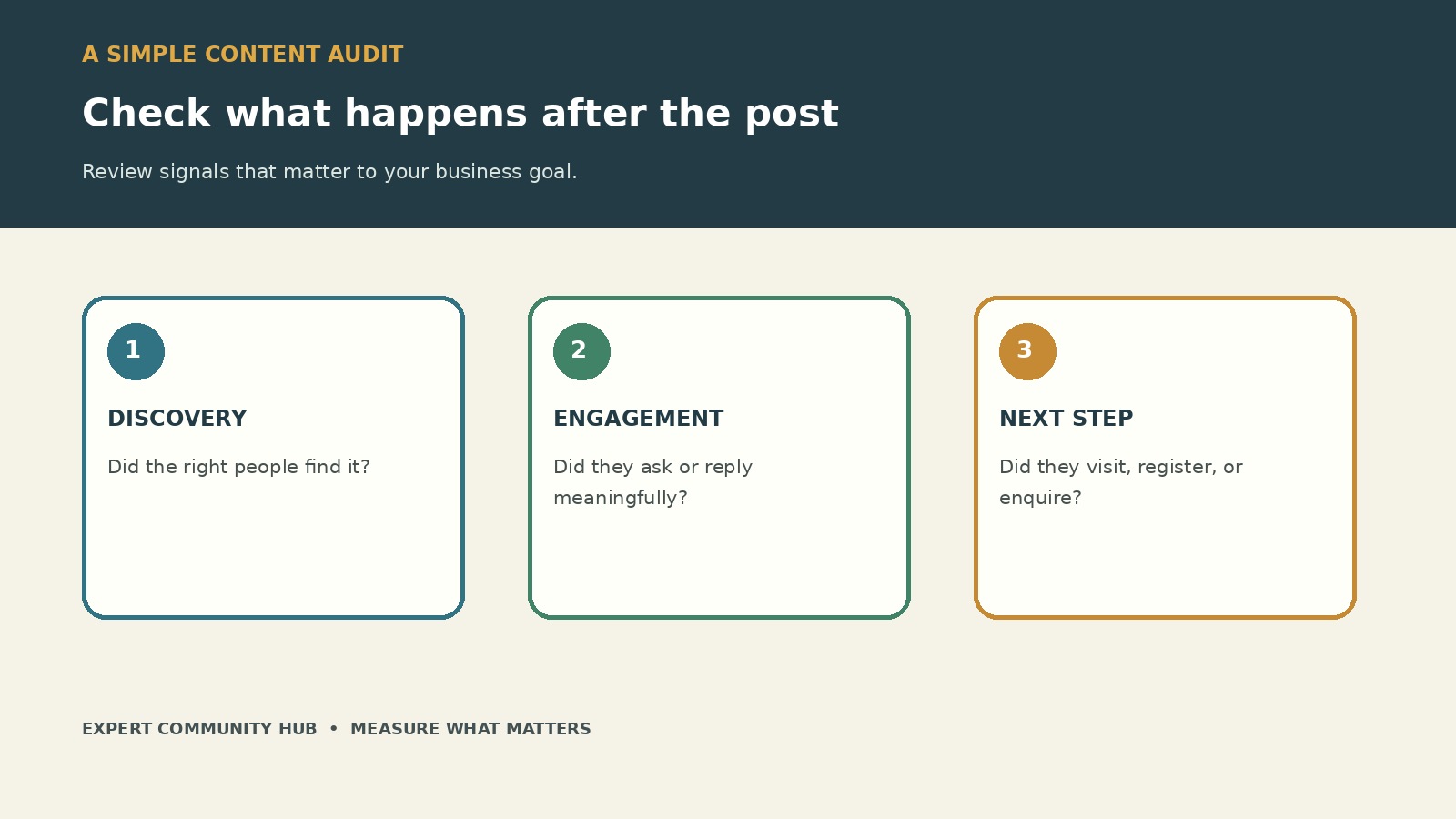
Measure movement, not just engagement
Likes, views, and saves can indicate that content is attracting attention. They do not tell the entire story.
Depending on your goal, review signals such as:
- Relevant replies and questions.
- Resource downloads or workshop registrations.
- Visits to your service page.
- Enquiries from people who fit your intended audience.
- Conversations that progress to a suitable next step.
- Feedback from people who used your resource.
Ask new enquiries how they found you. Keep a simple record. Over time, you may learn which topics attract suitable prospects and which invitations help them continue.
If people engage but do not enquire, check whether your service and next step are visible. If people enquire but do not proceed, review your offer, fit, and sales conversation too. Content is one part of the client journey, not the whole system.
Your 20-minute content-to-client reset
Choose one service you genuinely want to grow.
Minutes 1–5: Write down one problem your ideal client regularly faces.
Minutes 6–10: Draft a post that teaches one useful way to understand or address that problem.
Minutes 11–15: Add a short explanation of how the issue connects to the broader problem your service helps with.
Minutes 16–20: Choose one relevant next step: a resource, a workshop, a service page, or an invitation to ask a question.
Then review the complete journey as a first-time reader. Is the next step clear? Does it feel helpful? Can the person decide whether it is relevant without pressure?
You do not need to stop giving value for free
Free content can build trust, help people make better decisions, and demonstrate your expertise. It can be valuable even when it does not lead directly to a sale.
Your paid service should offer a clear reason to work with you: deeper diagnosis, personalized guidance, structured implementation, feedback, accountability, or support tailored to the client's situation.
You do not need to hide every useful idea behind a paywall. You need to communicate the difference between learning something useful and receiving the support required to apply it to a specific situation.
Your turn
Does your content currently give people a clear next step—or does it end after delivering another useful tip?
Share one change you could make to help interested readers move forward. Your answer may give another coach or consultant a practical idea to try.
Your next step
If you are a coach, consultant, or knowledge-based professional, Expert Community Hub can help you explore how to communicate your offer and build a more structured approach to client acquisition.
Keep teaching generously. Connect your content to a real problem. Then make the next step clear for people who want deeper help.
Written for coaches, consultants, and knowledge-based entrepreneurs by Expert Community Hub.