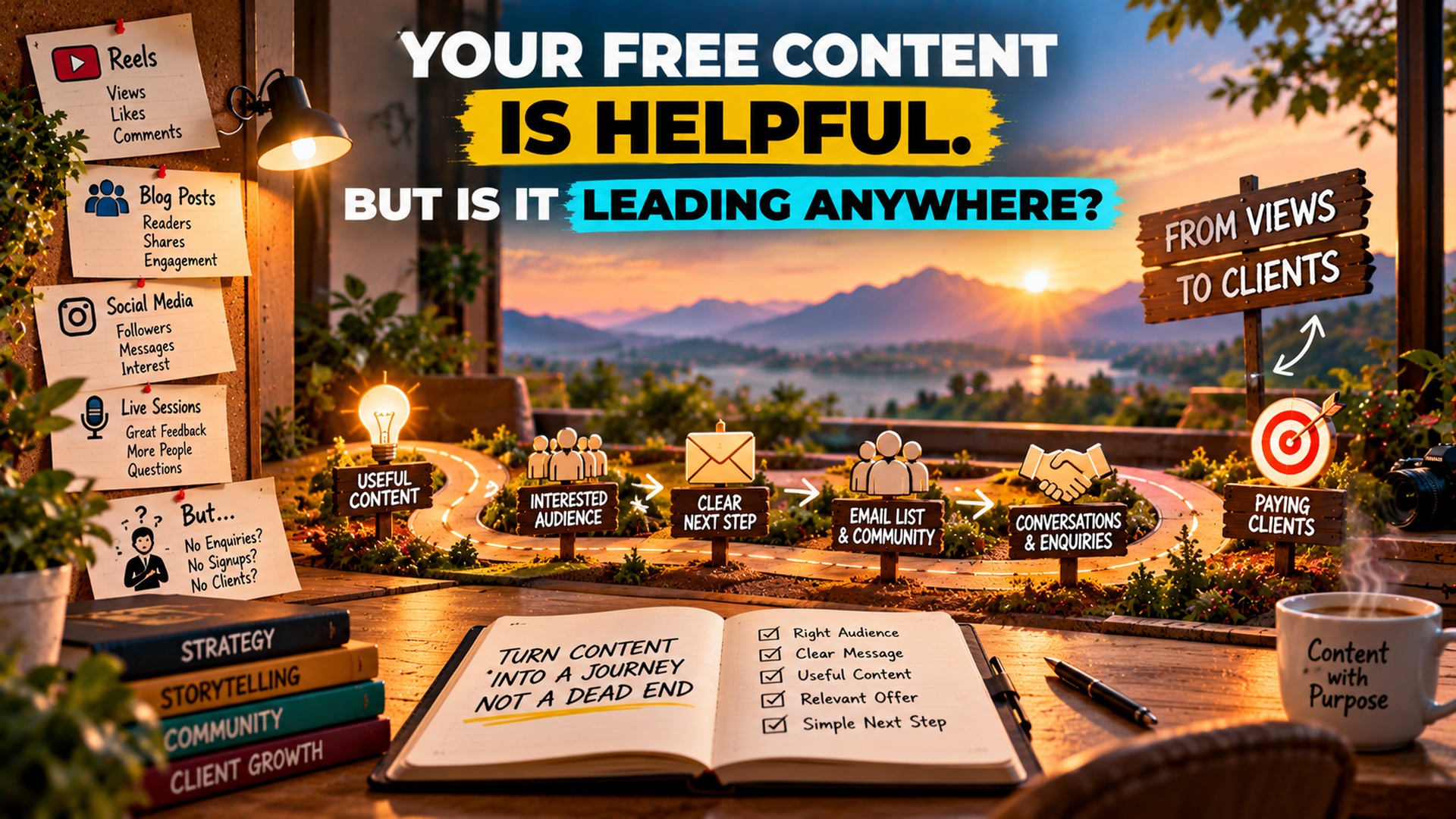
You can give away genuinely useful advice and still leave readers unsure what to do next. Learn how to connect free content to a helpful next step without turning every post into a sales pitch.
A reader saves your post.
Another sends you a thank-you message.
Someone comments, “This is exactly what I needed.”
You feel good. You should. Your content has helped someone.
But weeks pass. Your audience keeps consuming your advice, while your enquiries remain quiet.
Here is an uncomfortable question: Are you giving people useful information without showing them what they can do with it next?
Free content should absolutely be valuable on its own. It does not need to hide the answer behind a paywall. But when someone wants more help, they should not have to guess where to go.
Think of your content as a trail. Each post can be a worthwhile destination. A clear next step simply helps interested readers continue the journey.
The content that ends at a dead end
Picture this.
You publish a thoughtful post about why potential clients stop replying after an enquiry. You explain three reasons and give a useful tip.
At the end, you write: “Follow me for more tips.”
That is not wrong. If your goal is to grow your audience, it may be exactly right.
But what if a reader wants to apply the advice today? What if they need a checklist? What if they want help building a follow-up process?
Your post has created interest, but it has not offered a path for people who want to go further.
The solution is not to turn every post into a pitch. It is to decide what a useful next step would be for that particular reader.
First, stop treating every reader as a buyer
Not everyone who reads your content is ready to hire you.
Some people are discovering the problem. Some are learning how to solve it themselves. Others are comparing approaches. A smaller group may be actively looking for support.
If every post asks everyone to buy, your marketing can feel pushy and disconnected from the reader's needs.
If every post asks only for a like or follow, interested people may never discover the deeper resources you offer.
A better approach gives readers choices. They can learn, explore, ask a question, or consider paid support when it is relevant.
The BRIDGE Method
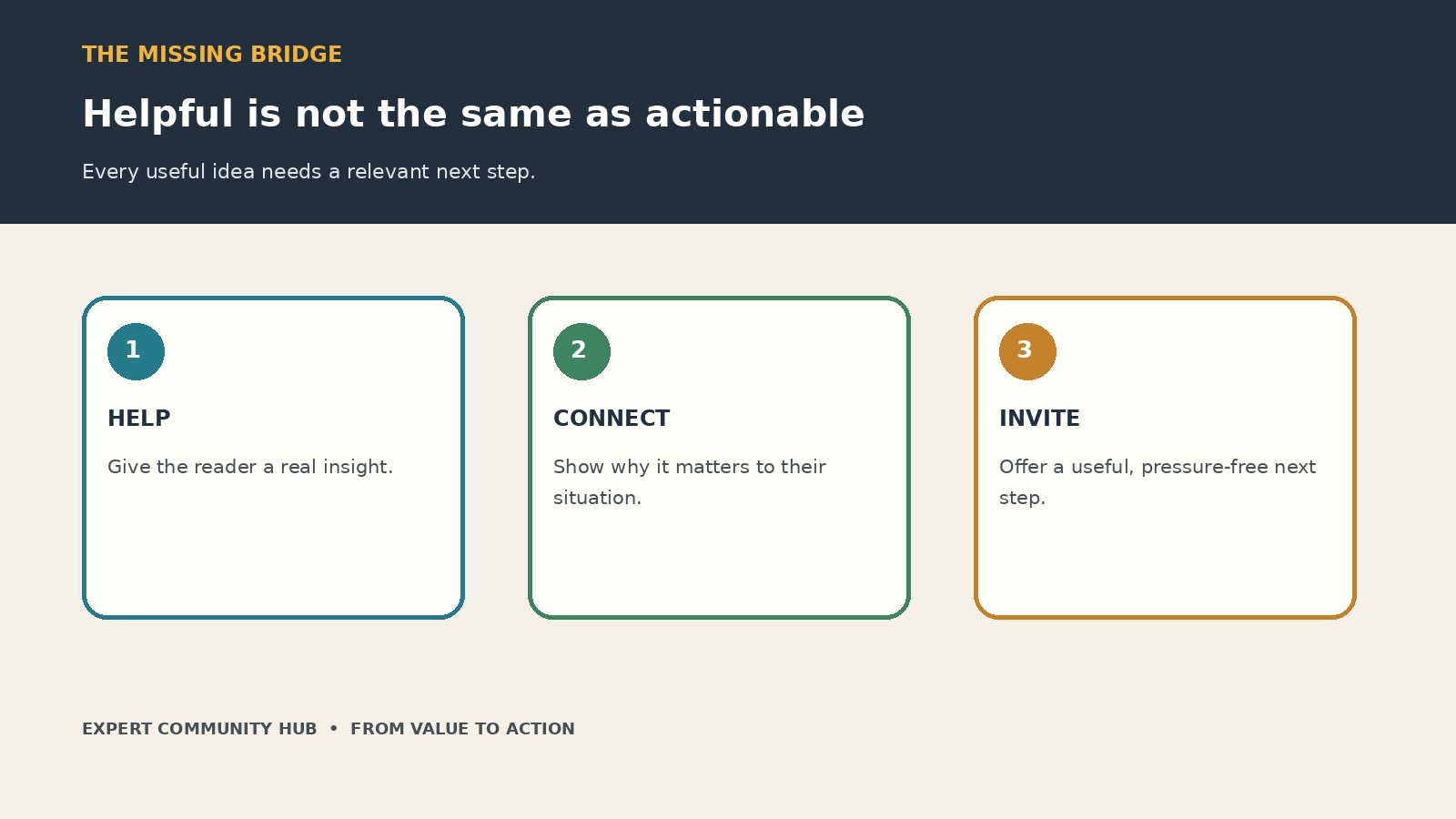
Use this six-step method to connect useful content to a natural next step.
B — Begin with one real problem
Start with a question your audience actually faces.
For example: “Why do enquiries go cold after someone asks about your service?”
A focused problem makes it easier to create useful content and choose an appropriate follow-up resource.
R — Respond with genuine value
Teach something the reader can use. Explain the reason behind the problem, show an example, or offer a practical step.
Do not make the content artificially incomplete just to force people into your funnel. Trust grows when the free advice is genuinely helpful.
I — Identify the reader's likely next need
After learning the first lesson, what might the reader need next?
They may need a checklist, a template, a deeper explanation, a chance to practise, or support adapting the idea to their own business.
You do not have to guess perfectly. Use audience questions and feedback to improve your understanding.
D — Direct them to one relevant next step
Choose a next step that naturally follows the content.
A post about a specific workflow might lead to a checklist. A detailed topic might lead to a workshop. A post about your service process might link to a page explaining how you work.
One clear invitation is often easier to act on than a long list of unrelated links.
G — Give people a choice
Make the invitation transparent and pressure-free.
Explain what the resource or event contains. If it is a paid service, make that clear. If someone is not ready, let them continue learning without making them feel they have failed.
E — Evaluate what happens
Notice whether readers use the resource, ask better questions, register for the workshop, or enquire about your service.
Do not judge every post only by immediate sales. Some content builds understanding over time. Look for patterns across several pieces of content.
Three useful next steps that do not feel pushy
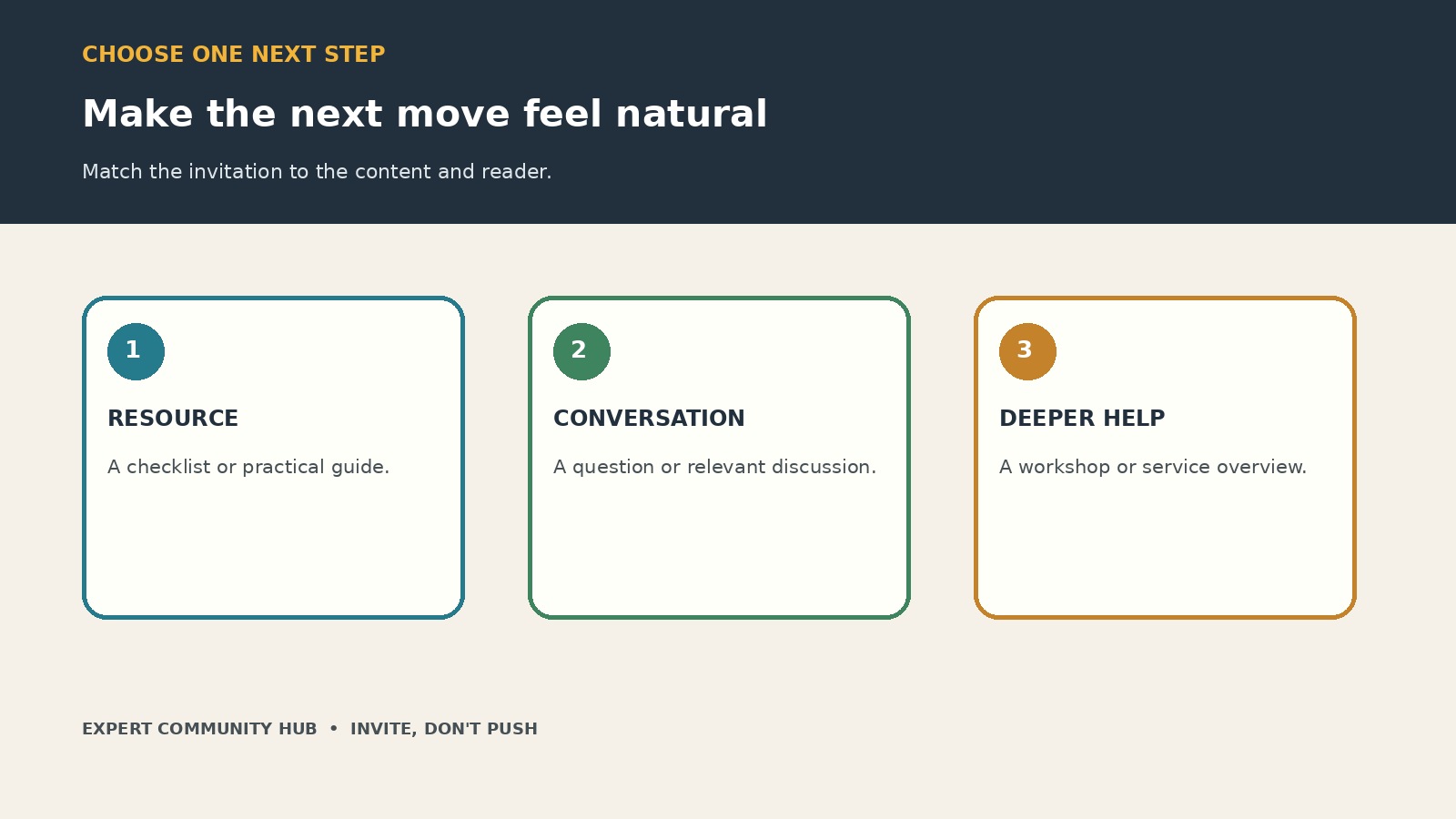
1. Offer a practical resource.
A checklist, worksheet, or short guide can help readers put your advice into action. Make sure it directly relates to the post and delivers what you promise.
2. Start a meaningful conversation.
Ask a specific question, invite readers to share their challenge, or offer a place to discuss the topic. Respond helpfully rather than treating every answer as a sales lead.
3. Offer deeper support when it fits.
If the topic connects naturally to a workshop, service, or community, explain what people can learn there and who it is designed for. Let them decide whether it suits their needs.
An example: from helpful post to useful journey
Suppose you help coaches improve their client-acquisition process.
You publish a post explaining why follow-up messages often fail.
The post gives three reasons and shows a simple example of a more helpful message. At the end, you invite readers to download a follow-up checklist.
The checklist helps them review their current process. Inside it, you explain that people who want more guidance can attend a workshop about building a consistent enquiry workflow.
At the workshop, you teach a practical method and explain your paid support option for people who want help implementing it.
Notice what happens here:
- The original post provides real value.
- The checklist helps readers apply the idea.
- The workshop offers deeper learning.
- The paid service is presented as an option, not a forced conclusion.
Not everyone will continue. That is fine. Each step is useful in its own right, and interested readers can choose how far they want to go.
The one-post, one-next-step rule
Before publishing a post, finish these three sentences:
This post helps the reader…
Name the problem, question, or task it addresses.
After reading, they may want to…
Identify a natural next need, if there is one.
So I will invite them to…
Choose one relevant action—or decide that no invitation is needed for this post.
Sometimes the right next step is simply to reflect or try the advice. Sometimes it is to read another article. Sometimes it is to explore a service.
The invitation should serve the reader, not just your conversion target.
Your 20-minute content journey audit
Choose one recent post that performed well or generated thoughtful responses.
Minutes 1–5: Write down the main problem the post helps solve.
Minutes 6–10: Imagine a reader who found it genuinely useful. What question might they ask next?
Minutes 11–15: Choose one relevant next step: a resource, related article, discussion, workshop, or service page.
Minutes 16–20: Add a short invitation to the post or create the resource if it does not exist yet. Make sure the destination matches what you promise.
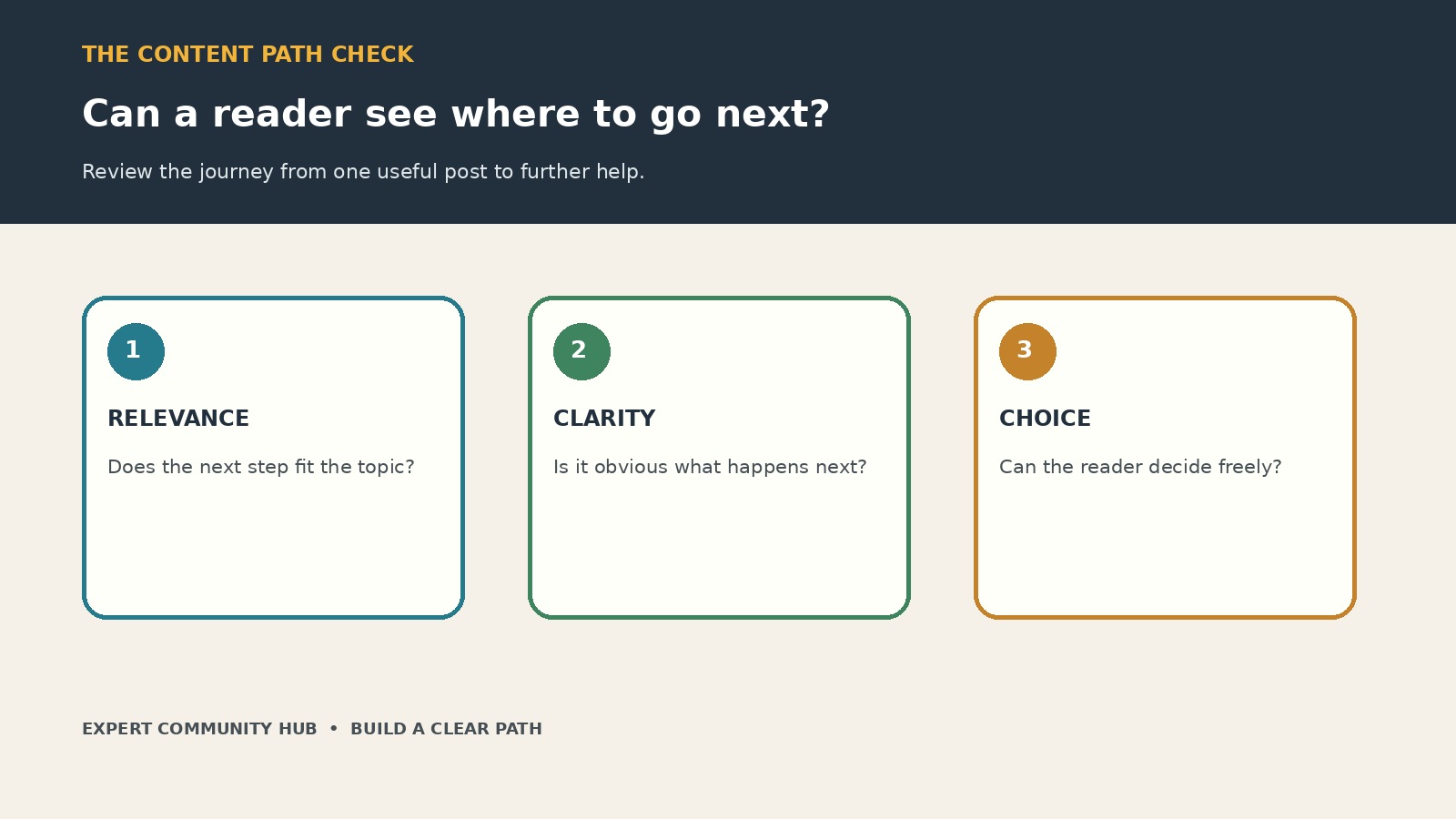
Then review the experience as a reader. Is the next step obvious? Is it genuinely useful? Can someone decline without feeling pressured?
If the answer is yes, your content is doing more than attracting attention. It is helping people move forward.
A final reminder: value first, direction second
You do not owe every reader a sales pitch. You do owe them honesty about what you are offering.
Give useful advice freely. Make your deeper resources easy to find. Explain your paid services clearly. Respect the reader's choice.
The goal is not to turn every interaction into revenue. It is to avoid leaving interested people at a dead end when a relevant next step could help them.
Your turn
When someone finishes reading your content, what is the most useful next step you can offer them—another lesson, a practical resource, a conversation, or deeper support?
Share your answer in the comments. You may give another expert an idea for making their content more useful.
Your next step
If you are a coach, consultant, or knowledge-based professional, Expert Community Hub can help you explore how to communicate your expertise, clarify your offer, and build a more structured approach to client acquisition.
Keep your free content valuable. Then build a clear, honest path for the people who want to take the next step.
Written for coaches, consultants, and knowledge-based entrepreneurs by Expert Community Hub.