
You can be excellent at what you do and still be overlooked. Learn how to make your expertise easier for the right people to discover, understand, and act on.
You may be very good at what you do. But the people who need your help may not know you exist.
You have knowledge. You have experience. You have solved problems that once felt difficult.
People who already know you may trust your advice. Friends may recommend you. Former colleagues may tell you that you should start a business around your expertise.
Yet your enquiries remain inconsistent.
You publish occasionally. You join new platforms. You update your profile. You try to explain everything you can do.
Still, the right people do not seem to find you.
This can make you question your skills. You may wonder whether your expertise is valuable enough or whether you need to learn another marketing tactic.
But there is another possibility:
Your expertise may not be the problem. Your discoverability may be.
People cannot choose you if they cannot find you, understand what you help with, or see a sensible next step.
The hidden frustration of being good but overlooked
Experts often spend years building their capability. They learn, practise, solve problems, and improve their craft.
But visibility requires a different set of habits.
It asks you to explain your work clearly. It asks you to show up where relevant people already spend time. It asks you to publish useful ideas consistently enough for people to recognize your expertise.
These activities can feel uncomfortable. They may even seem less important than improving your skills.
So you keep learning. You refine your website. You collect more certifications. You wait until your message feels perfect.
Meanwhile, a less experienced person with clearer positioning may be easier to understand and easier to contact.
This does not mean presentation is more important than competence. It means competence and discoverability solve different problems.
Your expertise helps you deliver value. Your visibility helps the right people discover that value.
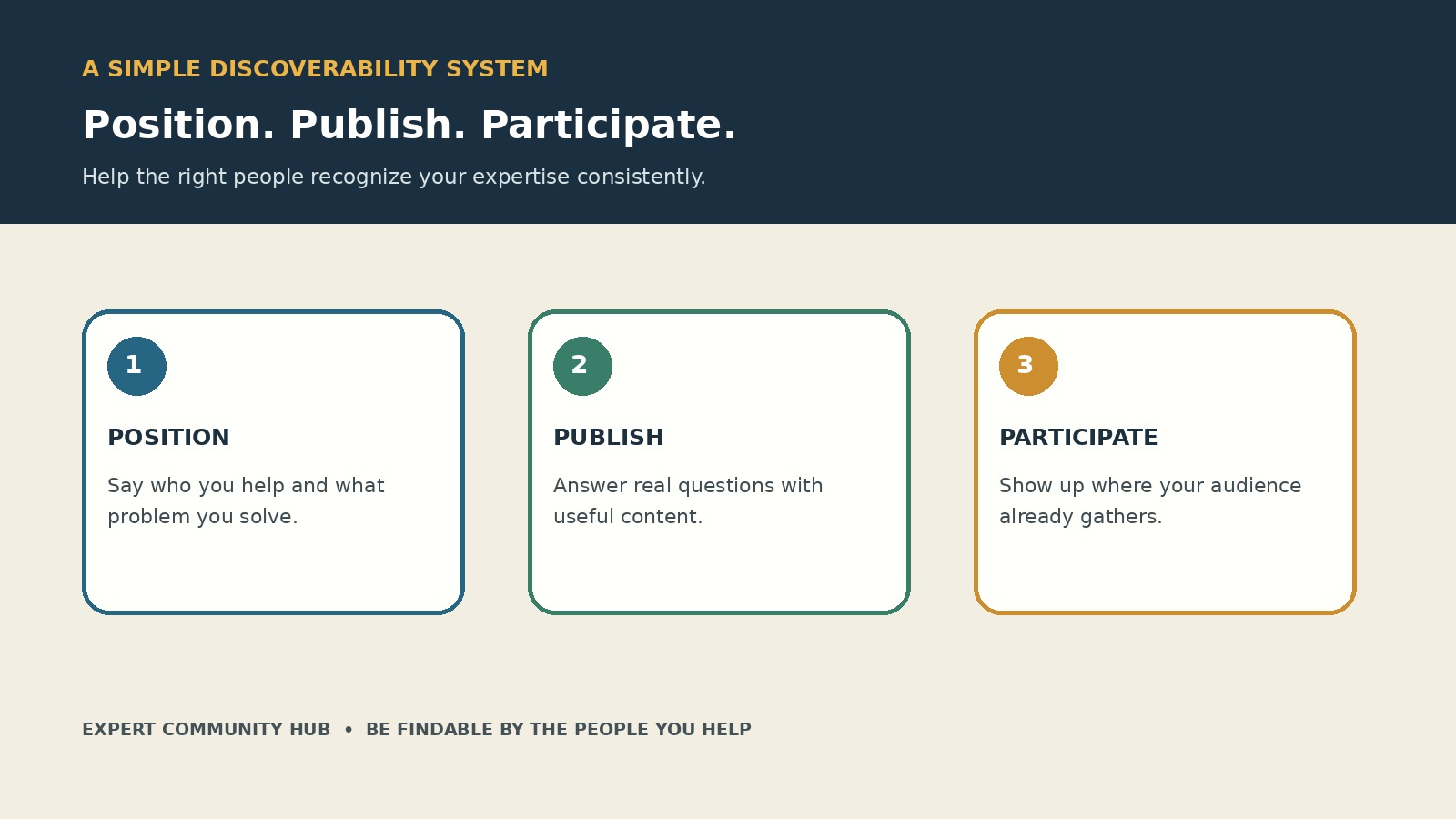
Three reasons the right people may not find you
1. Your message is too broad
If your profile says you help people with business, mindset, marketing, growth, and success, a potential client may struggle to identify where you fit.
You do not need to hide your range of skills. But lead with the problem you most want to be known for solving.
2. Your presence is scattered
You may post on several platforms, start a newsletter, join communities, and experiment with video—without building a consistent signal anywhere.
Being everywhere is not the same as being discoverable. A focused presence in one or two relevant places may be more useful than a thin presence across every channel.
3. Your content has no clear path forward
Someone may enjoy your post but still have no idea what you offer, who you help, or how to take the next step.
Every post does not need a sales pitch. But your overall presence should make it easy to move from useful information to a relevant resource, conversation, or service page.
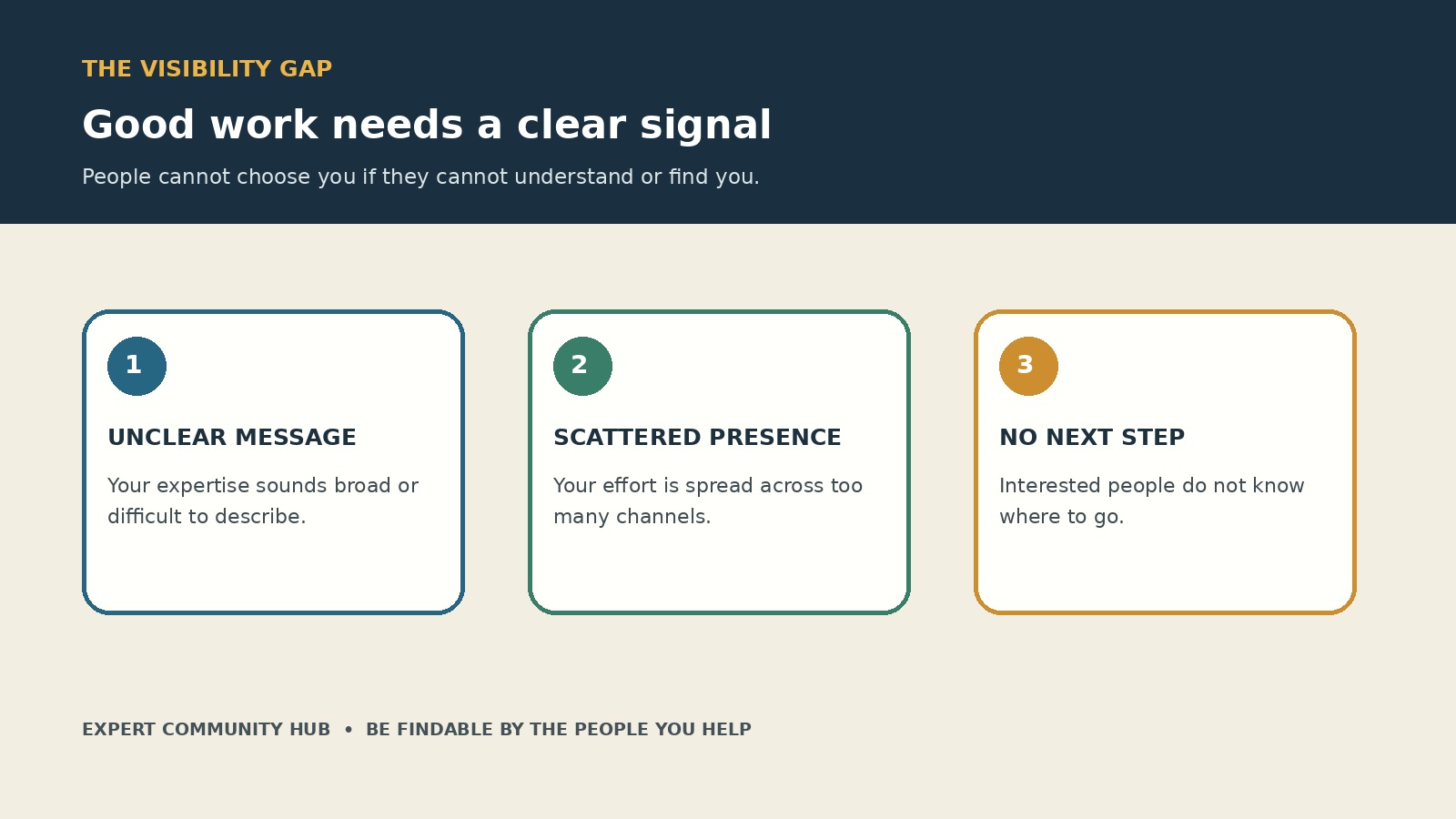
The Discoverability System: Position, Publish, Participate
You do not need to become famous. You need a practical way for suitable people to encounter your work and understand why it may matter to them.
1. Position: make your expertise easy to describe
Write a simple statement:
“I help [specific audience] work on [specific problem] through [your process].”
For example:
“I help independent coaches create a clearer process for turning enquiries into client conversations.”
Use this statement to guide your profile, website introduction, and content topics. Adjust it as you learn more about your audience.
Avoid claiming to be the best or promising outcomes you cannot guarantee. Clarity and credibility are stronger foundations than inflated claims.
2. Publish: answer the questions your audience already asks
Make a list of questions potential clients ask before they seek help.
What confuses them? What mistakes do they make? What have they tried? What do they worry about? What do they need to understand before making a decision?
Choose one question and answer it clearly. Use a blog post, short video, email, carousel, or another format you can sustain.
Helpful content creates a record of how you think. Over time, that record can help people recognize your approach and decide whether it fits their needs.
3. Participate: show up where relevant people already gather
Do not rely only on publishing and waiting.
Join relevant professional discussions. Attend useful events. Contribute thoughtful answers. Build relationships with people who serve a similar audience. Participate in communities where your knowledge is genuinely relevant.
The goal is not to turn every interaction into a pitch. Be useful first. When someone expresses a need you can help with, ask permission before moving into a sales conversation.
Build a simple path from discovery to action
Imagine that someone discovers one of your articles today.
What happens next?
Can they quickly understand who you help? Can they find a short explanation of your service? Is there a useful resource or a clear way to contact you? Does your next step feel relevant rather than confusing?
You do not need a complicated funnel to begin. A simple path could be:
- A useful post helps someone recognize a problem.
- Your profile or website explains who you help.
- A focused page describes your offer and how it works.
- The person can ask a question, register for a workshop, or request a conversation.
Check this path from the perspective of a first-time visitor. Remove unnecessary steps and unclear language.
You do not need to be visible everywhere
A common mistake is treating every new platform as a new opportunity you must pursue.
Instead, choose channels based on where your intended audience looks for information and whom they trust. Your best starting point may be a professional network, a relevant community, search-friendly articles, local business groups, referrals, or educational events.
Test your choice. Pay attention to the quality of the responses, the effort required, and whether the channel helps you build genuine relationships.
You can expand later when you have a repeatable process. For now, consistency in a relevant place is often more manageable than constant platform switching.
Your 20-minute visibility reset
Set aside 20 minutes today.
Minutes 1–5: Write one sentence describing who you help and the problem you help them address.
Minutes 6–10: Review your main profile or website introduction. Make sure it communicates that sentence clearly.
Minutes 11–15: List five questions your intended audience frequently asks. Choose one to answer in your next post.
Minutes 16–20: Identify one relevant community, event, or professional conversation where you can contribute something useful this week.
Small actions can make your expertise easier to discover. You do not need to rebuild your entire brand in one sitting.
Measure discoverability, not just popularity
Follower counts and impressions can show whether your content is reaching people. But they do not tell the whole story.
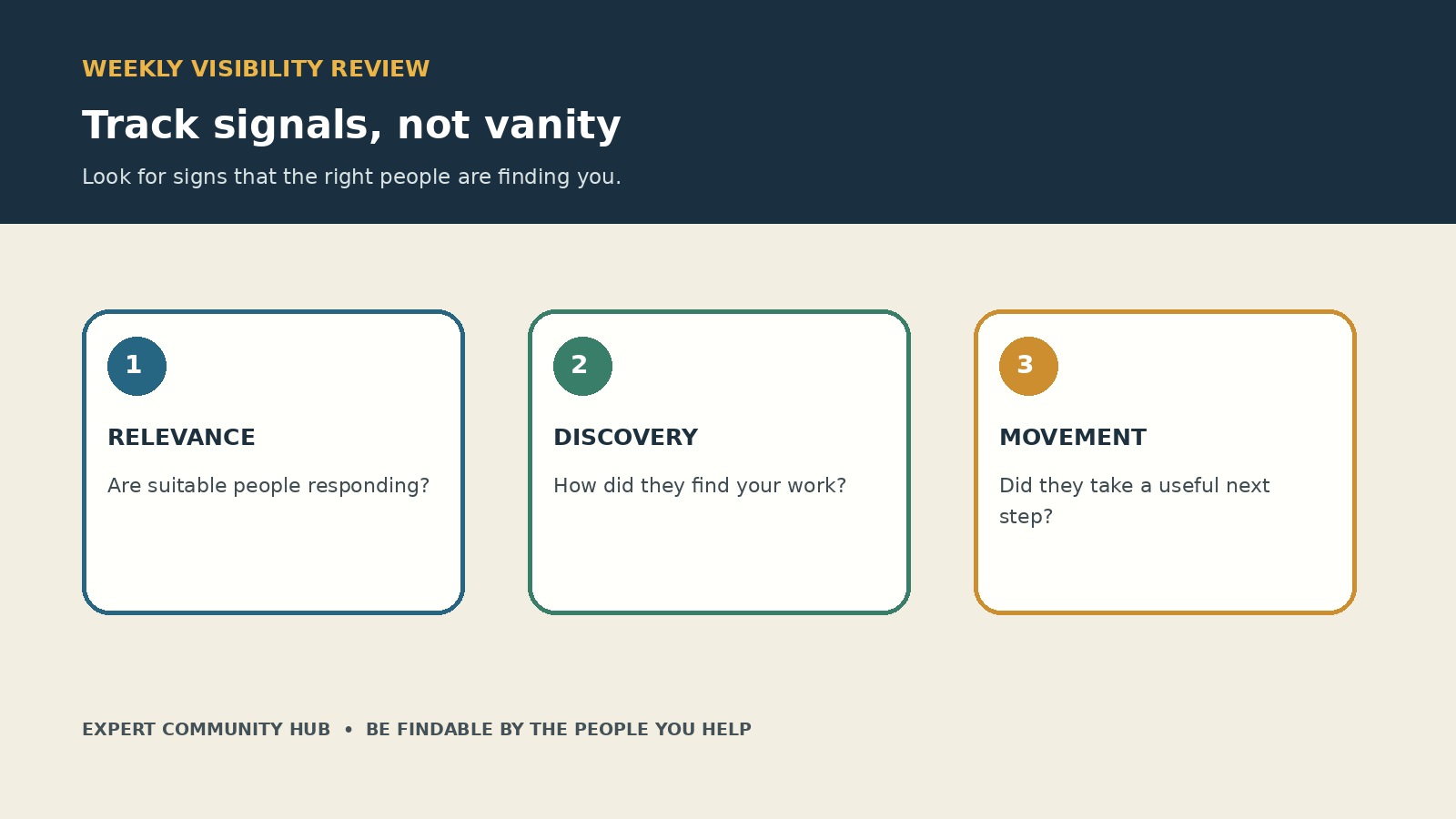
Track signals that connect more closely to your goal:
- Are people from your intended audience viewing or responding to your content?
- Are they asking more specific questions?
- Are visitors exploring your service or resource pages?
- Are people mentioning a post, referral, or event when they contact you?
- Are suitable prospects taking the next step?
You can ask new enquiries, “How did you first hear about my work?” Record the answer. Over time, you may discover that a small number of channels generate more relevant conversations than others.
Use this information to decide where to focus—not to chase every metric.
Your expertise deserves a clear path to the people who need it
You do not have to become an influencer to be discoverable.
You need a clear message, useful content, relevant relationships, and an easy next step. You need to repeat these actions long enough to learn what works for your audience.
There will still be quiet periods. Visibility is not an instant fix for every business challenge. Your offer, timing, trust, pricing, and sales process also matter.
But when the right people can find you and understand your value, you give your expertise a better chance to create opportunities.
Your turn
If someone discovered your profile or website today, would they immediately understand who you help and how—or would they need to figure it out themselves?
Share one change you could make to become easier to find or understand. Your idea may help another expert improve their visibility too.
Your next step
If you are a coach, consultant, or knowledge-based professional, Expert Community Hub can help you explore how to communicate your expertise, clarify your offer, and build a more structured approach to client acquisition.
Start by making your message clearer, answering one real audience question, and showing up where the right people already gather.
Written for coaches, consultants, and knowledge-based entrepreneurs by Expert Community Hub.