
You attract enquiries, but too many conversations go cold. Learn how to follow up consistently, provide value, and agree on next steps without sounding pushy.
You work hard to attract enquiries. Then some of the most promising conversations quietly disappear.
A person downloads your guide. Someone attends your webinar. Another prospect asks about your coaching service.
You reply. You share details. You wait.
A few people respond. Many do not.
Your first thought may be that you need more leads. More ads. More content. More webinars. More people entering the funnel.
But before you spend more time and money attracting new prospects, ask a different question:
Are you following up consistently with the people who have already shown interest?
Sometimes the issue really is lead quality or offer fit. But often, promising conversations get lost because there is no clear system for remembering context, answering questions, and agreeing on the next step.
The hidden cost of inconsistent follow-up
When you manage enquiries through memory, scattered messages, and occasional reminders, it is easy to lose track.
You forget who asked for a proposal. You send the same generic message to everyone. You contact someone without remembering what they were interested in. Or you wait too long because you do not want to seem pushy.
The result is frustrating for both sides.
You lose visibility into your pipeline. The prospect may feel forgotten—or may have moved on because they were unsure what to do next.
Follow-up is not about chasing every person until they buy. It is about providing a useful continuation to a conversation that the person has shown interest in having.
Why prospects go quiet
There is rarely one explanation for silence. A prospect may be busy, uncertain, comparing options, dealing with a different priority, lacking budget, or simply no longer interested.
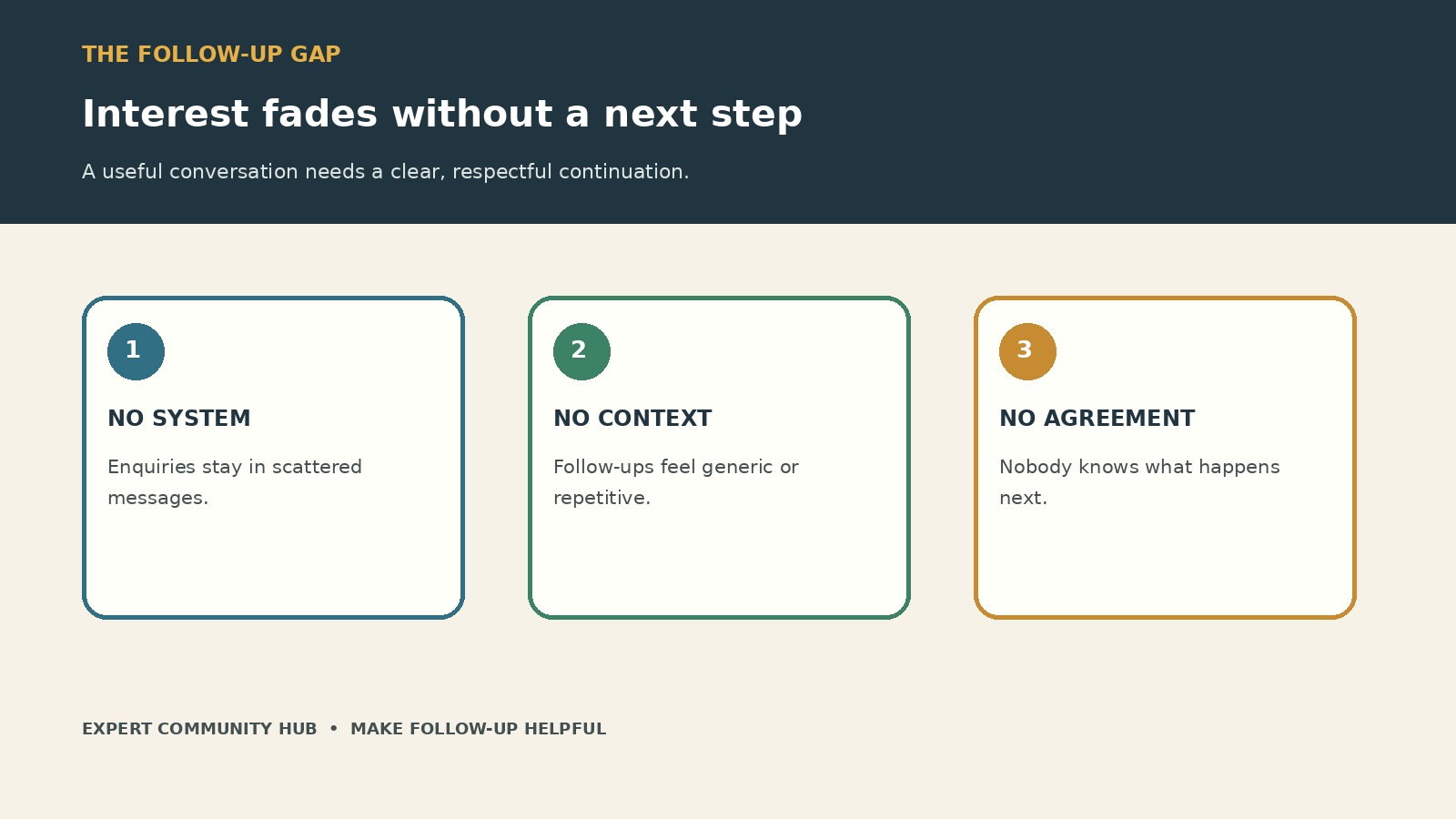
Three avoidable problems can make the situation worse.
1. There is no system
You rely on memory instead of recording who needs what and when a follow-up is appropriate.
2. Your messages have no context
“Just checking in” does not remind the person why you are contacting them or help them make a decision.
3. The next step was never clear
You send information but do not establish whether the person wants to reconnect, review a proposal, attend a session, or close the conversation.
You cannot control every response. But you can make your own process more thoughtful and reliable.
The CARE Follow-Up Framework
Use this simple four-part approach to make follow-up more helpful and less awkward.
C — Capture the context
Record what the person asked about, the problem they mentioned, the resource or offer they showed interest in, and any timing or preference they shared.
You do not need a complicated CRM to begin. A simple, access-controlled spreadsheet or customer management tool may be enough. Record only relevant information and handle personal data responsibly.
A — Acknowledge the conversation
Refer to the actual interaction. Thank them for attending, asking a question, or sharing their situation.
For example:
“Thanks for joining the workshop. You mentioned that keeping track of enquiries is a challenge. I hope the follow-up checklist is useful.”
This feels more human than a message that could have been sent to anyone.
R — Respond with something relevant
If you can help clarify a concern, answer it directly. Share a resource that matches the person's question. Explain a part of your service that they asked about.
Do not send extra material just to keep your name in their inbox. Relevance is more valuable than volume.
E — Establish the next step
Where appropriate, ask whether they would like to continue the conversation and agree on a suitable next step.
For example:
“Would it be useful to discuss how this might fit your situation, or would you prefer to revisit it later?”
If they say no, ask not to be contacted, or do not wish to continue, respect that. A healthy follow-up process includes a clear way to stop.
A practical follow-up rhythm
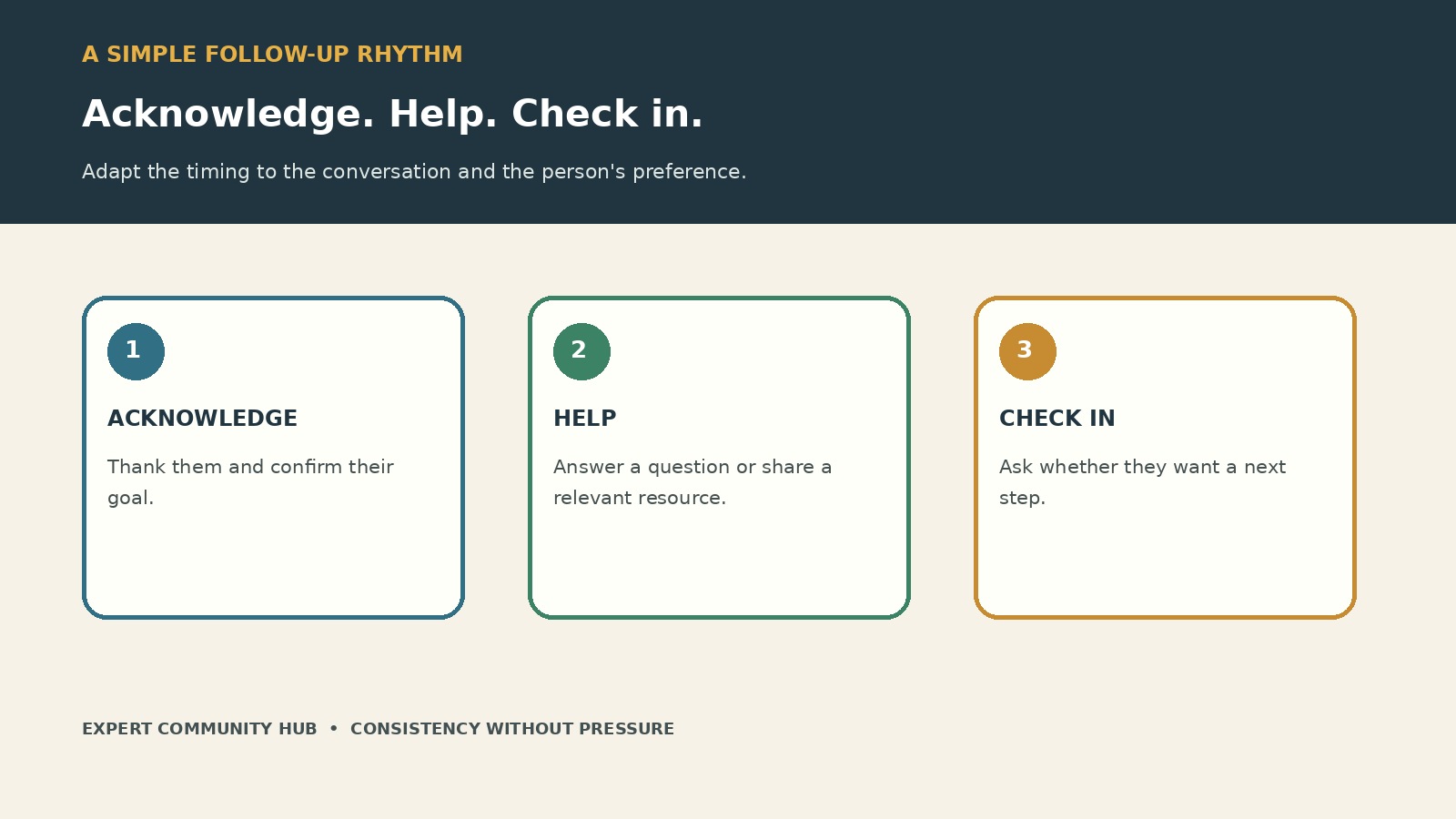
There is no single schedule that works for every lead. Follow the person's stated preferences, the context of the enquiry, and any applicable messaging or consent rules.
A simple starting point:
After the first interaction: Send the promised resource or requested details promptly.
After they have had a reasonable chance to review it: If follow-up is welcome, ask whether they have questions or need clarification.
If they are considering the offer: Agree on a specific date or event to reconnect rather than repeatedly asking whether they have decided.
If they are not ready: Ask whether they would prefer to hear from you later, receive occasional useful updates, or close the conversation.
If they decline or request no further contact: Thank them and stop promotional follow-up.
This is a flexible guide, not a licence to send repeated messages. The aim is to make communication useful and respectful.
What to say instead of “Just checking in”
A good follow-up message is short, specific, and easy to respond to.
After a webinar
“Thanks for attending the session. You asked about turning enquiries into client conversations. Here's the resource I mentioned. If you have a question after reviewing it, feel free to reply.”
After sending a proposal
“I’m following up on the proposal we discussed. Is there anything you would like clarified about the scope, timeline, or pricing? If the timing has changed, that's completely fine—just let me know.”
When a prospect is not ready
“Thanks for letting me know. Would you prefer to revisit this at a later date, or would you rather I close the loop for now?”
These messages give the person context and control. They do not manufacture urgency or imply that silence means agreement.
Build a simple prospect tracker
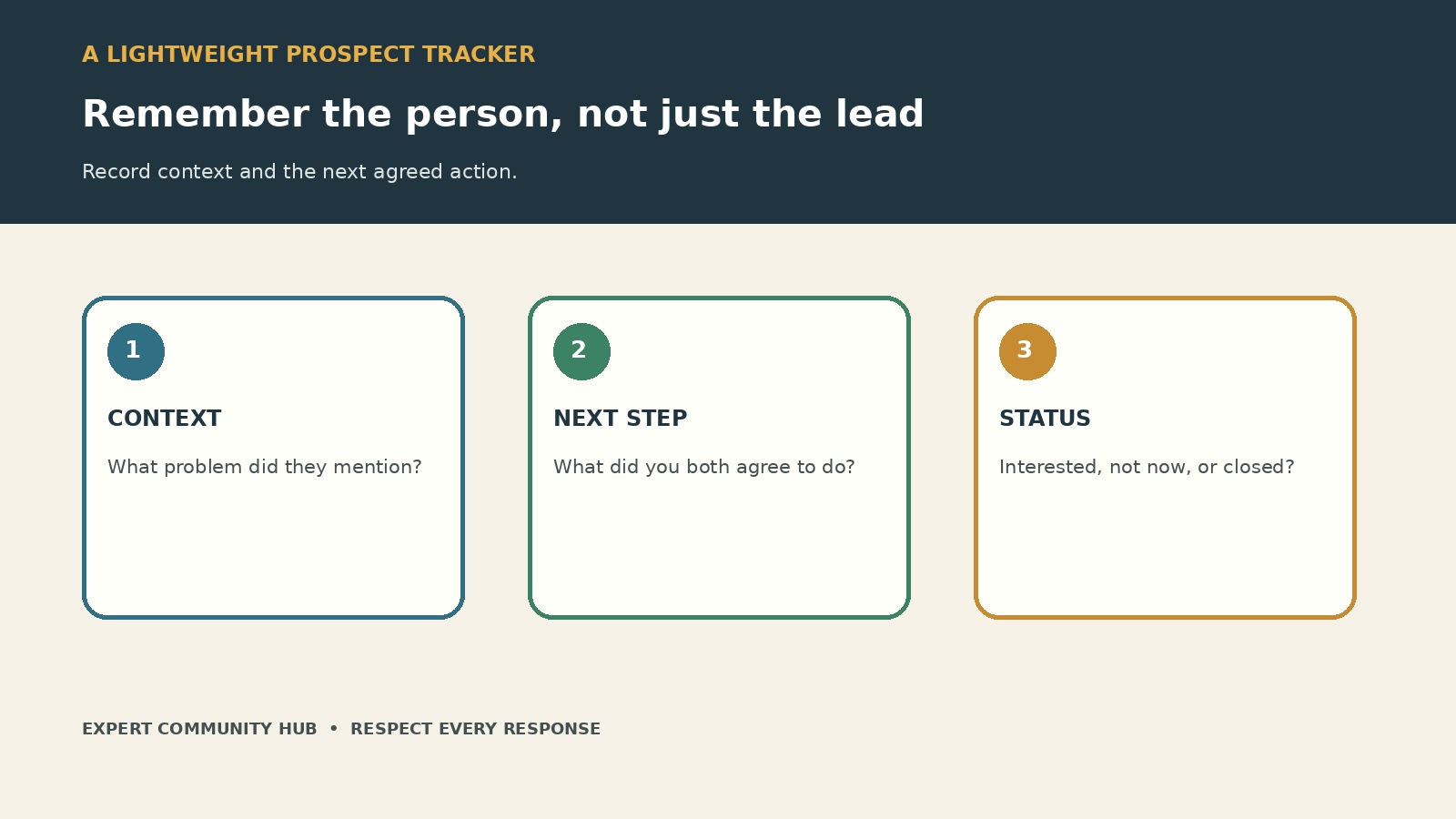
Create one row for each enquiry and keep the information limited to what helps you manage the conversation.
| Field | What to record |
|---|---|
| Name or identifier | Enough to recognize the enquiry |
| Source | Webinar, referral, website, or other channel |
| Main interest | The problem or service they asked about |
| Last interaction | Date and short context |
| Next agreed step | What, if anything, should happen next |
| Status | Open, follow-up agreed, not now, closed |
| Contact preference | Any relevant opt-in or do-not-contact request |
Update the tracker after each meaningful conversation. Review it at a regular time that fits your workflow.
Do not treat every lead as an opportunity to pursue indefinitely. Some enquiries will be unsuitable, some will go elsewhere, and some will not be ready. Marking them accurately helps you focus on the conversations that are genuinely active.
Your 20-minute follow-up reset
You can start without buying software or building an automation.
Minutes 1–5: Review recent enquiries and identify conversations where someone asked for information or agreed to a next step.
Minutes 6–10: Record the context and current status for each one.
Minutes 11–15: Choose one or two appropriate follow-ups. Make each message specific to the conversation and respect the person's contact preferences.
Minutes 16–20: Set a recurring time to review active conversations and close out those that are no longer relevant.
Start small. A simple process you actually use is more valuable than a sophisticated system that is difficult to maintain.
When more leads really are the answer
Follow-up cannot fix everything.
If you consistently contact prospects appropriately but most are not a fit, review the audience and lead source. If people are interested but do not understand your service, clarify the offer. If prospects regularly raise the same concern, investigate whether the offer, pricing, timing, or sales conversation needs improvement.
Track what happens at each stage rather than assuming every lost sale is a follow-up failure.
The goal is to identify the actual bottleneck before increasing your marketing spend.
Your turn
How do you currently track people who enquire about your services—a CRM, a spreadsheet, messages, or your memory? What is the biggest follow-up challenge you face?
Share your experience in the comments. A simple method that works for one expert may help another build a more consistent process.
Your next step
If you are a coach, consultant, or knowledge-based professional, Expert Community Hub can help you explore how to build a clearer client-acquisition process—from attracting suitable enquiries to communicating your offer and following up responsibly.
Before investing in more leads, make sure the conversations you already have are being handled with clarity, consistency, and respect.
Written for coaches, consultants, and knowledge-based entrepreneurs by Expert Community Hub.