
You wanted more control over your time. Now every client, decision, and task seems to depend on you. Learn how to design a business that supports your life instead of consuming it.
You left the traditional path to gain more control over your life. So why does your business seem to own every hour of it?
You imagined choosing your schedule.
More time with family. More meaningful work. The freedom to take a day off without feeling that everything might fall apart.
Then the business began to grow.
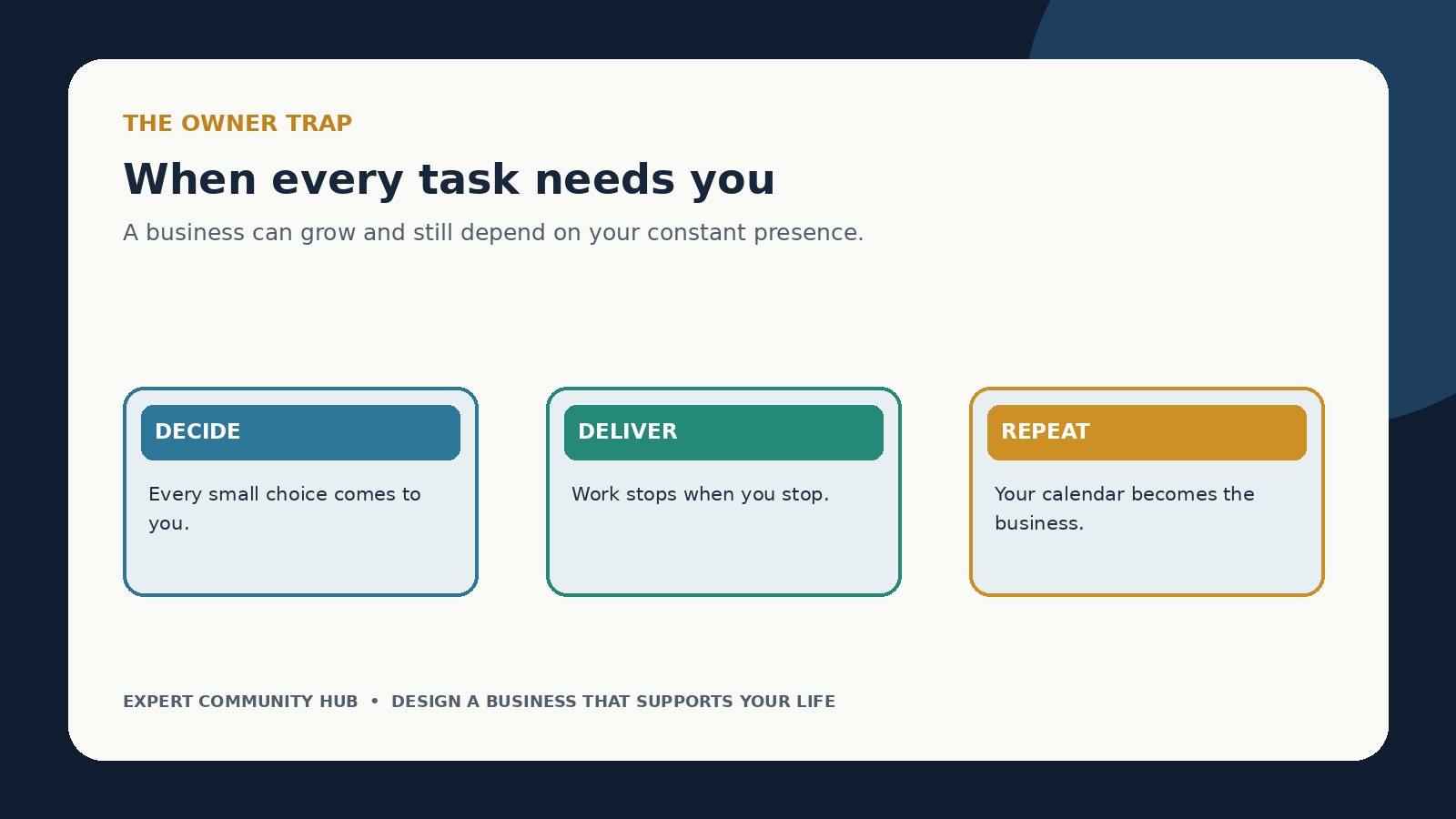
Client calls filled the calendar. Messages arrived at all hours. Content needed to be created. Proposals needed to be sent. Payments needed to be tracked. Every new client brought more work—and more decisions that only you seemed able to make.
You became the marketer, salesperson, coach, administrator, tech support, and problem solver.
You are technically your own boss.
But you may not feel free.
A business can give you more control over your work while quietly taking control of your time.
The pain of becoming the busiest person in your business
At first, doing everything yourself can feel necessary. You are keeping costs low, learning the process, and making sure clients receive good service.
But over time, the same habit can become a trap.
You may find yourself working evenings because the day was filled with client delivery. You postpone family plans because a launch is coming. You take a break but keep checking messages. Even when revenue improves, your workload does not seem to fall.
This creates a frustrating equation: more clients mean more tasks, and more tasks mean less freedom.
It can also make growth feel risky. If every new client adds hours to your schedule, you may begin to avoid opportunities you once wanted.
The problem is not that you care about your business. The problem is that the business may depend too heavily on your constant presence.
The hidden reason: you built a role, not a system
When you start independently, you often build the business around what you personally do.
You remember every client detail. You write every message from scratch. You make every decision. You handle each step of delivery differently because the process lives in your head.
This can work for a while. But it becomes difficult to repeat consistently.
A system does not mean turning your business into a cold machine. It means deciding how recurring work should happen so you do not have to reinvent it every time.
Ask yourself:
- What do I do repeatedly each week?
- Which decisions come up again and again?
- What information do I keep explaining?
- Which tasks require my expertise—and which only require my attention?
- What stops working when I take a day off?
The answers reveal where your business depends on you unnecessarily.
The Freedom-by-Design framework
You do not need to hire a big team or build complicated automation to start. Begin by redesigning the work you already do.
1. Separate expert work from support work
Your highest-value work might be coaching clients, diagnosing problems, creating strategy, or delivering specialist advice.
Other tasks may include scheduling, sending standard information, organizing files, reminding people about appointments, and recording routine data.
Both kinds of work matter. But they do not always need the same level of personal attention.
List your recurring tasks and identify which ones genuinely require your judgment or expertise.
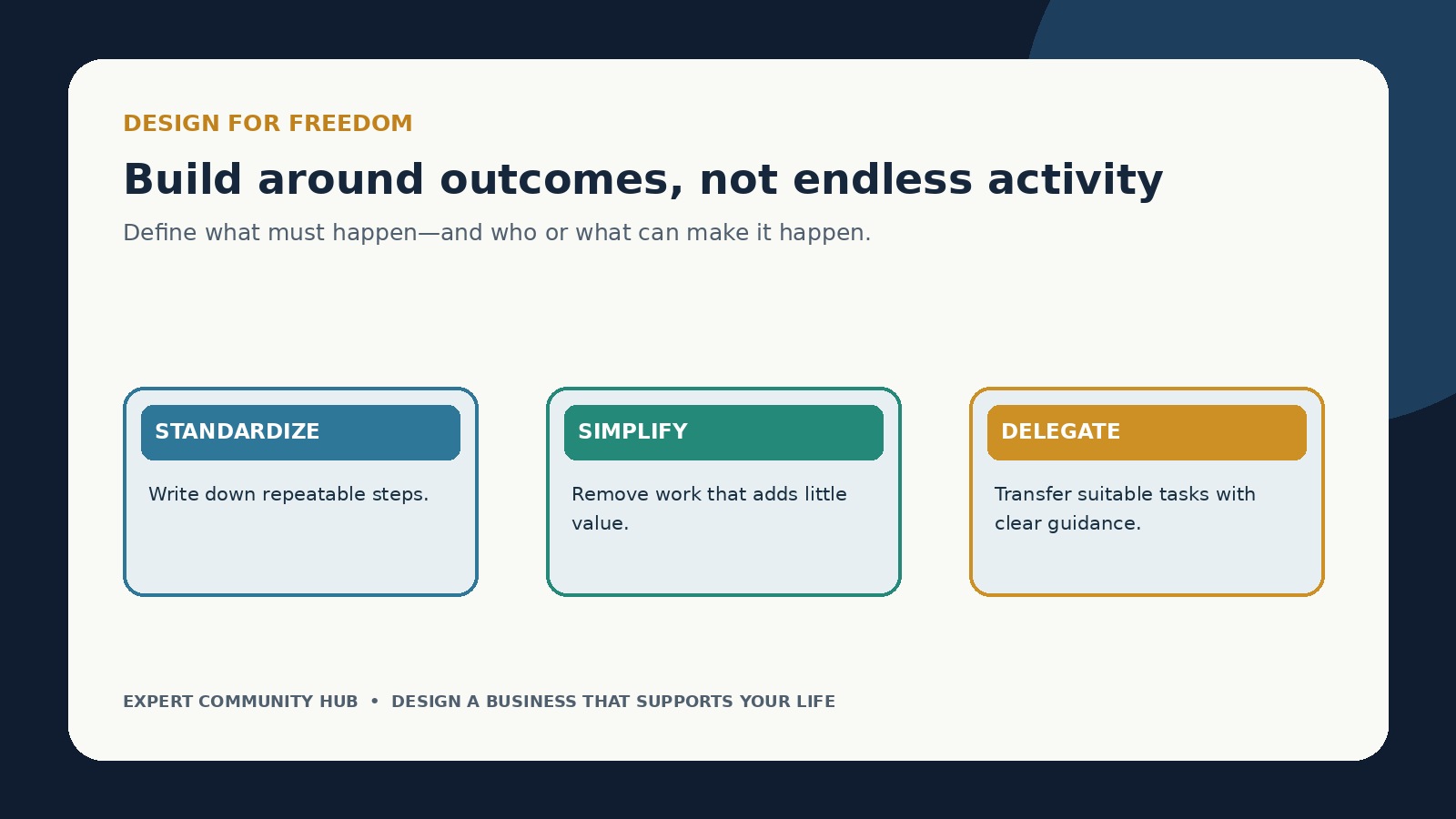
2. Standardize what repeats
If you answer the same question every week, create a clear resource.
If you repeat the same onboarding steps for every client, write a checklist.
If you prepare similar proposals, create a template that you can personalize.
If you publish regularly, develop a simple content workflow.
Standardization reduces repeated decisions. It also makes the experience more consistent for clients.
3. Simplify before automating
Technology can help, but automating an unnecessarily complicated process can make it harder to manage.
First remove steps that do not add meaningful value. Then make the remaining process clear. Finally, consider whether a tool can reliably handle a repetitive part of the workflow.
Start with one small process. Test it. Keep it only if it saves time or improves the client experience.
4. Delegate with clarity
Delegation does not always mean hiring a full-time employee. It might mean using a contractor for a defined task, asking a team member to own a process, or giving clients a self-service resource for routine questions.
Explain the expected outcome, the steps, the boundaries, and when a problem should come back to you.
Do not expect someone else to read your mind. A documented process makes good delegation more likely.
You do not have to remove yourself from everything
Your expertise may be the central reason clients choose your service. Some work should remain personal.
The goal is not to make yourself irrelevant. It is to protect your attention for the work where your experience makes the biggest difference.
For a coach, that might mean keeping client conversations personal while systemizing booking, onboarding, reminders, resource delivery, and feedback collection.
For a consultant, it might mean personally leading the strategic decisions while using templates and documented workflows for recurring reports and administration.
For a course creator, it might mean teaching and mentoring while improving how people enroll, access materials, and get support.
Design around the client outcome. Keep the human moments that matter. Reduce unnecessary friction around them.
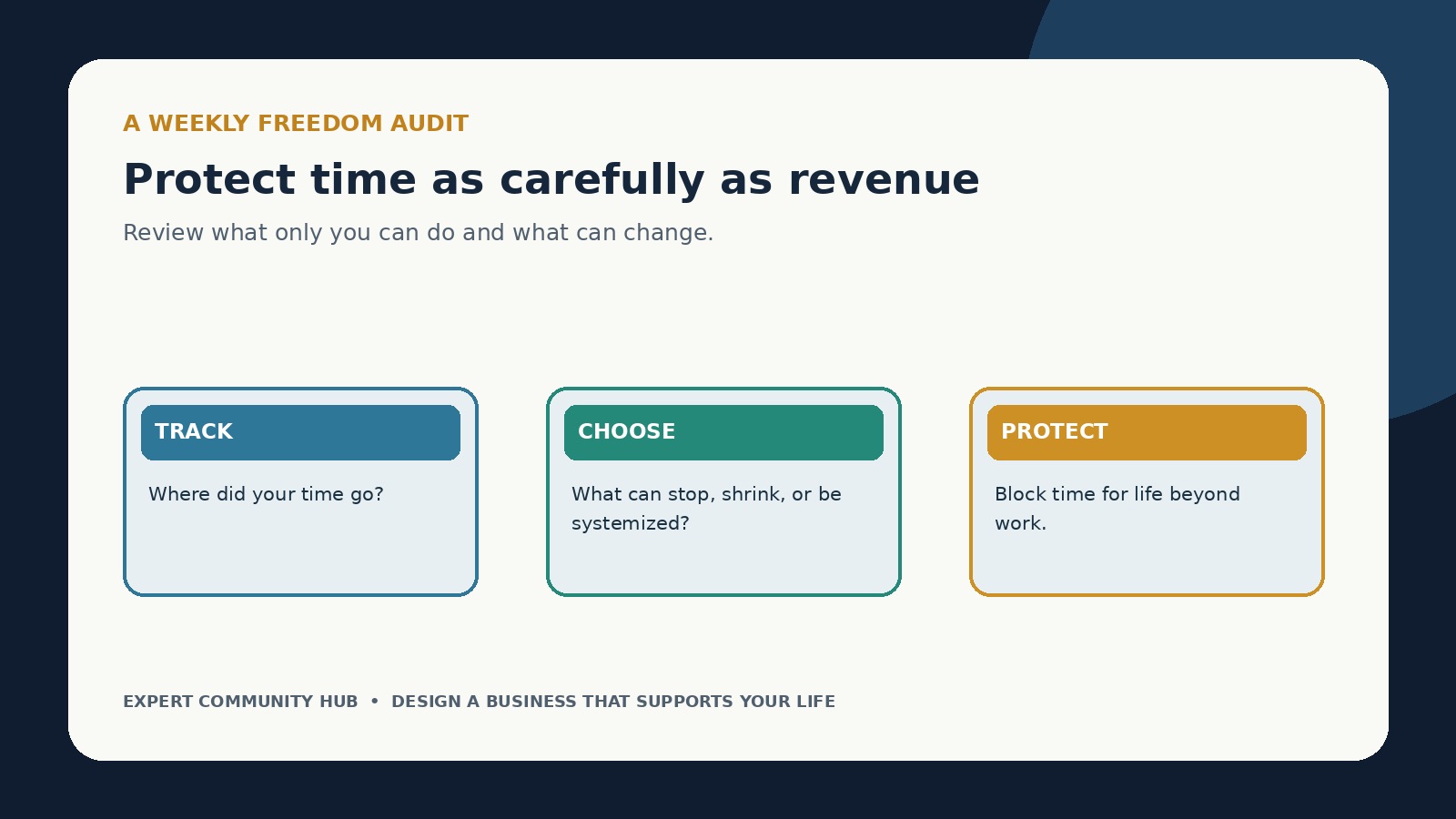
Your 30-minute weekly freedom audit
Take a look at your last seven days.
Minutes 1–10: Track your time. List the main activities that occupied your week. Estimate the time spent on client delivery, marketing, administration, follow-up, and unexpected tasks.
Minutes 11–15: Find the owner bottleneck. Circle the tasks that could not move forward without you. Which truly needed your expertise? Which depended on you only because no process existed?
Minutes 16–20: Choose one change. Pick a recurring task to simplify, document, stop, or delegate. Avoid trying to redesign the entire business at once.
Minutes 21–30: Put it into practice. Write a short checklist, prepare a template, block a recurring time slot, or define a task for someone else to own.
Then review the result next week. Did the change save time? Did quality remain strong? What needs adjustment?
Protect the life your business was meant to support
Freedom is not only the ability to work from anywhere. It can also mean having the time and attention to be present with people you care about, pursue interests, rest, and choose which opportunities deserve your energy.
If those things matter to you, treat them as part of the design—not as rewards you will earn after the business becomes successful.
Choose boundaries you can realistically maintain. Set working hours where possible. Protect time for family or personal commitments. Define what counts as a genuine emergency. Review whether your offers, pricing, and delivery commitments fit the capacity you actually have.
A business model that requires you to be available all the time may need redesigning, even if it produces revenue.
Your turn: one question to change your week
You do not have to fix everything today.
Start by asking:
“If I had to take one full day away from my business next week, what would break first—and what could I change to prevent it?”
Your answer can reveal the first system worth improving.
Share your biggest owner bottleneck in the comments. Is it client delivery, marketing, follow-up, administration, or making every decision yourself?
Your next step
If you are a coach, consultant, or knowledge-based professional, Expert Community Hub helps you explore how to turn your expertise into a clearer offer and a more structured business.
Start with one recurring task. Make it easier to repeat. Protect a small block of time. Build a business that supports the life you want—not just a calendar that stays full.
Written for coaches, consultants, and knowledge-based entrepreneurs by Expert Community Hub.