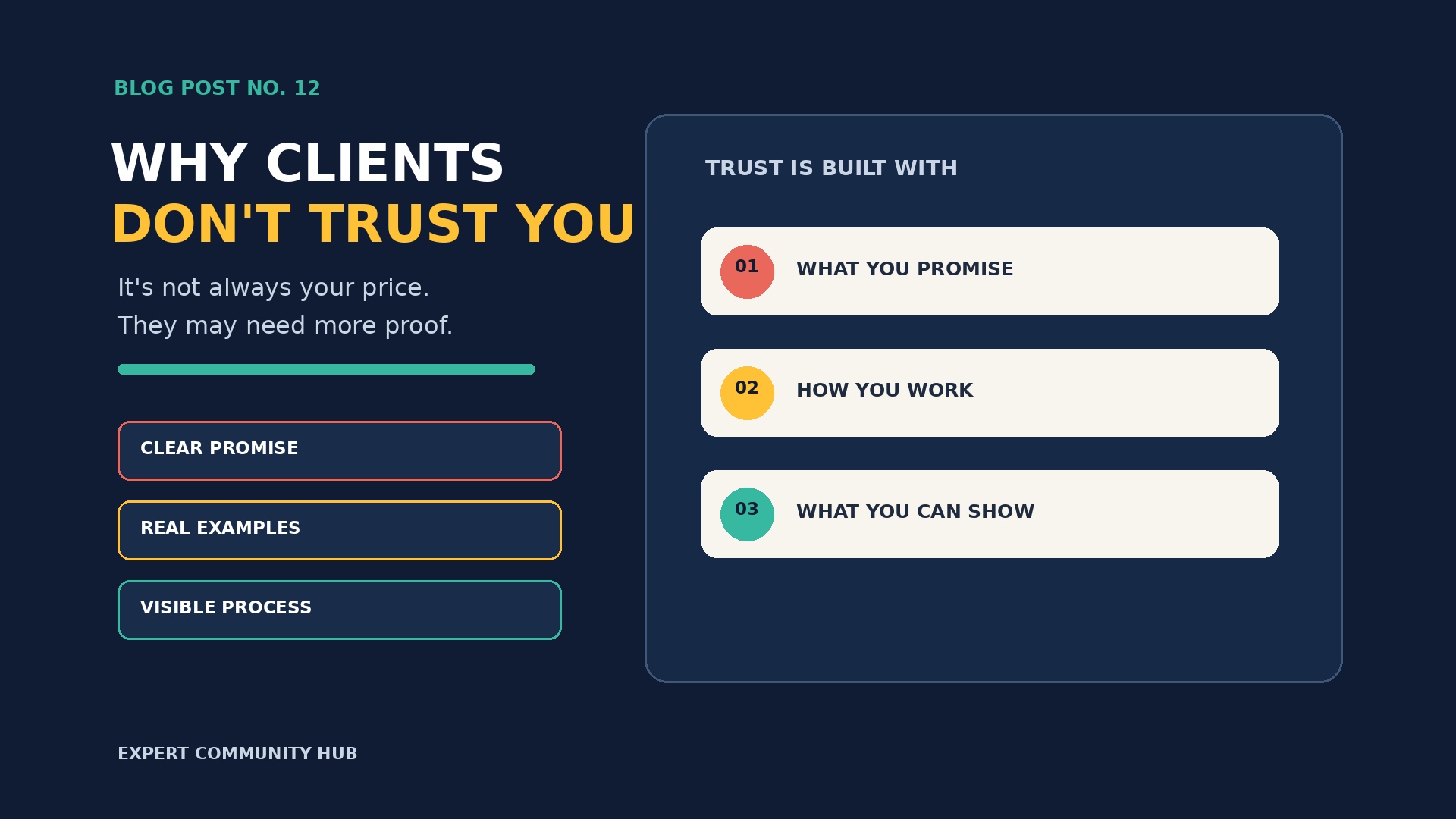
Potential clients may like your content and still hesitate to hire you. The missing piece may be trust. Learn how to make your process, proof, and promises clearer without using hype.
Someone reads your posts. They watch your videos. They may even tell you your advice is helpful.
But when it is time to hire you, they hesitate.
They say, "Let me think about it."
Then the conversation goes quiet.
What happened?
It may not be your price. It may not mean your expertise is weak.
They may not have enough evidence to feel confident about taking the next step.
By Dharmendra Singh | Expert Community Hub
The pain behind the silence
You know you can help people.
You have studied your subject. You have invested time and money in learning. You have developed methods that you believe can make a difference.
So when a potential client hesitates, it can feel personal.
You may wonder whether your offer is wrong. You may lower your price. You may add more bonuses. You may make bigger promises.
But trust is not built by adding more words or making louder claims.
People want to understand what they are buying. They want to know how you work. They want realistic expectations. They want a reason to believe your service fits their situation.
Your job is not to convince everyone.
It is to help the right people make an informed decision.
The trust gap: what you say versus what they can see
Consider this statement:
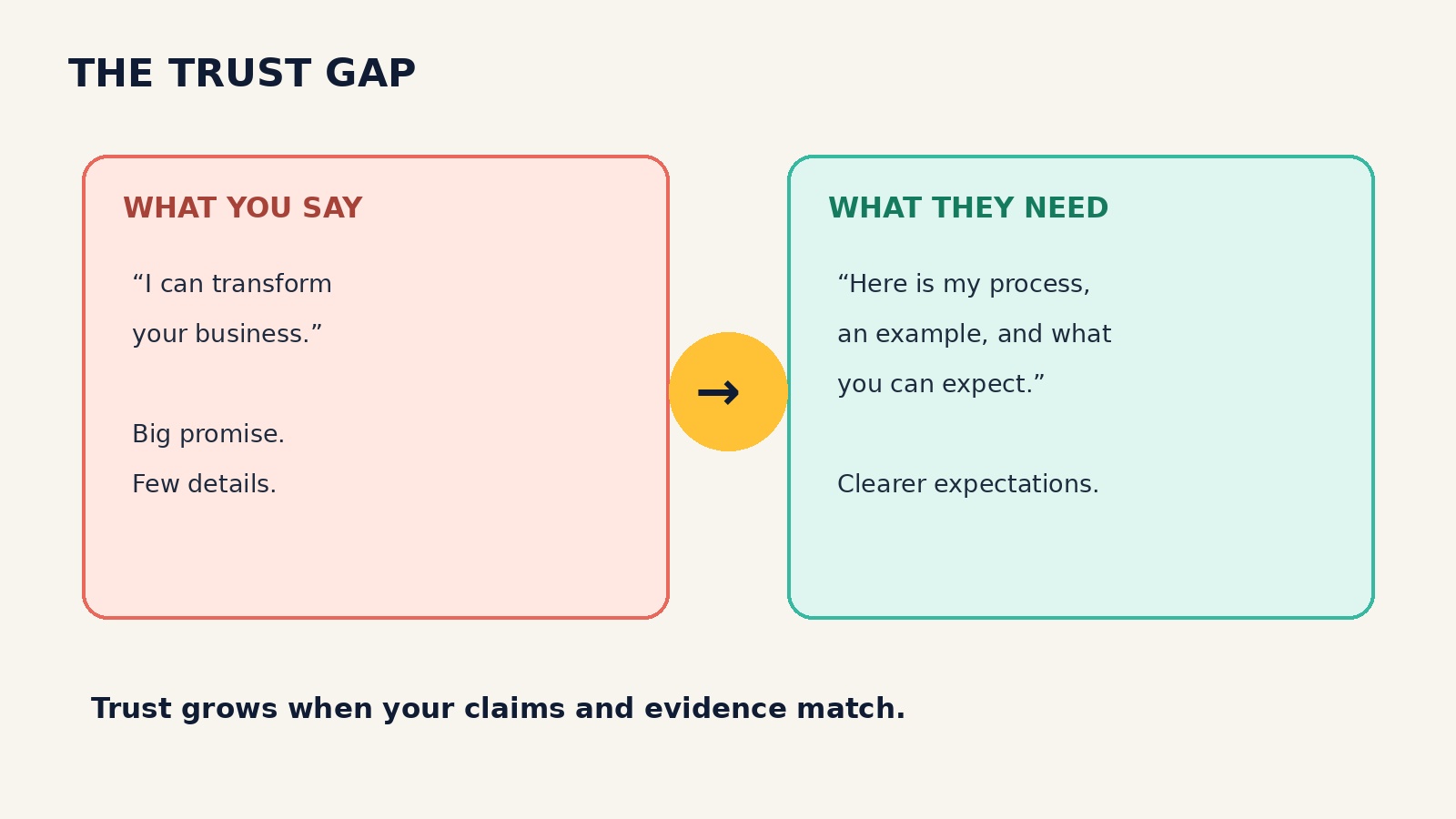
"I can transform your business."
It sounds confident. But it leaves important questions unanswered.
What does transformation mean? What process will you use? What effort will be required? What is included? What evidence supports your approach?
Now compare it with a more concrete explanation:
"I help new coaches clarify their offer, create a simple lead-capture process, and build a consistent follow-up routine."
This describes the work more clearly.
You can make it stronger by explaining your process, showing an example, and being honest about what results depend on.
Trust grows when your claims and your evidence match.
Four reasons potential clients may hesitate
1. Your promise sounds too broad
Words such as "transform," "scale," and "unlock your potential" can sound attractive. But they may not explain what you actually do.
Use concrete language.
Describe the problem you help solve. Explain the process. Name the outcome your service is designed to support.
Avoid guarantees you cannot control.
2. People cannot see how you work
A list of credentials can show that you have studied a subject. It does not always show what working with you feels like.
Explain your process.
What happens first? What will the client work on? What support will they receive? How will you review progress?
A clear process reduces uncertainty.
3. You make claims but show little evidence
You may say your method works. But the audience has no way to evaluate that statement.
Show your thinking. Share a useful demonstration. Explain a real example with permission. If you have testimonials or case studies, present them accurately and in context.
If you are new, do not invent success stories. Show your process, sample work, relevant experience, and the value of your approach.
Credibility can grow without pretending to have results you do not yet have.
4. Your offer leaves too many questions
Potential clients may wonder what is included, how long the engagement lasts, what support is available, or what they need to do themselves.
Answer these questions before they have to ask.
Clear boundaries build confidence. They also help people decide whether your service is right for them.
Build a simple proof ladder
You do not need a huge collection of testimonials to start building trust.
Begin with evidence you can honestly provide.
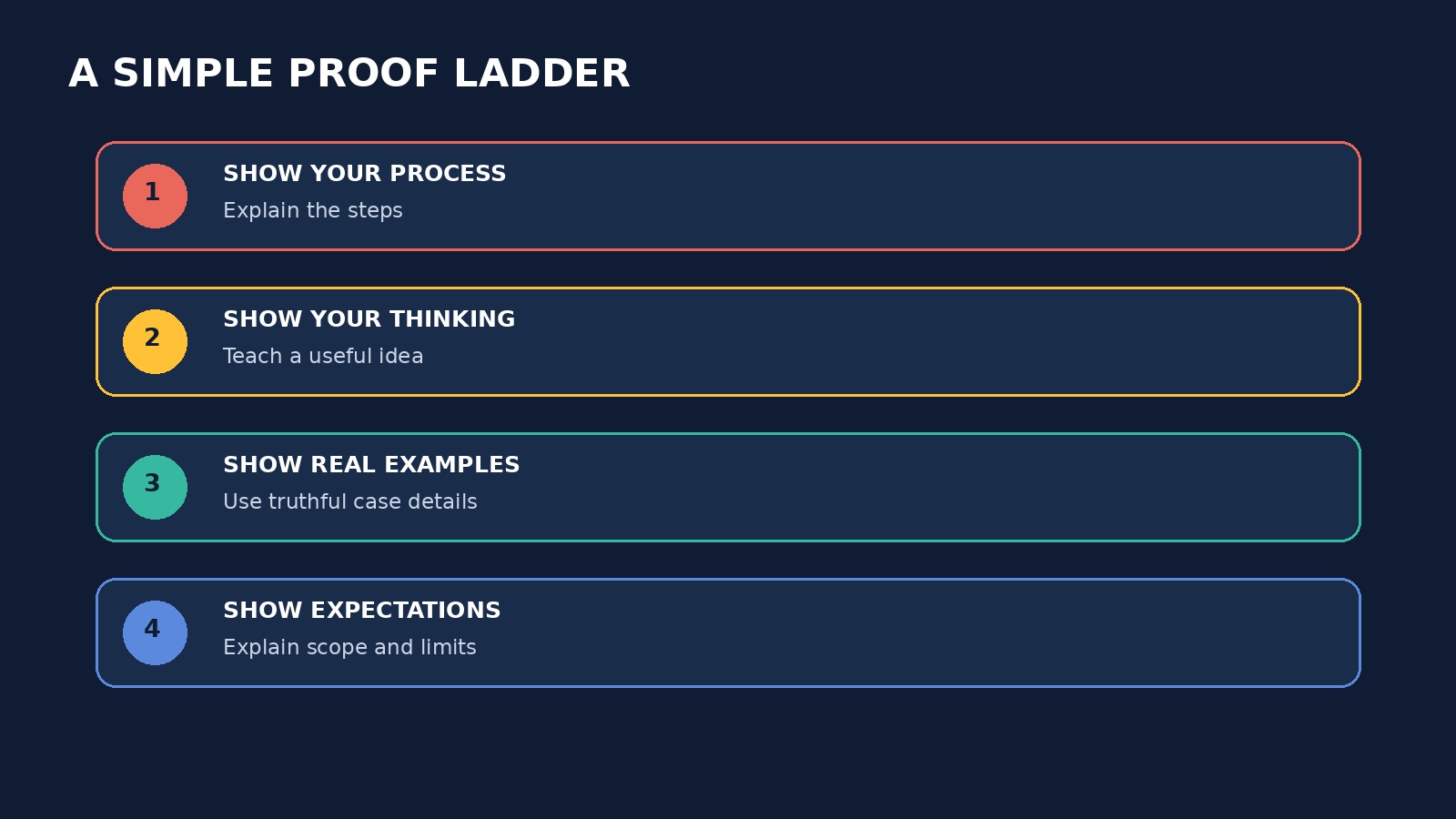
Step 1: Show your process
Break your method into clear steps.
For example, explain how you help a coach identify a niche, clarify an offer, and set up a lead-capture process.
Step 2: Show your thinking
Publish a useful explanation. Walk through a common mistake. Demonstrate how you would approach a problem.
People can evaluate your expertise by seeing how you think.
Step 3: Show real examples
Share relevant work samples, demonstrations, or client experiences you have permission to use.
Explain the context. Be accurate about what changed and what contributed to the result.
Step 4: Set clear expectations
Explain what your service includes. Describe what the client must contribute. Be transparent about limits and uncertainties.
This helps the right people decide with greater confidence.
Make your content more trustworthy
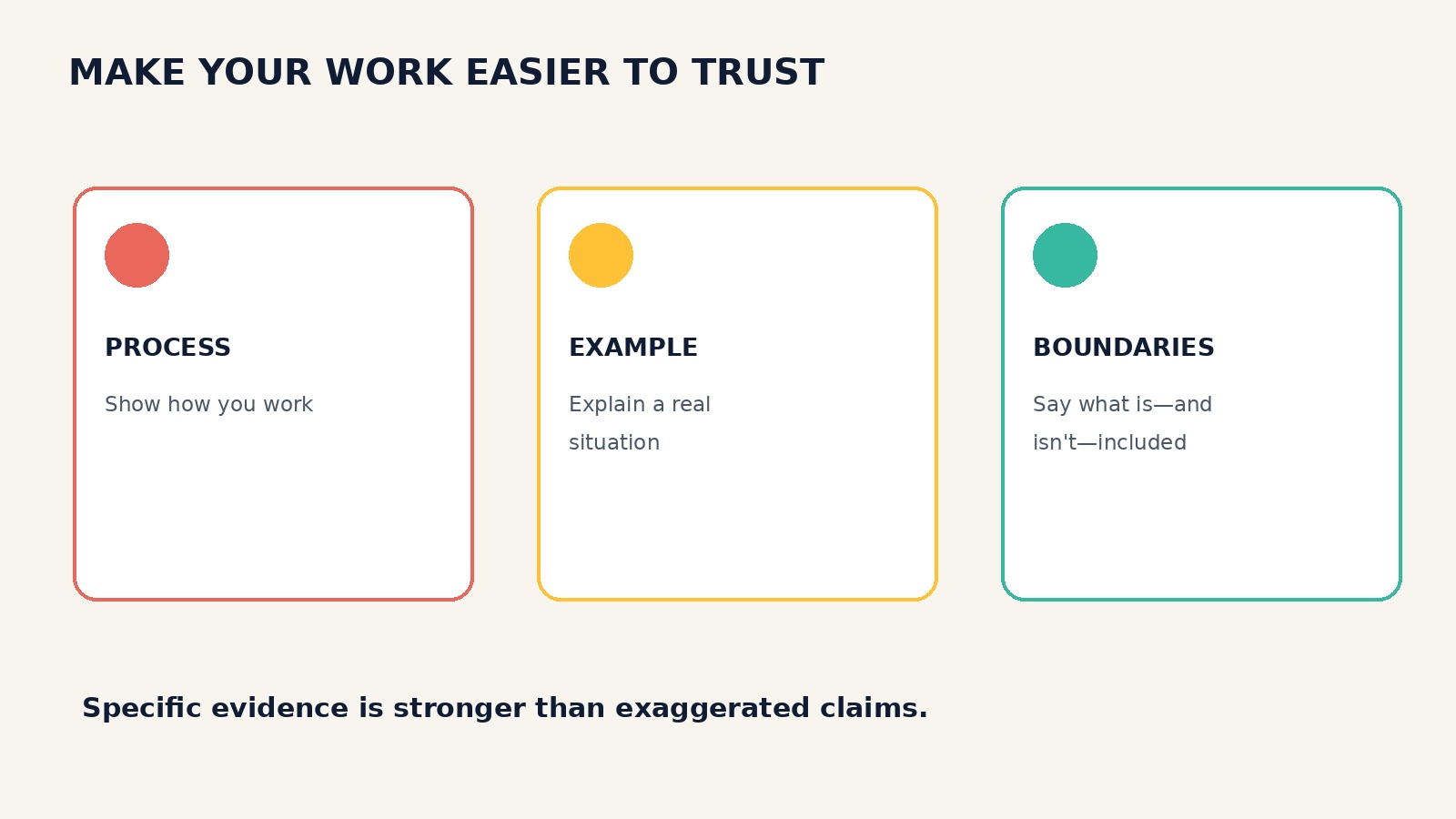
Try these three content ideas.
Show the process
Create a post explaining how you approach one common problem.
Do not reveal private client information. Focus on the steps and the reasoning behind them.
Explain a real example
Describe a situation, the challenge, the action taken, and the lesson learned.
Use genuine details. Get permission when needed. If you use an illustrative example, label it clearly.
Explain what your offer does not include
This may feel uncomfortable. But clear boundaries help people understand whether your service fits.
Explain who the offer is for, what is included, and when another solution may be more appropriate.
Honesty is not a weakness in marketing. It helps establish realistic expectations.
Replace pressure with a better conversation
When someone hesitates, avoid assuming they need another discount.
Ask a useful question.
"Is there anything about the process or offer that you would like me to clarify?"
Listen to the answer.
They may have a genuine concern. They may need more information. They may not be ready. They may simply be the wrong fit.
Respond honestly. Give them room to decide.
A respectful conversation can build trust even when the person does not buy.
A 20-minute trust audit
Review your website, landing page, or social profile.
Minutes 1–5: Check the promise.
Can a visitor quickly understand who you help and what problem you solve?
Minutes 6–10: Check the process.
Have you explained what working with you involves?
Minutes 11–15: Check the evidence.
Do you show useful examples, demonstrations, relevant experience, or genuine testimonials?
Minutes 16–20: Check expectations.
Is it clear what is included, what is required, and what the next step will be?
Choose the weakest area. Improve that first.
You do not need to rebuild your entire business in one day.
Key takeaways
1. Hesitation is not always a price problem. People may need clearer information before deciding.
2. Make specific promises. Explain the problem, process, and realistic outcome.
3. Show evidence honestly. Use real examples and never invent testimonials or results.
4. Explain what clients can expect. Clear processes and boundaries reduce uncertainty.
5. Replace pressure with useful conversations. Help people make informed choices.
Final thought: make trust easier to earn
You cannot force someone to trust you.
You can make your work easier to understand. You can communicate honestly. You can show your process. You can share evidence. You can set clear expectations and deliver on your commitments.
Trust grows through consistent actions, not just persuasive words.
At Expert Community Hub, we help coaches, consultants, and experts build clear offers and practical client acquisition systems. The aim is to help potential clients understand the value of your expertise and take the next step with confidence.
Your turn
Look at your current offer.
What is one question a potential client might still have before buying?
Answer that question in your next post, video, or landing page update.