

A prospect says your service sounds interesting, then disappears. Learn why polite interest is not the same as buying intent—and how to have clearer, more helpful sales conversations.
“This sounds interesting. Send me the details.” Then… silence.
If you sell coaching, consulting, or professional services, you may know this pattern.
A prospect listens to your explanation. They nod. They say your offer sounds useful. They ask you to send the details.
You leave the conversation feeling hopeful.
Then nothing happens.
You follow up. They say they are busy. You wait. You send another message. Eventually, the conversation fades away.
It is easy to assume that your price is too high, your offer is not good enough, or you need to become a better salesperson.
Sometimes one of those things is true. But there is another possibility:
The person was interested in the conversation—not yet committed to solving the problem.
Understanding the difference can change how you sell.
The frustration of hearing “yes” without getting a decision
For an independent expert, every promising conversation can feel important. You may spend time preparing proposals, explaining your process, customizing packages, and following up with people who seem close to becoming clients.
When they disappear, you lose more than a possible sale. You lose time and clarity.
You may start chasing prospects who were never a good fit. You may discount your price to overcome an objection that was never really about money. Or you may keep sending longer explanations when the real issue is that the person does not see enough reason to act now.
The goal is not to treat every hesitant prospect as a lost sale. It is to understand what their hesitation means before deciding what to do next.
The hidden reason: interest and intent are different
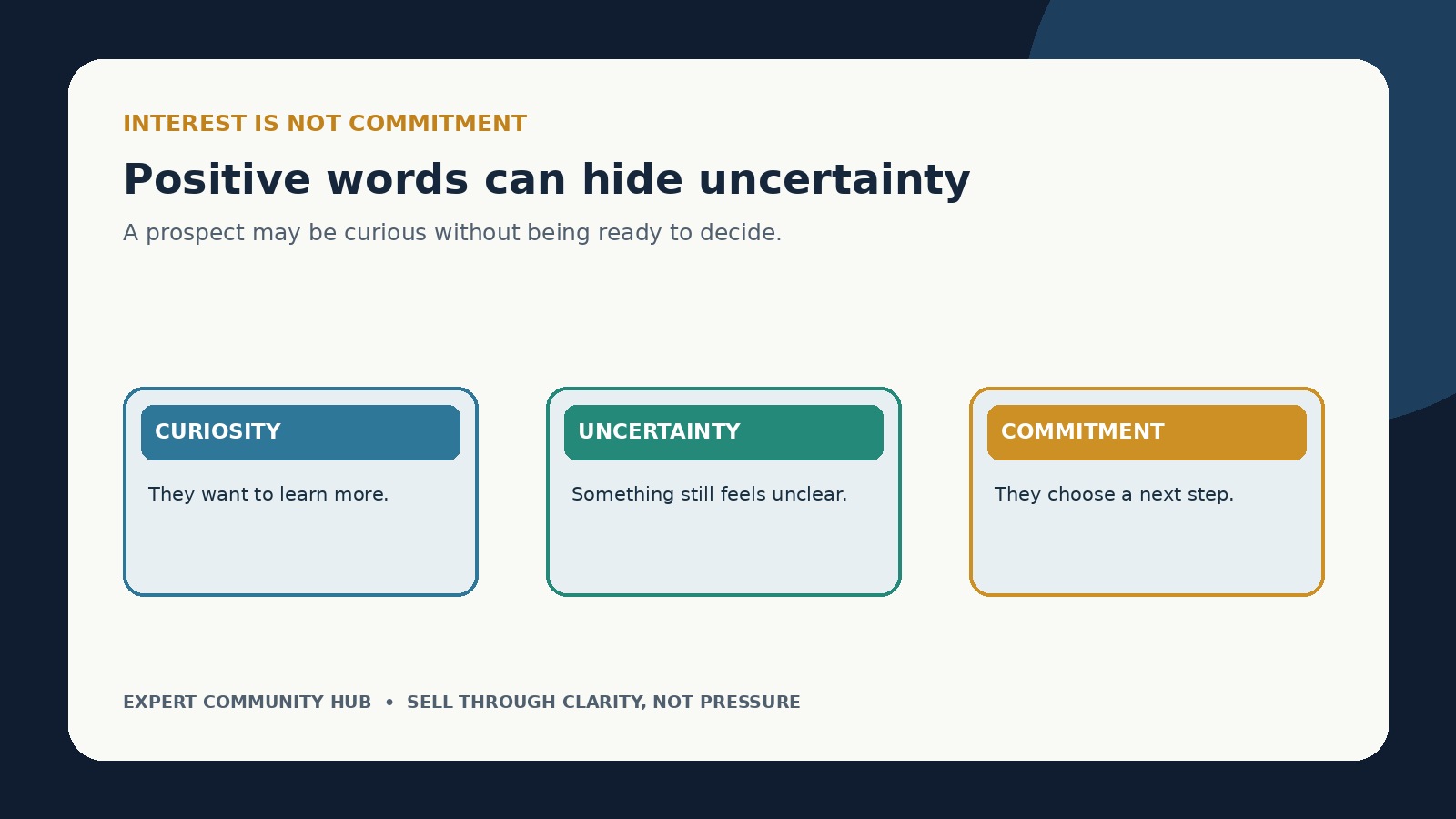
A person can be genuinely interested in your topic without being ready to buy your service.
They may want to learn more. They may be comparing options. They may recognize the problem but have other priorities. They may not understand the difference between your offer and alternatives. They may lack budget or decision-making authority. Or they may simply be trying to end a conversation politely.
You cannot know which explanation applies by guessing.
And you should not interpret every hesitation as an objection you must overcome.
Instead, use the conversation to understand four things:
- Problem: Is this a real and relevant challenge for them?
- Priority: Do they want to address it now?
- Fit: Does your service match what they need?
- Readiness: Are they willing and able to take a next step?
A clear “not now” or “not a fit” is more useful than a vague promise that keeps both sides waiting.
Stop presenting. Start discovering.
Many experts spend most of a sales conversation explaining their credentials, methods, modules, bonuses, and deliverables.
They want the prospect to understand the value.
But if you explain before understanding the person's situation, you may be describing the wrong solution in impressive detail.
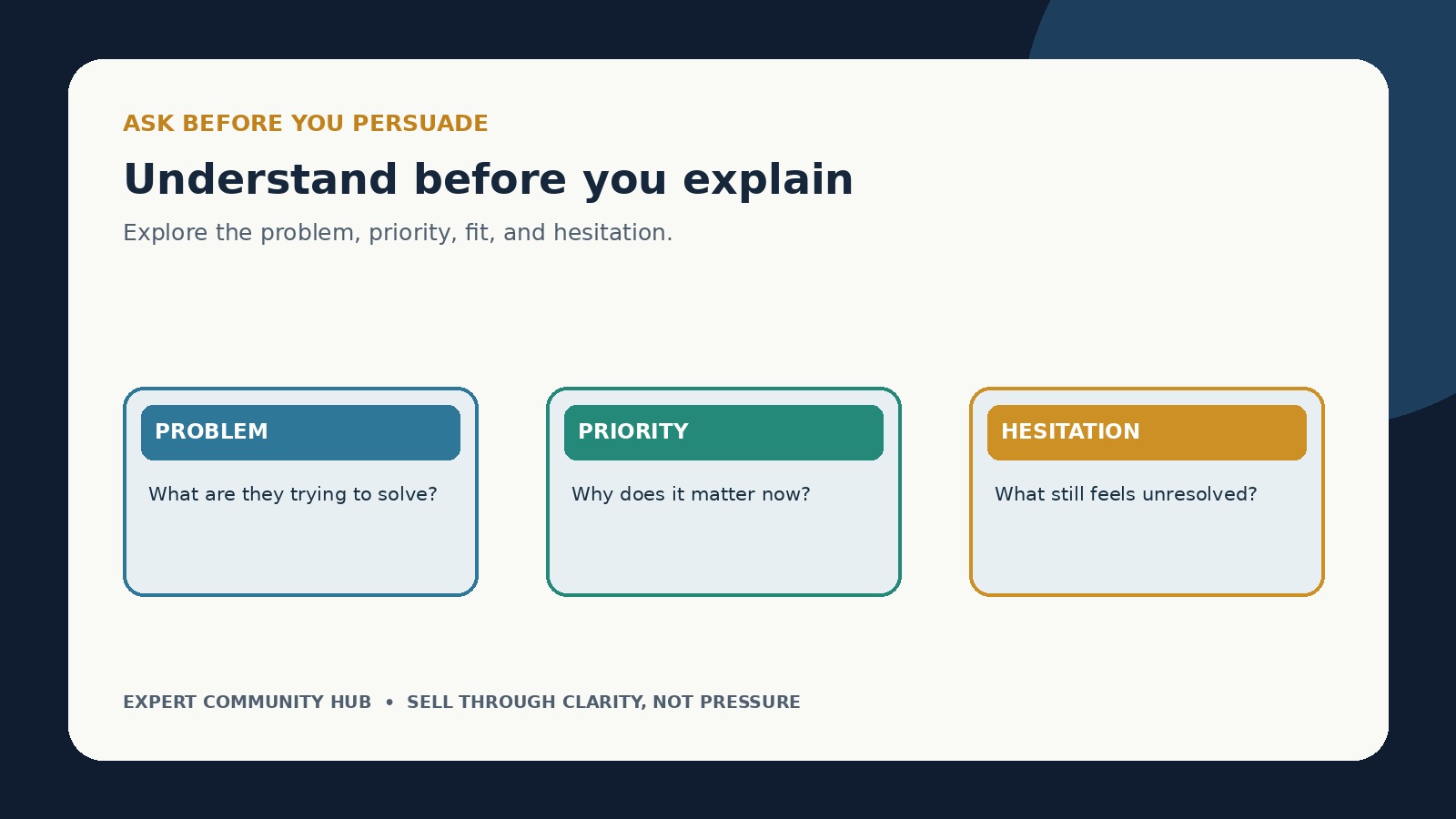
Try asking a few thoughtful questions first.
“What made you interested in this?”
This helps you understand what caught their attention.
“What are you trying to improve or solve right now?”
This shifts the conversation from general interest to a specific problem.
“What have you tried so far?”
Their answer may reveal what has not worked, what they value, and what they already understand.
“Why is this important to address now?”
This explores priority without pressuring them to invent urgency.
“What would you need to know to decide whether this is right for you?”
This gives them permission to raise concerns instead of hiding behind “send me the details.”
You do not need to ask every question like a checklist. Listen carefully, follow the person's answers, and respect their boundaries.
The CLEAR Conversation Framework
Use this simple framework to guide a sales conversation without turning it into a pressure tactic.
C — Clarify the problem
Understand the situation in the prospect's own words. Avoid assuming that the problem you solve is the problem they want to solve.
L — Learn the priority
Explore what happens if the issue remains unresolved and whether they want to address it now. If it is not a current priority, acknowledge that.
E — Establish fit
Explain how your service works and who it is best suited for. Be honest about limitations, requirements, and what you cannot promise.
A — Address uncertainty
Ask what still feels unclear. It may be price, timing, trust, implementation effort, decision authority, or something else. Do not assume every concern can or should be overcome.
R — Request a clear next step
If there is a fit, agree on a specific next step: a proposal, a follow-up date, a second conversation, or enrollment. If there is no fit or no readiness, leave the door open respectfully without endless chasing.
What to do when someone says, “Send me the details”
You do not need to refuse. Send the details—but make them relevant.
You might reply:
“Absolutely. So I send you the most useful information, could you tell me which part you are most interested in improving?”
If they answer, tailor the information to that need. Keep it concise and make the next step easy to understand.
You can also ask:
“After you have reviewed it, would it be useful for us to reconnect on a particular day, or would you prefer to reach out if it feels relevant?”
This creates clarity without forcing a commitment. If they do not want to schedule a follow-up, respect that preference.
What to do when price seems to be the problem
Do not immediately reduce your price.
First, understand what the concern means. Is the service outside their budget? Is the value unclear? Are they comparing it with a different type of solution? Is the timing wrong? Do they need a smaller starting point?
You can explain what is included, who the service is designed for, and the basis for your pricing. If you offer a smaller scope or payment option, describe it transparently and only if it makes sense for both sides.
Sometimes the right decision is to decline the sale. A prospect who cannot comfortably afford a service should not be pressured into buying it.
The follow-up that builds trust
Following up is useful when it helps someone make an informed decision. It becomes frustrating when every message simply asks, “Have you decided yet?”
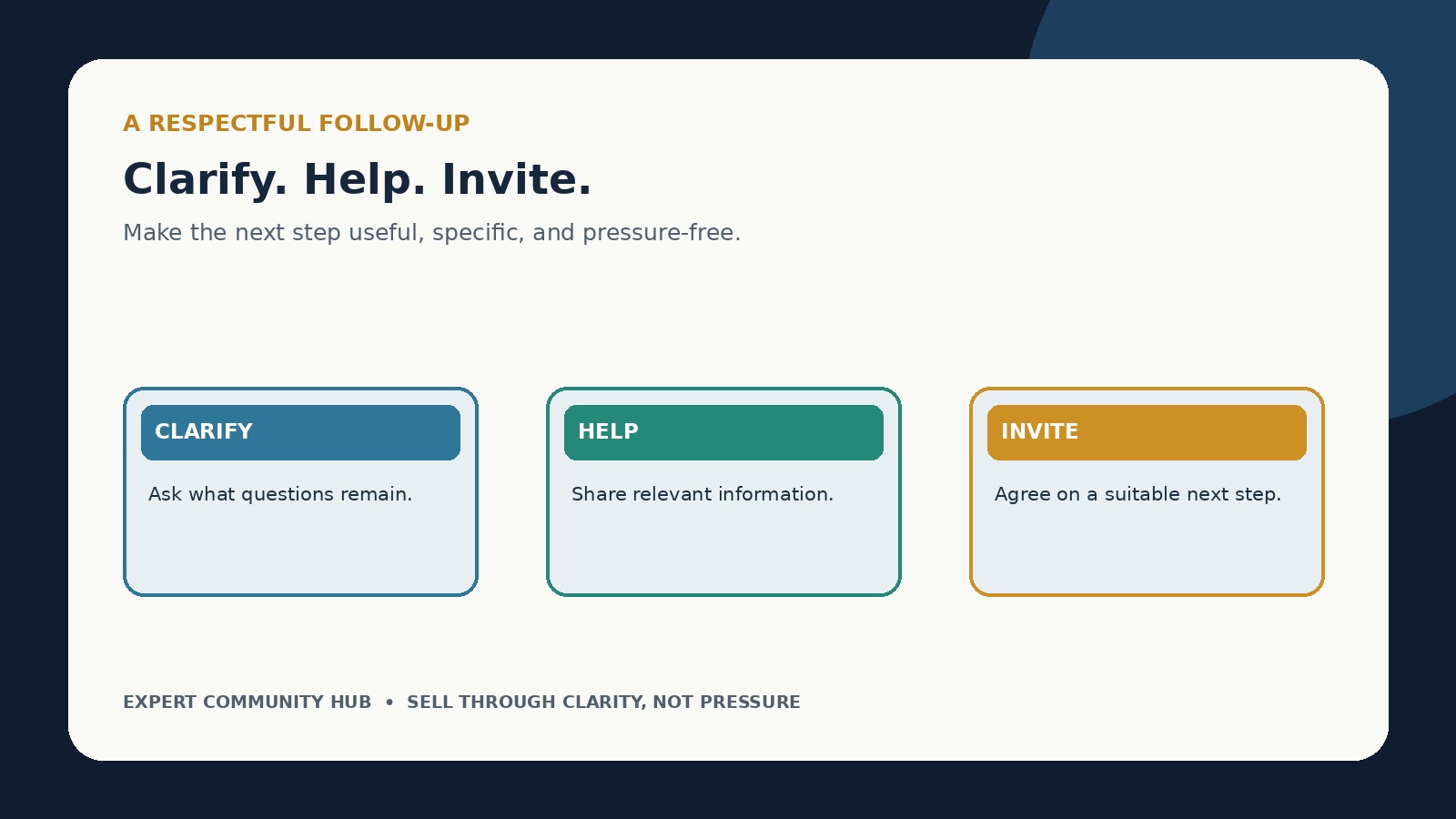
Try this three-part approach:
1. Clarify. Refer to the problem or goal the person discussed.
2. Help. Share one relevant answer, resource, or detail that addresses an open question.
3. Invite. Offer a clear next step and make it easy for them to say yes, no, or not now.
For example:
“Hi, I enjoyed our conversation about making your lead follow-up more consistent. You mentioned that the main challenge was keeping track of enquiries. I’m sharing the short overview of how the process works. If it seems relevant, we can discuss whether it fits your situation. If the timing isn't right, that's completely fine too.”
A message like this demonstrates attention and respect. It does not guarantee a sale—and it should not be designed to make someone feel guilty for not buying.
Your 20-minute sales conversation reset
Think about one recent prospect who expressed interest but did not buy.
Spend 20 minutes reviewing the conversation.
Minutes 1–5: Write down the problem the prospect said they wanted to solve. Use their words, not your interpretation.
Minutes 6–10: Identify what you learned about priority, fit, budget, timing, and decision-making. Mark what you know versus what you merely assumed.
Minutes 11–15: Identify the question you could have asked to understand their hesitation more clearly.
Minutes 16–20: Draft one respectful follow-up—or decide that no further follow-up is appropriate based on their response and preferences.
The purpose is not to turn every prospect into a buyer. It is to make your process clearer, more useful, and less dependent on guesswork.
A “no” can be a useful business result
Not every interested person will become a client.
Some will decide the problem is not urgent. Some will choose another provider. Some will lack the resources to proceed. Some will discover that your service is not the right fit.
That is part of doing business.
When you allow prospects to make an honest decision, you spend less time trying to extract commitment from people who are not ready. You can focus on improving your offer, serving suitable clients, and having better conversations with future prospects.
A clear no is not always a failure. Sometimes it is the information you need to move forward.
Your turn
When a prospect says “I’m interested” but does not buy, what usually happens next in your business—and what question could help you understand their hesitation better?
Share your experience in the comments. A practical example may help another coach or consultant improve their own sales conversations.
Your next step
If you are a coach, consultant, or knowledge-based professional, Expert Community Hub can help you explore how to communicate your offer clearly, build a client-acquisition process, and create a more consistent way to follow up with interested prospects.
Start by listening carefully, understanding the real problem, and agreeing on a clear next step. Sell through clarity and fit—not pressure.
Written for coaches, consultants, and knowledge-based entrepreneurs by Expert Community Hub.