
Leaving a familiar job title can shake your confidence—even when your skills remain. Learn how to separate your identity from a role and communicate your value in a new chapter.
If your professional identity is built around your job title, what happens when that title is no longer yours?
For years, introductions may have been easy.
You had a role. A company name. A department. A title that explained where you belonged and what people could expect from you.
Then something changes.
You leave the company. Your role is restructured. You decide to work independently. Or you begin exploring a new direction after years in the same profession.
Suddenly, the old introduction no longer fits.
You may still have the knowledge, judgment, relationships, and experience you built over many years. But without the familiar title, you may find yourself wondering how to explain your value—or even how to think about yourself.
This can be a surprisingly difficult transition.
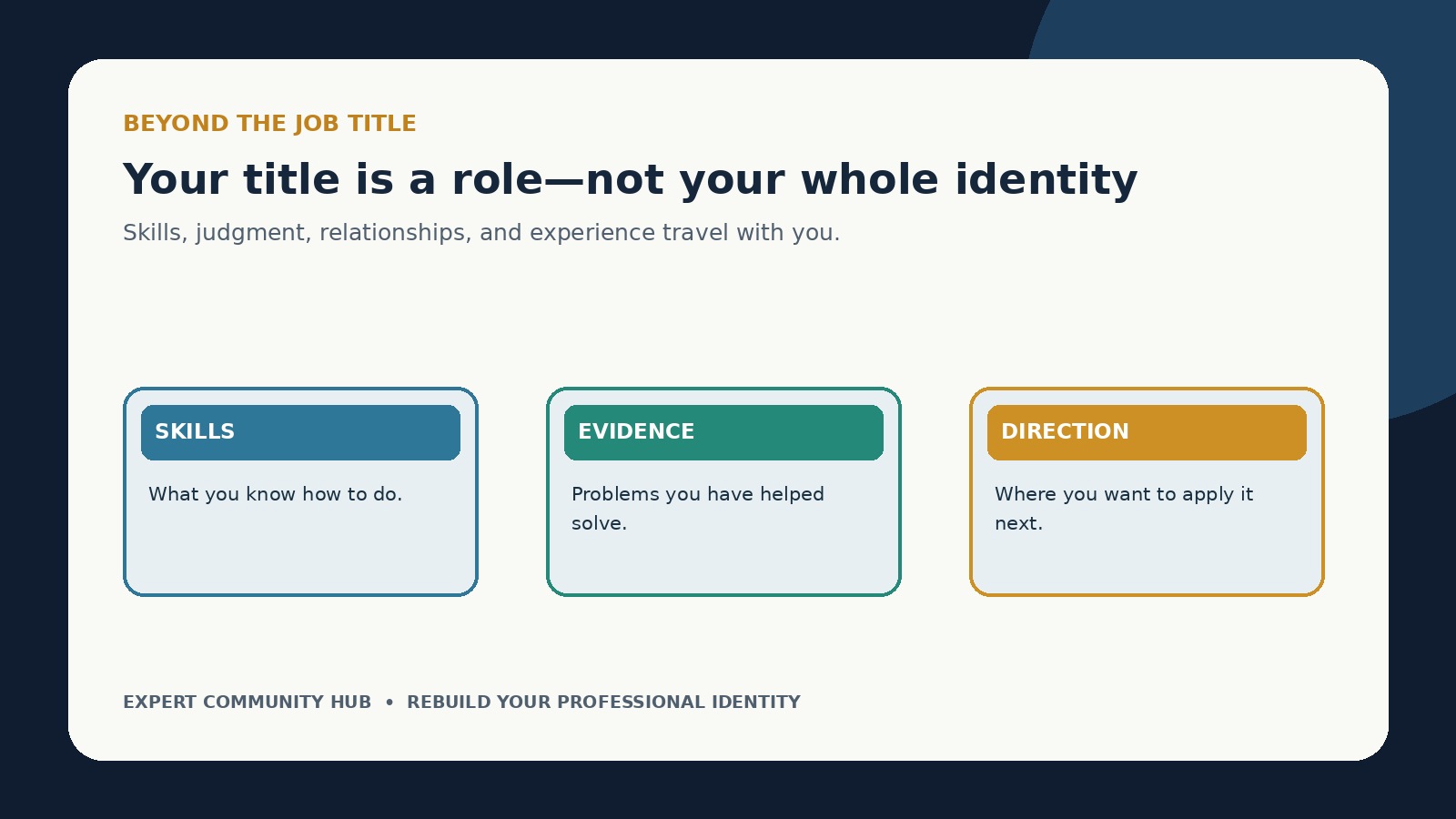
A job title can describe your role. It cannot contain your entire identity.
The quiet pain of losing a familiar professional label
A job is more than a source of income for many people. It can provide routine, status, social connection, a sense of progress, and a ready-made answer to the question, “What do you do?”
When the role disappears, several things can feel uncertain at once.
- You may wonder whether your experience still matters outside that organization.
- You may compare your new situation with former colleagues who appear to be moving ahead.
- You may hesitate to introduce yourself because you have not settled on a new title.
- You may keep collecting qualifications because you feel you need permission to begin again.
- You may struggle to explain what you can offer without the reputation of your former employer.
These feelings do not mean your skills have disappeared. They may mean that the structure you used to describe yourself is changing.
Give yourself room to acknowledge the change without treating it as a verdict on your worth.
The hidden mistake: confusing your role with your value
Your title was one way of organizing and communicating your professional contribution. It was never the full source of that contribution.
Think about what you actually did in your previous role.
Did you solve recurring problems? Make complex information understandable? Lead people through uncertainty? Improve a process? Build relationships? Help customers make decisions? Coordinate projects? Teach others?
Those capabilities may remain useful even when the original role is gone.
The challenge is to translate them into language that makes sense in a new context.
A former corporate manager might become a consultant, coach, trainer, or independent specialist. But the transition requires more than changing a LinkedIn headline. It requires identifying which problems you can help solve, for whom, and in what way.
The Transferable Value Framework
Use this simple framework to turn your past experience into a clearer description of future value.
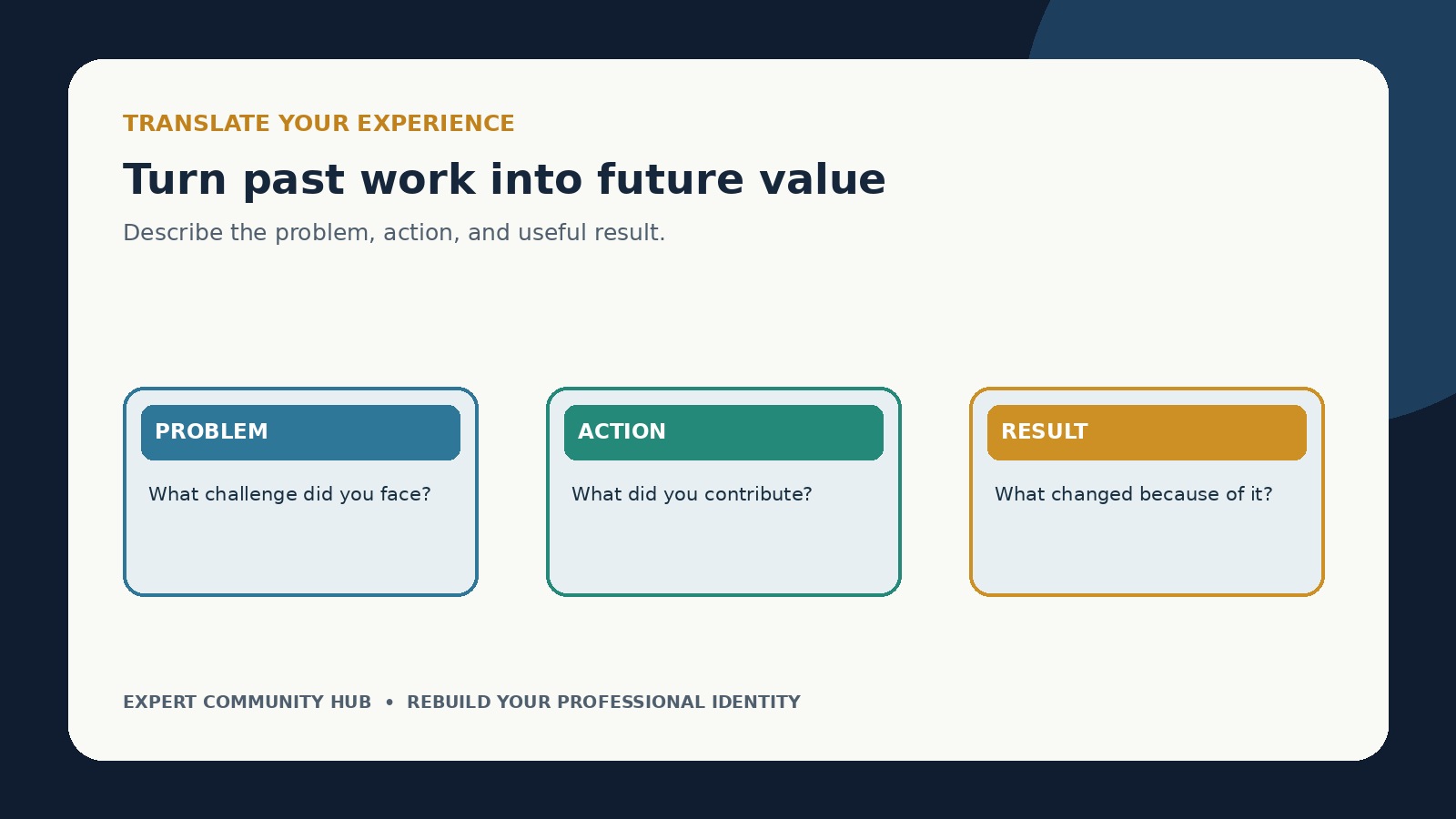
1. Identify the problem
Think of a situation in which your work made a meaningful difference.
What was difficult, slow, confusing, expensive, or uncertain before you became involved?
Avoid starting with your title or list of responsibilities. Start with the problem.
2. Describe your contribution
What did you actually do?
Perhaps you simplified a workflow, trained a team, improved communication, helped customers understand a product, or created a process that others could follow.
Focus on your contribution rather than taking credit for results that depended on a whole team.
3. Explain the useful result
What changed? Use evidence where you have it: time saved, errors reduced, a process clarified, a team supported, or a decision made more confidently.
If you do not have a reliable number, do not invent one. A concrete description can still be meaningful.
4. Connect it to a new audience
Ask who else experiences a similar problem today.
A skill that was valuable inside one organization may also be useful to small businesses, independent professionals, or teams that do not have the same internal resources.
The opportunity is not to sell your old job. It is to identify which parts of your experience can help someone else.
You do not need to reinvent your entire identity overnight
When people enter a new chapter, they sometimes feel pressure to choose a perfect niche, create a polished personal brand, build a website, and announce a complete transformation.
That is a lot to decide at once.
Instead, treat your next professional identity as something you can explore and refine.
Start with one group of people you understand. Choose one problem you know how to help with. Have a few conversations. Share an insight from your experience. Notice which questions people ask and where your skills seem most useful.
You are not required to turn every past skill into a business. You are simply exploring what is relevant and valuable in your next chapter.
If you are considering coaching or consulting, begin with honest conversations and a small, clearly defined service rather than building an elaborate product before you have tested the need.
A 20-minute professional identity reset
Set aside 20 minutes and write down your answers.
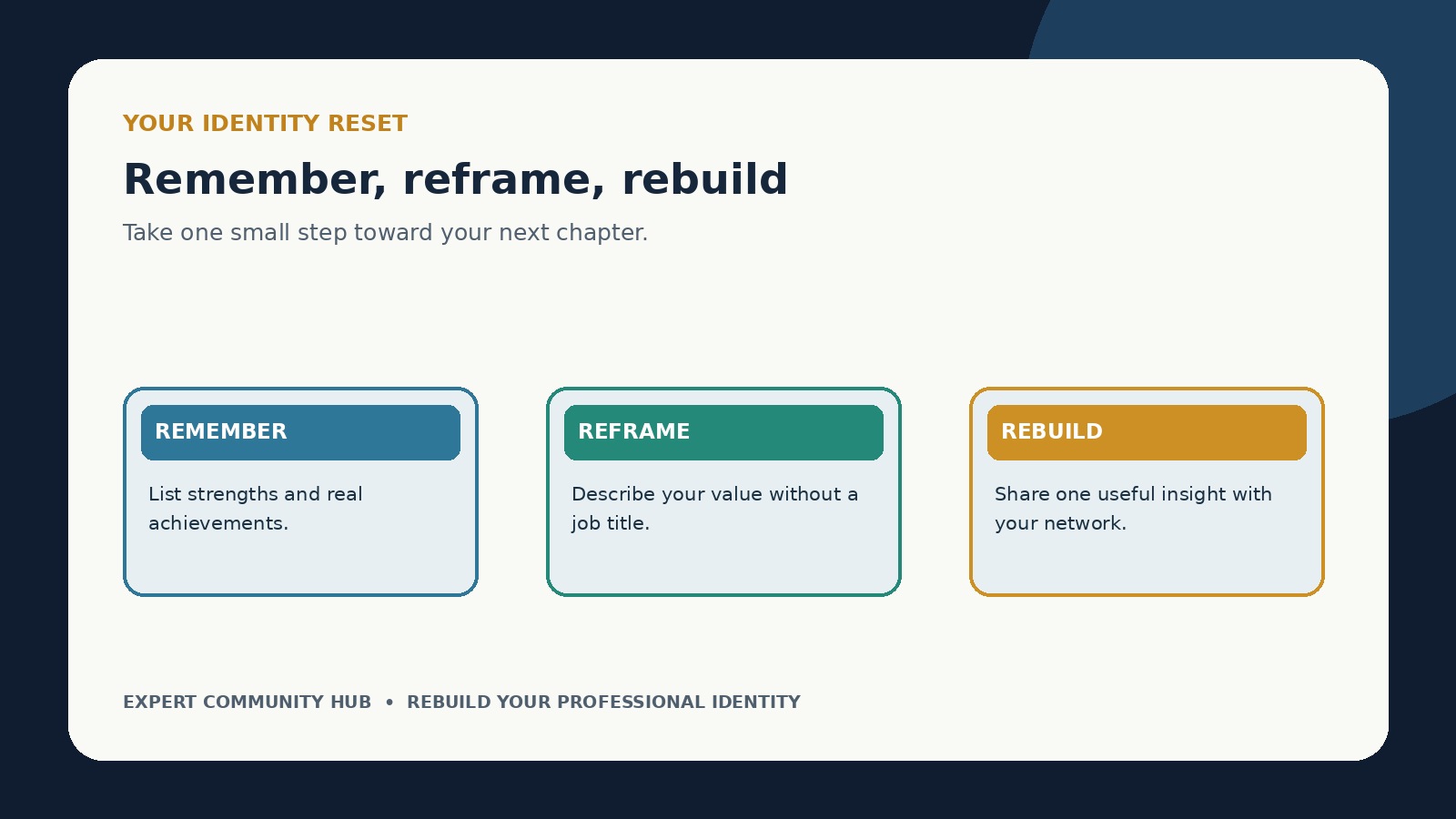
Minutes 1–5: Remember. List five problems you have helped solve during your career. Include work that felt ordinary to you but was difficult for others.
Minutes 6–10: Reframe. For each problem, identify the skill or process you used. Look for patterns in what people trusted you to do.
Minutes 11–15: Connect. Choose one audience that may face similar challenges today. It could be a group of professionals, business owners, coaches, or teams.
Minutes 16–20: Communicate. Complete this sentence:
“I help [type of person or organization] work through [specific problem] using my experience in [relevant skill or process].”
Treat this as a working draft, not a permanent label.
What if you do not know what comes next?
You do not need to have the whole next chapter mapped out before taking a step.
Start by separating three questions:
- What can I do? Your skills, experience, judgment, and strengths.
- What do people need? The problems they are trying to solve and the help they are seeking.
- What do I want? The type of work, lifestyle, relationships, and responsibilities you want in this stage of life.
The overlap between these questions can help you choose a direction worth exploring.
Not every skill will become an offer. Not every interest will become a career. And not every experiment will work. That is why small tests and conversations are useful.
You can change direction without declaring your previous career a failure.
Your title may change. Your story can continue.
Perhaps your next chapter will involve a new role. Perhaps it will involve coaching, consulting, teaching, entrepreneurship, or a combination of several paths.
You do not have to decide your entire future today.
Your experience is not valuable only because an organization once gave it a title. Its value comes from what you learned, how you think, the problems you can help solve, and the way you apply those capabilities now.
Give yourself permission to carry the useful parts forward—and to leave behind the parts that no longer fit.
Your turn
If you could no longer use your current or former job title to introduce yourself, how would you describe the value you bring to other people?
Share your thoughts in the comments. Your answer may help someone else see their experience in a new way.
Your next step
If you are exploring coaching, consulting, or another knowledge-based business, Expert Community Hub can help you think through how to communicate your expertise, define an offer, and build a practical path toward serving the right audience.
You do not need a perfect new title to begin. Start with one problem you understand and one useful way to help.
Written for coaches, consultants, and knowledge-based professionals by Expert Community Hub.