

Your expertise may be valuable, but potential clients cannot buy what they do not understand. Use a simple offer formula to explain who you help, what problem you solve, and how you help.
If a potential client cannot quickly understand what you do, they may move on—even when you could genuinely help them.
You have years of experience.
You have completed courses, developed skills, helped colleagues, solved difficult problems, and collected ideas for the business you want to build.
Then someone asks a simple question:
“So, what exactly do you offer?”
You begin explaining your background. You describe your methods, tools, modules, frameworks, and everything the client might learn.
A minute later, the person still looks uncertain.
This is frustrating. You know you have something valuable. But the value is getting lost in the explanation.
Here is the uncomfortable truth:
Your potential client does not need to understand everything you know. They need to understand how you can help them.
A clear offer does not make your expertise smaller. It makes its relevance easier to see.
Why knowledgeable experts often create confusing offers
When you know a lot, it is tempting to include a lot.
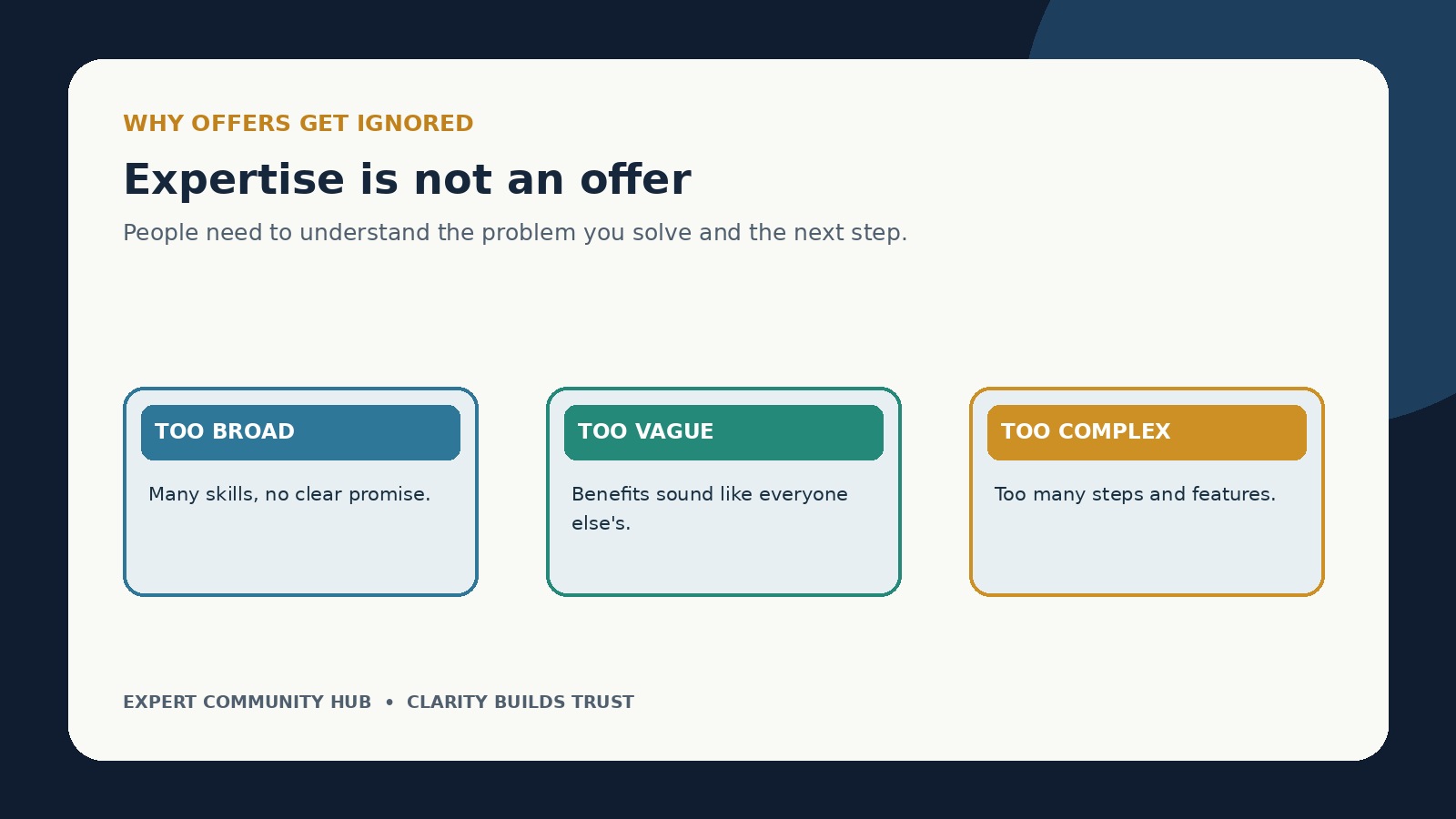
You may offer coaching, consulting, courses, templates, community access, AI tools, strategy sessions, and ongoing support. Each feature feels useful, so removing anything feels like reducing the value.
But buyers do not evaluate an offer by counting its features. They first need to understand whether it is relevant to their situation.
A confusing offer creates several problems:
- People cannot tell whether it is designed for them.
- They struggle to identify the main problem it addresses.
- They compare features instead of understanding the intended value.
- They postpone making a decision because the next step is unclear.
- You end up repeating long explanations in every sales conversation.
The issue may not be that your offer lacks value. The issue may be that its value is buried under too much information.
The hidden mistake: describing your knowledge instead of the client's problem
Consider these two introductions.
“I offer business coaching, mindset training, digital marketing, AI implementation, productivity systems, and personal development.”
Now compare:
“I help independent coaches create a simple process for attracting enquiries and following up with potential clients.”
The first describes several areas of knowledge. The second helps a specific person recognize a relevant problem.
The broader list may contain valuable services. But it asks the listener to work out which one matters to them.
A clear offer does some of that work for the buyer.
The 10-Second Offer Formula
Use this structure to explain your offer in one sentence:
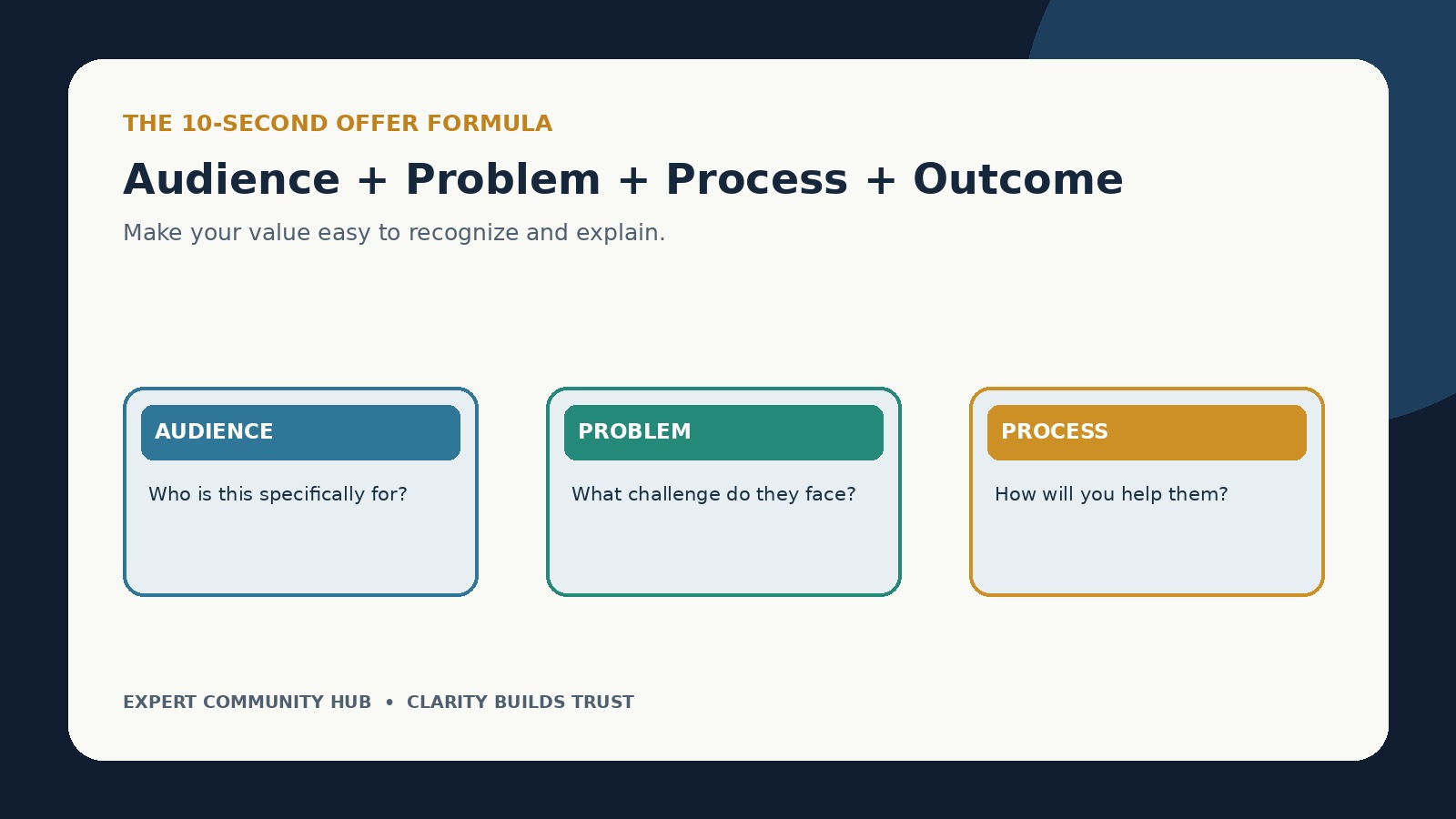
I help [specific audience] solve [specific problem] through [your process] so they can [realistic intended outcome].
Each part has a job.
1. Audience: Who is it for?
Name a group of people who can recognize themselves in your message.
For example, “independent coaches,” “small business owners,” or “experienced professionals exploring consulting.”
You can serve different audiences through different offers. For each offer, make the intended audience clear.
2. Problem: What challenge do they face?
Choose a problem the audience understands and cares about.
“Grow your business” is broad. “Improve follow-up so more suitable enquiries turn into sales conversations” gives the reader a more concrete situation to consider.
Use language your audience uses—not only technical terms from your industry.
3. Process: How do you help?
Describe the method, service, or support you provide.
It could be a consulting engagement, a coaching process, a practical workshop, or guided implementation. You do not need to list every module or tool in the first sentence.
4. Intended outcome: What are they working toward?
Explain the useful change your service is designed to support. Be specific without promising results you cannot guarantee.
For example, a program may help clients build a repeatable follow-up process. It should not guarantee a particular revenue result unless you can substantiate and appropriately qualify that claim.
Three examples of clearer offers
These examples are starting points. Adapt them to your real experience, audience, and delivery capability.
For a business coach
“I help independent coaches improve their lead follow-up process through a simple weekly system, so fewer promising conversations get forgotten.”
For a career consultant
“I help experienced professionals translate their corporate skills into a clear consulting offer, so they can explore independent work with greater direction.”
For a marketing consultant
“I help small businesses identify gaps in their customer journey and prioritize practical improvements to their enquiry-to-sale process.”
Notice what these offers leave out: long biographies, lists of every skill, complicated product names, and unsupported promises.
Those details may belong elsewhere. The first message simply needs to create understanding.
Make the offer clearer before making it bigger
If people do not understand your offer, adding more bonuses or modules may not solve the problem.
Before expanding it, ask:
- Can my intended audience recognize themselves in the description?
- Is the problem specific enough to picture?
- Can someone understand what I actually provide?
- Is the intended outcome realistic and relevant?
- Is the next step obvious?
If you answer “no” to any of these, simplify the message first.
You may discover that the service itself needs refinement. Or you may find that the service is useful but the explanation is too broad. Test both possibilities rather than assuming that more features will make the offer more attractive.
The 10-second clarity test
Try this with someone who represents your intended audience.
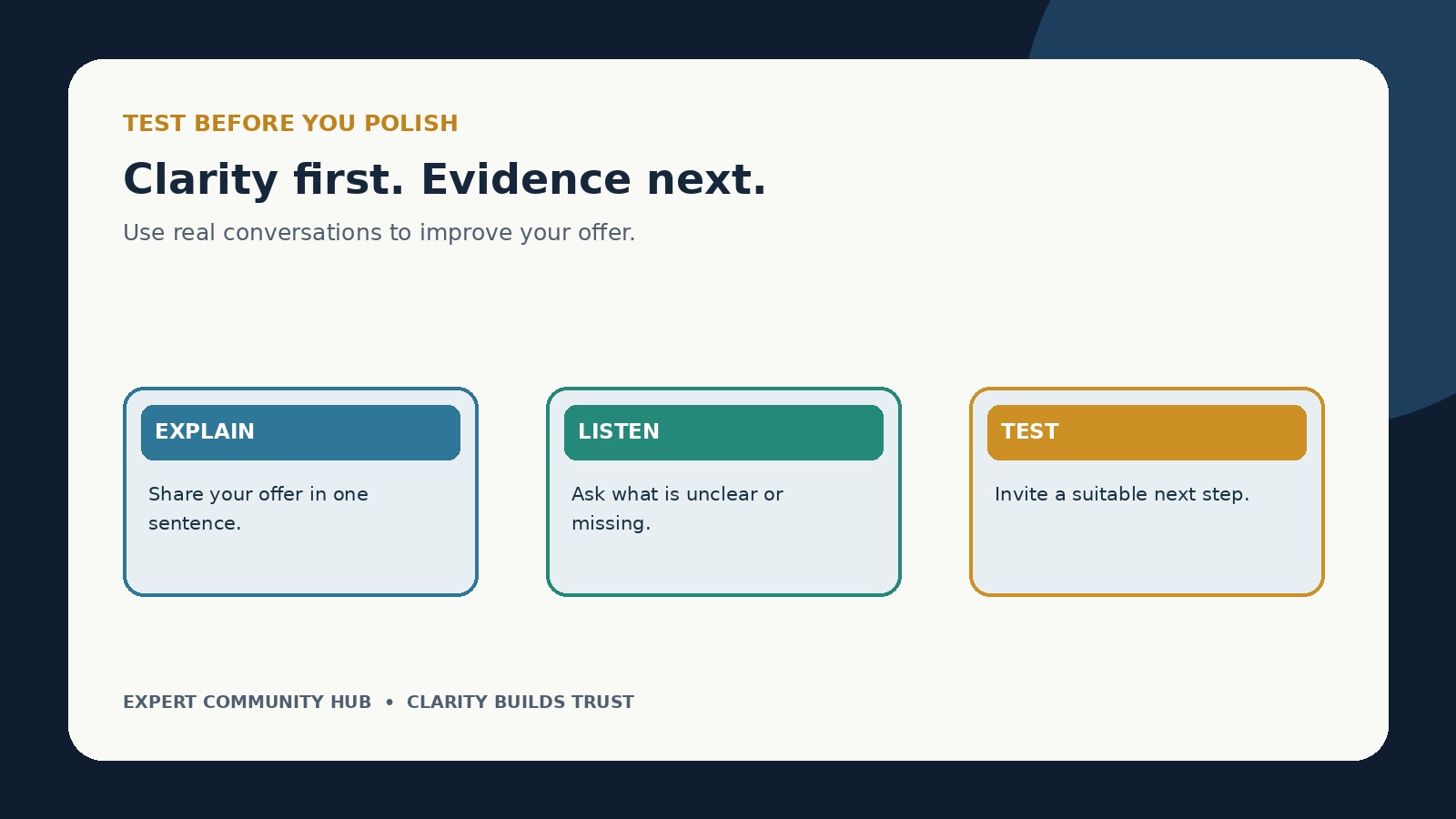
Step 1: Explain the offer once
Read your one-sentence offer aloud. Avoid adding a long explanation unless they ask for it.
Step 2: Ask them to repeat it
Ask, “In your own words, what do you think I help people do?”
If their answer is very different from your intention, that is useful feedback. It may reveal a vague phrase, an unclear audience, or a problem that is not immediately recognizable.
Step 3: Ask what is still unclear
Do not defend the offer immediately. Listen for the words or ideas that caused confusion.
Step 4: Rewrite and test again
Use simpler language. Remove jargon and unnecessary features. Then ask another suitable person or test the revised version in a real conversation.
The goal is not to make every person interested. It is to help the right person understand the offer well enough to decide whether to explore it.
Your 20-minute offer exercise
Set a timer and complete these steps.
Minutes 1–5: Write down the audience you want to help and the main problem you want to solve.
Minutes 6–10: Complete the formula: “I help [audience] solve [problem] through [process] so they can [intended outcome].”
Minutes 11–15: Remove jargon, extra services, and vague claims. Keep only what helps someone understand the core offer.
Minutes 16–20: Share the sentence with one suitable person. Ask them what they think the offer means and what remains unclear.
You do not need a perfect tagline by the end of 20 minutes. You need a clearer draft and a plan to test it.
What if you offer several services?
You do not have to abandon your range of expertise.
Think of your business as a collection of offers, each designed for a particular audience or situation. A potential client should not have to understand your entire business to decide whether one service is relevant.
Lead with the offer that best matches their current problem. Once the conversation develops, you can explain additional services when they genuinely fit.
Clarity is not about hiding your capabilities. It is about presenting the right information at the right time.
Your turn
If a potential client asked what you offer, could you explain it in one sentence—or would you need five minutes?
Share your current offer in the comments if you feel comfortable. Try using the formula above, and notice whether it makes your value easier to communicate.
Your next step
If you are a coach, consultant, or knowledge-based professional, Expert Community Hub can help you explore how to turn your expertise into a clearer offer and a more structured business.
Start with one audience, one meaningful problem, and one sentence that explains how you help. Then test it with real people and improve from what you learn.
Written for coaches, consultants, and knowledge-based entrepreneurs by Expert Community Hub.