
Losing clients to another expert does not always mean they are better than you. Discover how clarity, trust, perceived risk, and an easy next step shape a buyer's decision.
You know you can help. The prospect seems interested. Then they hire someone else.
It is a frustrating experience for any coach, consultant, or expert.
You have experience. You understand the problem. You may even be more qualified than the person they eventually choose.
So why did they go elsewhere?
It is tempting to assume they were cheaper, more popular, or simply better at selling. Sometimes those factors matter. But there is another possibility: the other expert made the decision feel easier.
Potential clients do not evaluate expertise in a vacuum. They also try to understand what you do, whether they can trust your approach, what working with you will involve, and how risky the decision feels.
You may not need to become a better expert first. You may need to make your value easier to understand and trust.
The hidden frustration of being qualified but overlooked
Imagine two consultants with similar experience.
One describes a long list of services, tools, certifications, and methods. Their website says they help businesses grow, improve performance, and unlock potential.
The other explains one specific problem they help solve, describes their process in plain language, shares a relevant example, and offers a clear way to start a conversation.
A prospect may find the second consultant easier to evaluate—even if both are capable.
This is not proof that the second consultant is better. It shows how clarity can reduce the effort a buyer needs to make a decision.
When your message is broad, your proof is difficult to find, or your next step is confusing, a prospect has to do extra work. They may choose a competitor simply because that option feels more understandable.
The three invisible decision factors
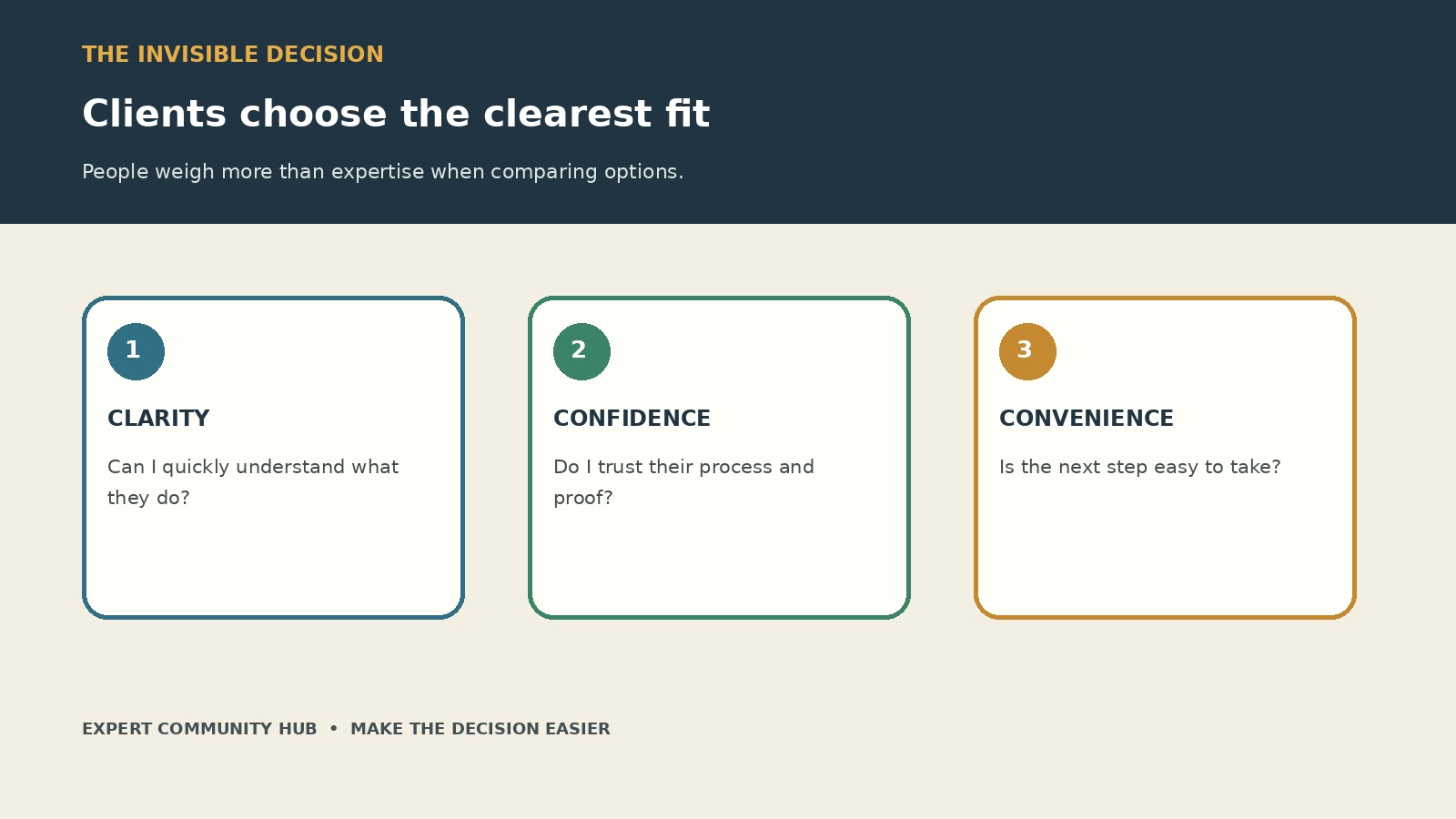
1. Clarity: “Do I understand what this person can help me with?”
If a prospect has to decode your service description, they may struggle to see whether it fits their problem.
Broad claims such as “I help you achieve success” or “I offer complete business transformation” rarely explain what the engagement actually addresses.
Make the problem, audience, and intended progress concrete. You can have multiple capabilities, but lead with the one most relevant to the person you want to serve.
2. Confidence: “Do I have a reason to trust this approach?”
Interest does not automatically create confidence.
People may want to know how you work, what your process looks like, what experience is relevant, and whether your expectations are realistic.
You can build confidence by explaining your method, sharing a useful demonstration, offering a relevant case study with accurate context, or describing who your service is—and is not—designed for.
You do not need to claim that you are the best. You need to give people a fair basis for evaluating fit.
3. Convenience: “Is it easy to take the next step?”
A prospect may be interested but unsure what to do.
Should they message you? Book a call? Fill in a long form? Buy immediately? Wait for your next workshop?
Too many choices or unclear instructions can create friction.
Give the person one appropriate next step. Explain what happens after they take it, how much time it may require, and what information they should expect to provide.
The CCF Framework: Clarity, Confidence, Convenience
Use this simple framework to review the experience a potential client has when discovering your business.
Step 1: Make the value clear
Complete this sentence:
“I help [specific audience] address [specific problem] through [your approach], so they can work toward [realistic outcome].”
For example:
“I help independent coaches organize their enquiry follow-up process, so they can manage prospect conversations more consistently.”
This is more useful than listing every topic you know. It gives the reader a starting point for deciding whether your service is relevant.
Step 2: Make your approach believable
Explain what working with you looks like.
You might describe the steps you follow, share a sample deliverable, show how you diagnose a problem, or provide a relevant example of your work. Use testimonials or client results only when they are genuine and shared appropriately.
Be honest about the role the client must play and the factors that may affect results. Clear boundaries can build more trust than an exaggerated promise.
Step 3: Make the next step easy
Choose one primary action for the page or message.
It could be registering for a workshop, requesting a consultation, reviewing a service outline, or asking a question. Explain what will happen next.
A simple next step does not mean pressuring someone into a purchase. It means helping an interested person make an informed decision without unnecessary confusion.
Stop competing only on price or popularity
When prospects do not understand the difference between two offers, they may compare the easiest visible factors: price, follower count, number of bonuses, or how polished the sales page looks.
Those factors can matter, but they do not always reveal the quality of the service.
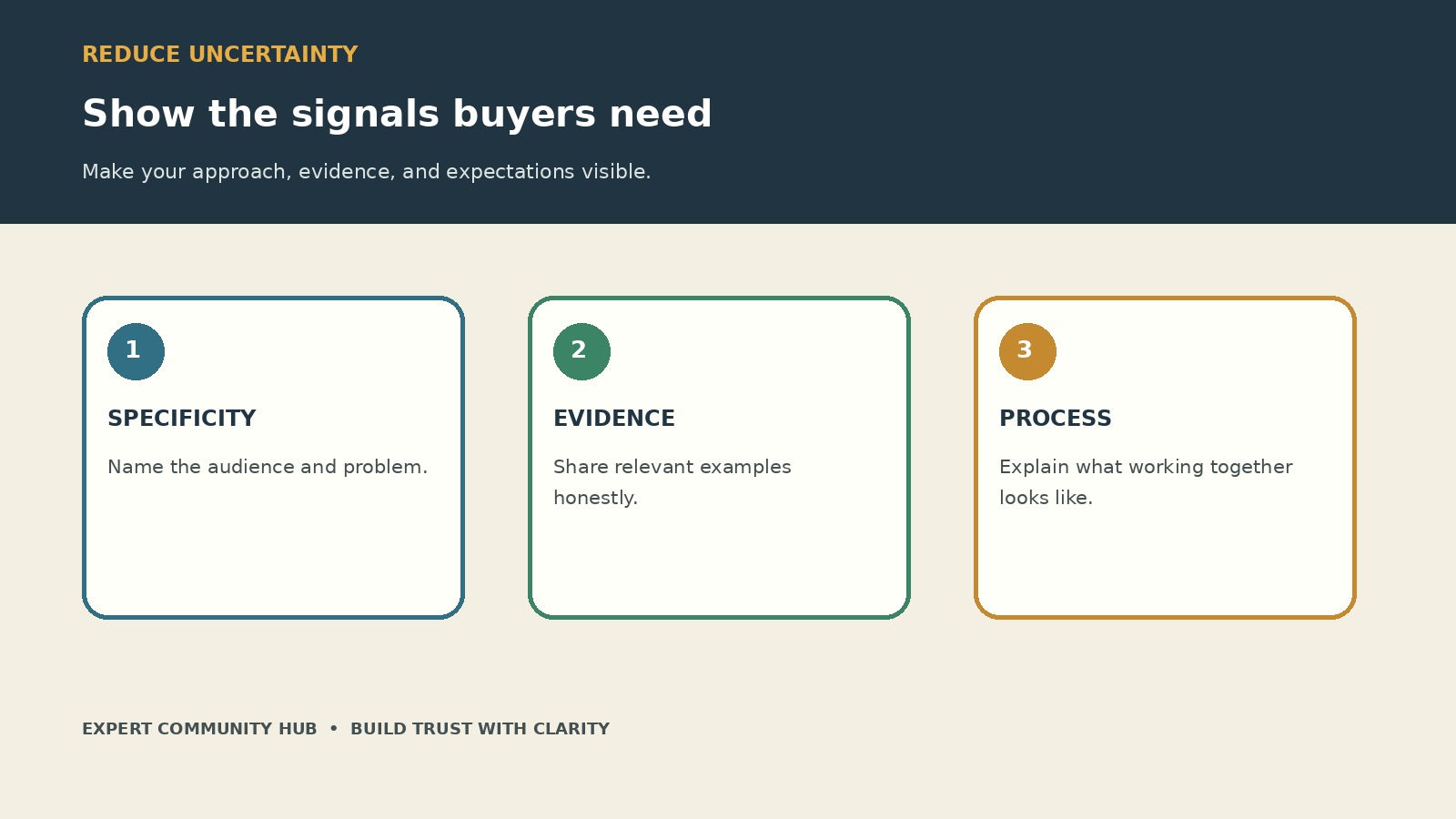
Help people evaluate the things that are more relevant to their needs:
- The problem your service is designed to address.
- The process and support you provide.
- The fit between your approach and their circumstances.
- The deliverables and responsibilities involved.
- The evidence available to support your claims.
- The expectations and limitations they should understand before buying.
You cannot control every buyer's decision. Some will prefer another expert, a different price, or a different style. Your goal is not to appeal to everyone. It is to help suitable prospects understand why your offer may fit them.
Review your offer through a buyer's eyes
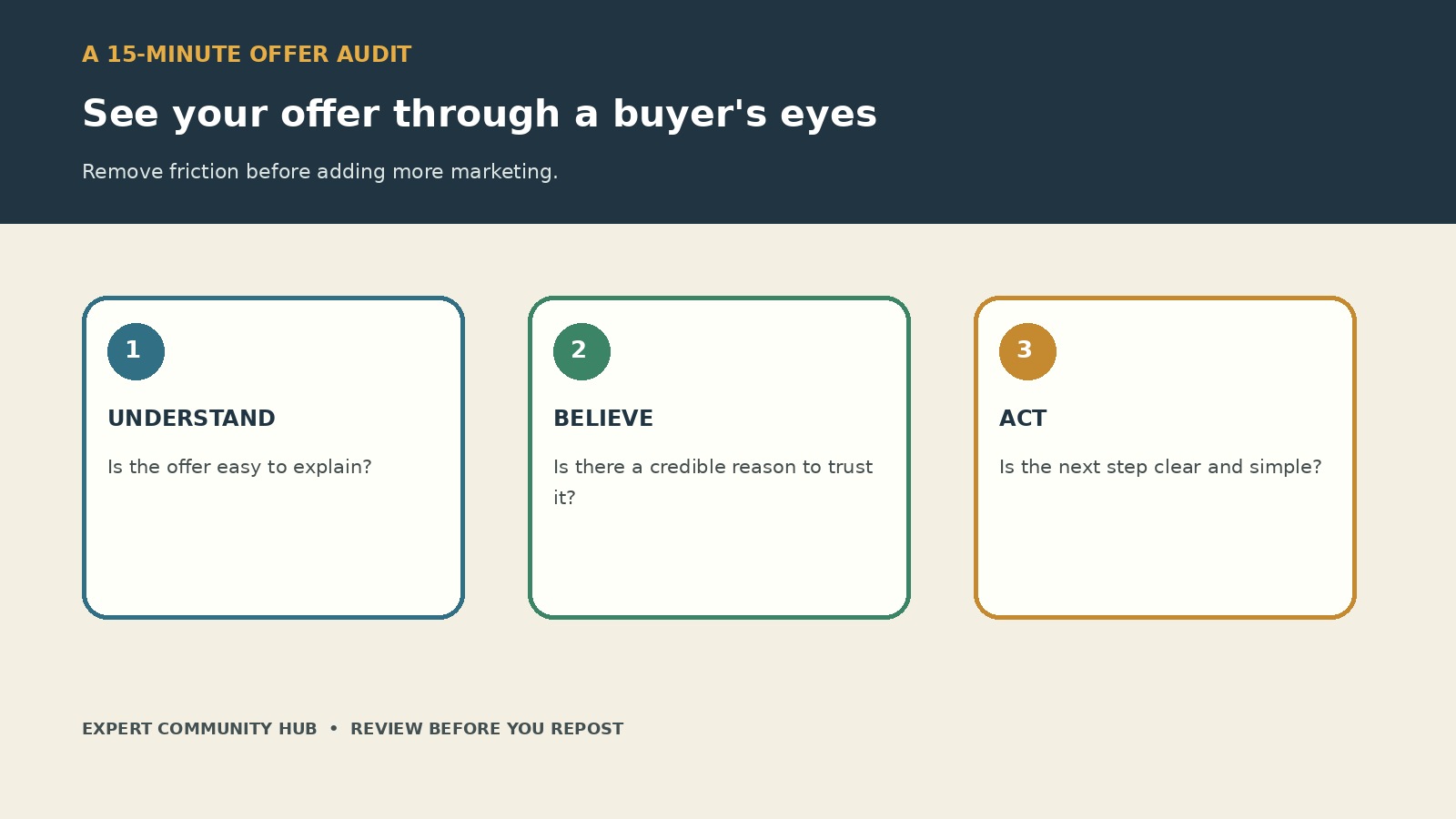
Open your main profile, website, landing page, or service description. Pretend you have never heard of your business.
Ask yourself:
Can I tell who this is for? If not, clarify the audience.
Can I identify the problem it addresses? Replace broad language with a recognizable situation.
Can I understand the process? Explain what happens after someone becomes a client.
Can I find a credible reason to trust it? Show relevant experience, a clear method, a demonstration, or honest evidence.
Can I see what to do next? Make the next step visible and explain what it involves.
You do not need to redesign everything. One clear improvement may remove a meaningful point of confusion.
Your 15-minute conversion reset
Set a timer for 15 minutes.
Minutes 1–5: Read your current offer description and underline any vague phrases, such as “unlock your potential,” “transform your life,” or “grow your business.”
Minutes 6–10: Rewrite the opening to name one audience, one problem, and one realistic intended outcome.
Minutes 11–15: Add one credible signal—such as a description of your process or a relevant sample—and make the next step obvious.
Then ask a trusted person to read the page and explain what they think you offer. Their interpretation may reveal a gap you no longer notice because you know your business so well.
What if your offer is already clear?
Then look beyond the message.
A prospect may not be a good fit. They may lack budget, urgency, authority to decide, or confidence that the timing is right. Your offer may also need to be improved, or your audience may be finding you through the wrong channels.
Do not assume every lost sale is a branding problem. Ask respectful questions when appropriate, review patterns across several conversations, and use the evidence to decide what to improve.
A single prospect choosing someone else does not prove that your business is broken. Repeated patterns are more useful than one disappointing outcome.
Your turn
When a potential client compares you with another expert, what makes your offer easier to understand, trust, and act on?
Share one improvement you could make. Your answer may help another coach or consultant see their offer from a buyer's perspective.
Your next step
If you are a coach, consultant, or knowledge-based professional, Expert Community Hub can help you explore how to communicate your expertise, clarify your offer, and build a more structured approach to client acquisition.
Start by improving one of the three decision factors: clarity, confidence, or convenience. Make the choice easier for the right people—without pressuring the wrong people to buy.
Written for coaches, consultants, and knowledge-based entrepreneurs by Expert Community Hub.