

Your content may be useful and polished, yet still blend into the feed. Discover how a distinctive point of view, repeatable message, and signature ideas can help the right audience remember your expertise.
Imagine someone scrolling through their feed.
They see a tip about productivity. Then a motivational quote. Then a video about AI. Then a carousel about business growth.
Every post is decent. Some are genuinely helpful.
Ten minutes later, could they tell you who created which one?
Often, no.
That does not mean the creators are bad at what they do. It means the feed is crowded with ideas that can sound remarkably similar.
The hidden problem may not be the quality of your content. It may be that your content gives people nothing distinctive to associate with you.
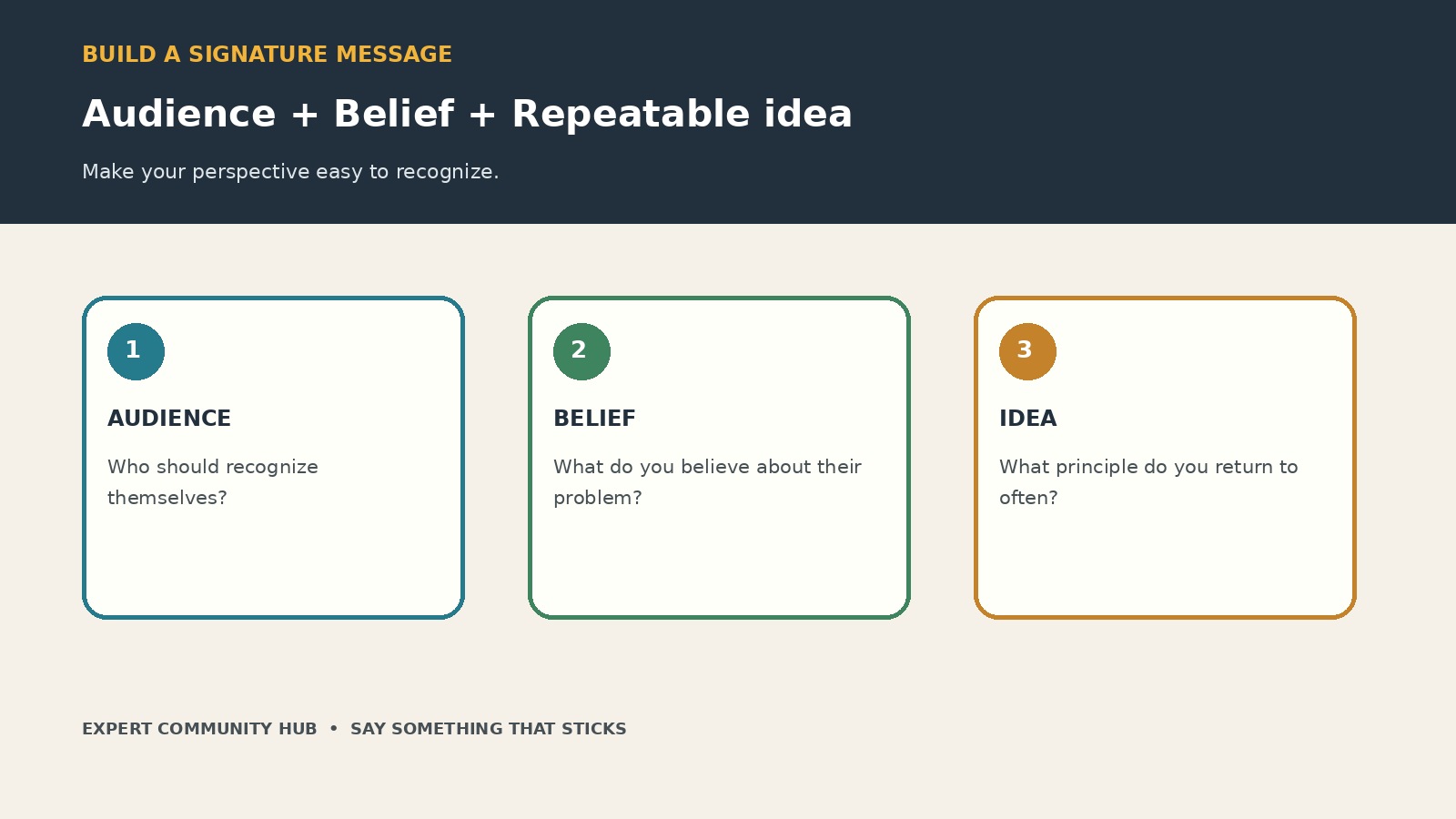
If you want the right audience to remember your expertise, you need more than useful information. You need a recognizable point of view.
The feed is full of good advice
“Be consistent.”
“Know your audience.”
“Provide value.”
“Build trust.”
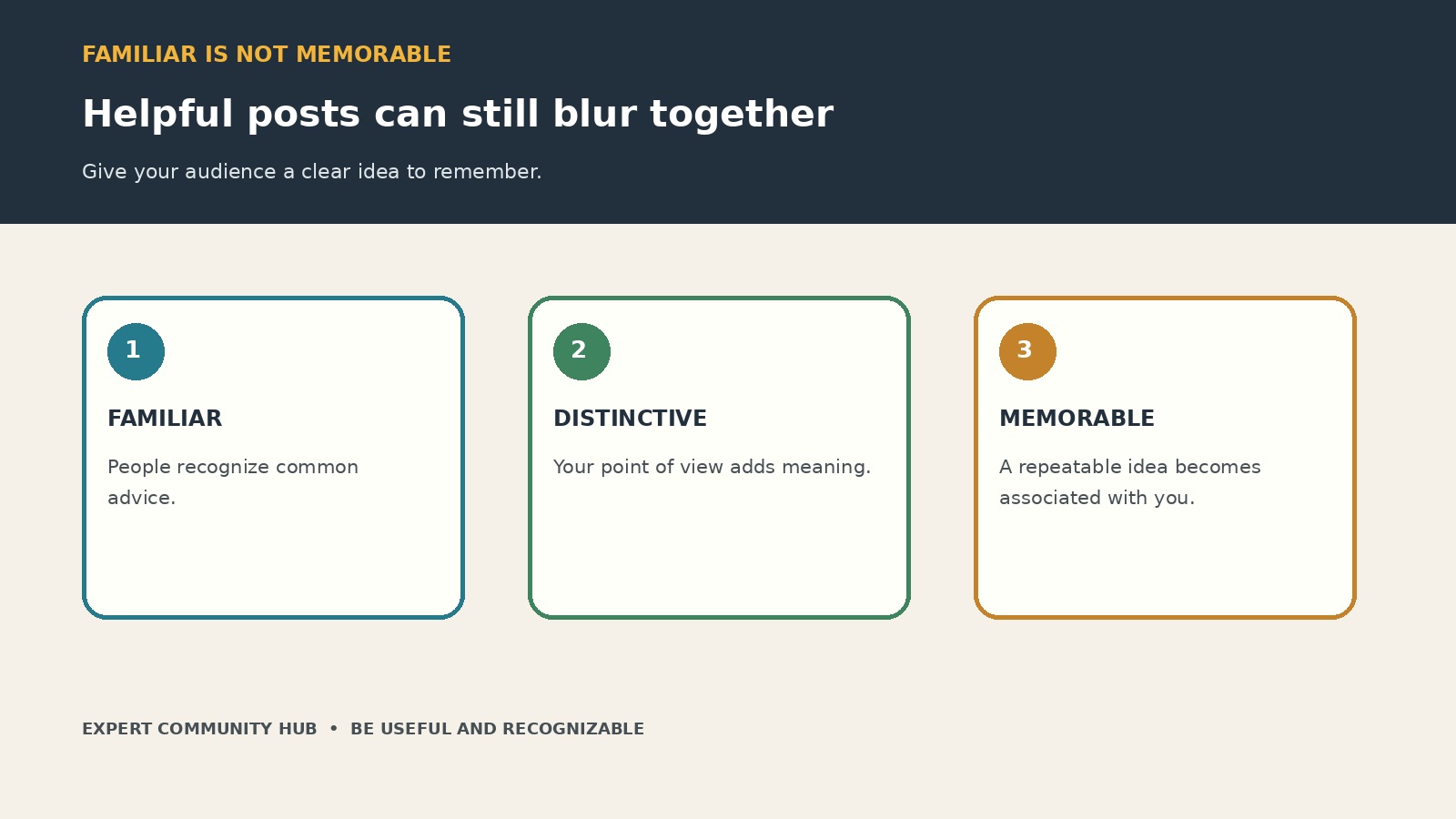
These ideas are not wrong. In fact, they are often important. But when everyone repeats them in almost the same way, they become difficult to associate with one person or brand.
You can publish useful content for months and still feel invisible because your ideas never connect into a recognizable story.
One post is about mindset. The next is about a trending tool. The next repeats a general business tip. Each post may earn attention, but the audience does not learn what you consistently stand for.
Memorability is not about being controversial for its own sake. It is about giving people a clear, useful idea they can connect to your name.
What makes an expert memorable?
Think of the teacher whose explanation finally made a difficult concept click.
You may not remember every lesson. But you remember the analogy, the phrase, or the way that person helped you see the problem differently.
That is the power of a recognizable perspective.
A memorable expert often does three things:
- Names a problem clearly. They describe something their audience has experienced but struggled to explain.
- Offers a distinct interpretation. They show why the problem happens or challenge an unhelpful assumption.
- Returns to a core idea. Across different examples, their work reinforces a recognizable principle.
You do not need to invent an entirely new theory. You need to explain what you know in a way that is specific, honest, and useful to the people you serve.
The SIGNATURE Method
Use this framework to develop a recognizable content identity.
S — Select the audience you want to be remembered by
A message becomes easier to recognize when it speaks to a clear group.
You might help independent coaches, small business owners, career professionals, or health experts. You can have more than one audience, but each piece of content should make it reasonably clear whom it is for.
Ask: “Who should see this and think, ‘This person understands my situation’?”
I — Identify a belief you genuinely hold
What do you believe about your audience's problem that shapes how you work?
For example:
- More content is not always the answer; a clear content system may matter more.
- More leads will not fix an offer that people do not understand.
- A useful follow-up process should help prospects make an informed decision, not pressure them.
These beliefs are not magic slogans. They are working principles you can explain and support with examples.
Choose a belief that reflects your actual approach—not merely a catchy line.
G — Give the belief a clear phrase
Create a short way to express your idea.
For example: “Attention needs a direction.”
That phrase can anchor content about calls to action, resource pages, workshops, and client journeys. It is simple enough to remember and broad enough to explore through different examples.
Avoid forcing a phrase into every post. Use it when it genuinely helps explain the lesson.
N — Narrate the idea through real examples
A point of view becomes more convincing when people can see it in action.
Use client questions, anonymized patterns, demonstrations, lessons from your own process, or hypothetical examples clearly presented as such. Explain what happened, what you learned, and how the lesson applies.
Never invent client results or present made-up testimonials as evidence.
A — Apply the idea in different formats
Your central idea can appear in a blog post, a short video, a live workshop, a checklist, or a community discussion.
The format changes. The underlying perspective remains recognizable.
T — Track what people remember
Look beyond likes. Notice whether people repeat your phrases, ask questions connected to your core ideas, or describe your work in terms that match your intended positioning.
Ask trusted audience members what they associate with your brand. Their answers may reveal whether your message is landing as intended.
U — Update when your understanding improves
A signature idea is not a permanent cage. Your audience may change, your expertise may deepen, and your language may become clearer.
Keep the principles that are useful. Refine or retire the ones that no longer represent your work.
R — Repeat with variation
Repetition helps recognition, but repetition does not mean publishing the same post again and again.
Explore the same principle through different problems, stories, examples, objections, and practical exercises. Let your audience encounter the idea in ways that add new value.
E — Ensure the idea serves the audience
The purpose of being memorable is not to make everything about you. It is to help the right people recognize the value of your perspective.
If a clever phrase distracts from the lesson, simplify it. Clarity matters more than cleverness.
Example: from generic advice to a recognizable point of view
Imagine two coaches discussing content marketing.
The first says: “Post consistently and provide value.”
The second says: “Every post should have a job. Some posts help people discover you. Some help them trust your thinking. Others help them take a useful next step.”
The second message gives the audience a framework to remember. It also creates several practical topics: discovery content, trust-building content, and next-step content.
The coach can return to that idea without repeating the same article. One post can explain the framework. Another can audit a content calendar. A video can demonstrate how to improve a call to action. A workshop can help participants apply it.
The signature idea becomes a thread connecting the work.
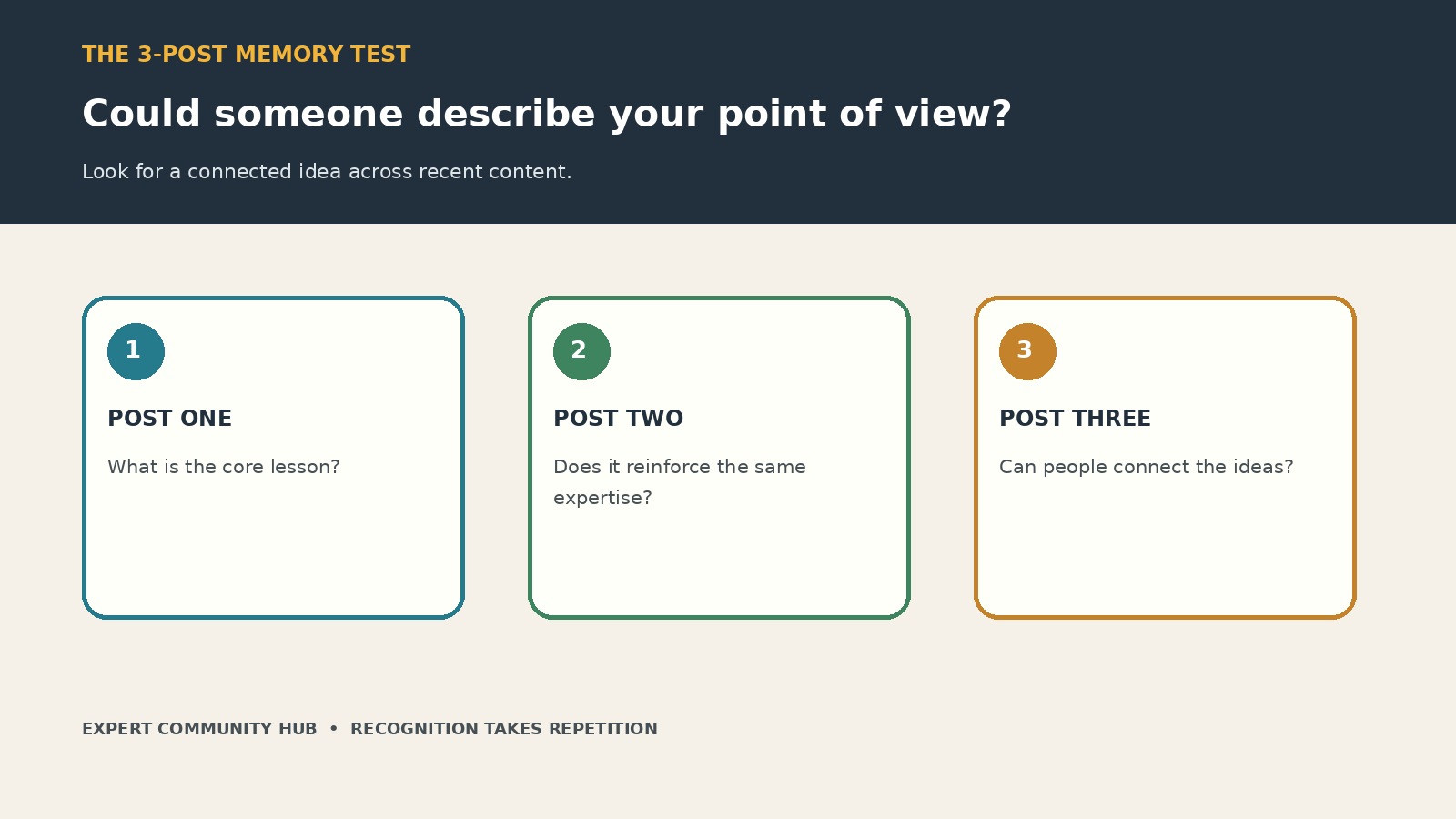
The three-post memory test
Open your last three posts.
Do not judge them by design or reach yet. Ask:
Post one: What is the main idea someone should remember?
Post two: Does it connect to the kind of problem you want to be known for?
Post three: Does it reinforce or deepen your point of view?
If the posts feel unrelated, you do not necessarily need to delete them. Use the exercise to decide what to publish next.
Choose one core belief and create three different pieces around it: one that explains the problem, one that demonstrates your approach, and one that helps the audience take action.
Your 25-minute memorable-message exercise
Set a timer and answer these prompts.
Minutes 1–5: Write down the three problems your best-fit audience asks about most often.
Minutes 6–10: Choose one belief you hold about why one of those problems occurs.
Minutes 11–15: Write a short phrase that expresses the belief clearly. Avoid jargon and exaggerated claims.
Minutes 16–20: Brainstorm three different posts that explain the idea through different examples.
Minutes 21–25: Review your bio or website headline. Does it help people understand the audience and problem you want to be associated with?
You do not need to finish a complete brand strategy in 25 minutes. You need one useful idea to develop further.
Do not confuse memorability with noise
Being memorable does not require outrage, manufactured controversy, or exaggerated promises.
You can stand out by explaining a familiar problem unusually clearly, sharing a thoughtful perspective, using a practical framework, or showing your work with honesty.
The best signature idea is one you can keep supporting with useful content and real expertise.
People may not remember every post. That is fine. Aim to leave them with a clearer understanding of the problem, a useful principle, or a phrase that helps them recall your approach when they need it.
Your turn
What is one idea you want people to associate with your name or business?
It could be a belief, a method, a phrase, or a problem you are especially good at explaining. Share it in the comments—and tell us why it matters to your audience.
Your next step
If you are a coach, consultant, or knowledge-based professional, Expert Community Hub can help you explore how to clarify your positioning, communicate your expertise, and build a more structured approach to client acquisition.
Do not try to be remembered for everything. Start by helping the right people remember one useful thing about how you think and how you help.
Written for coaches, consultants, and knowledge-based entrepreneurs by Expert Community Hub.