

A prospect showed interest and then went quiet. Learn how to follow up with confidence, add value, and invite a conversation without sounding pushy.
They asked for details. You replied. Then… silence.
You see their name in your messages.
They had a question about your coaching. They asked about your program. Maybe they even said, “This sounds interesting. Let me think about it.”
You sent the details.
And nothing happened.
Now you are stuck between two thoughts:
“Maybe they are busy.”
And:
“If I message again, will I sound desperate?”
So you wait. A few days pass. Then a week. Eventually, the conversation disappears under newer messages.
Here is the truth: silence does not always mean rejection. People get busy. They have questions they have not articulated. They need time to discuss a decision or understand whether your offer fits.
A thoughtful follow-up can reopen the conversation.
The key is to stop treating follow-up as a demand for a decision. Treat it as a chance to help someone take the next step—whatever that step may be.
Why most follow-up messages feel awkward
Many follow-ups focus on the seller's need for an answer.
“Any update?”
“Have you decided?”
“Are you joining?”
These messages are not automatically wrong. But without context, they can feel like pressure. They ask the prospect to move the sale forward without giving them anything useful to respond to.
A better follow-up gives the conversation a reason to continue.
It connects to the person's original goal. It offers something relevant. It asks a simple question. And it leaves room for an honest answer.
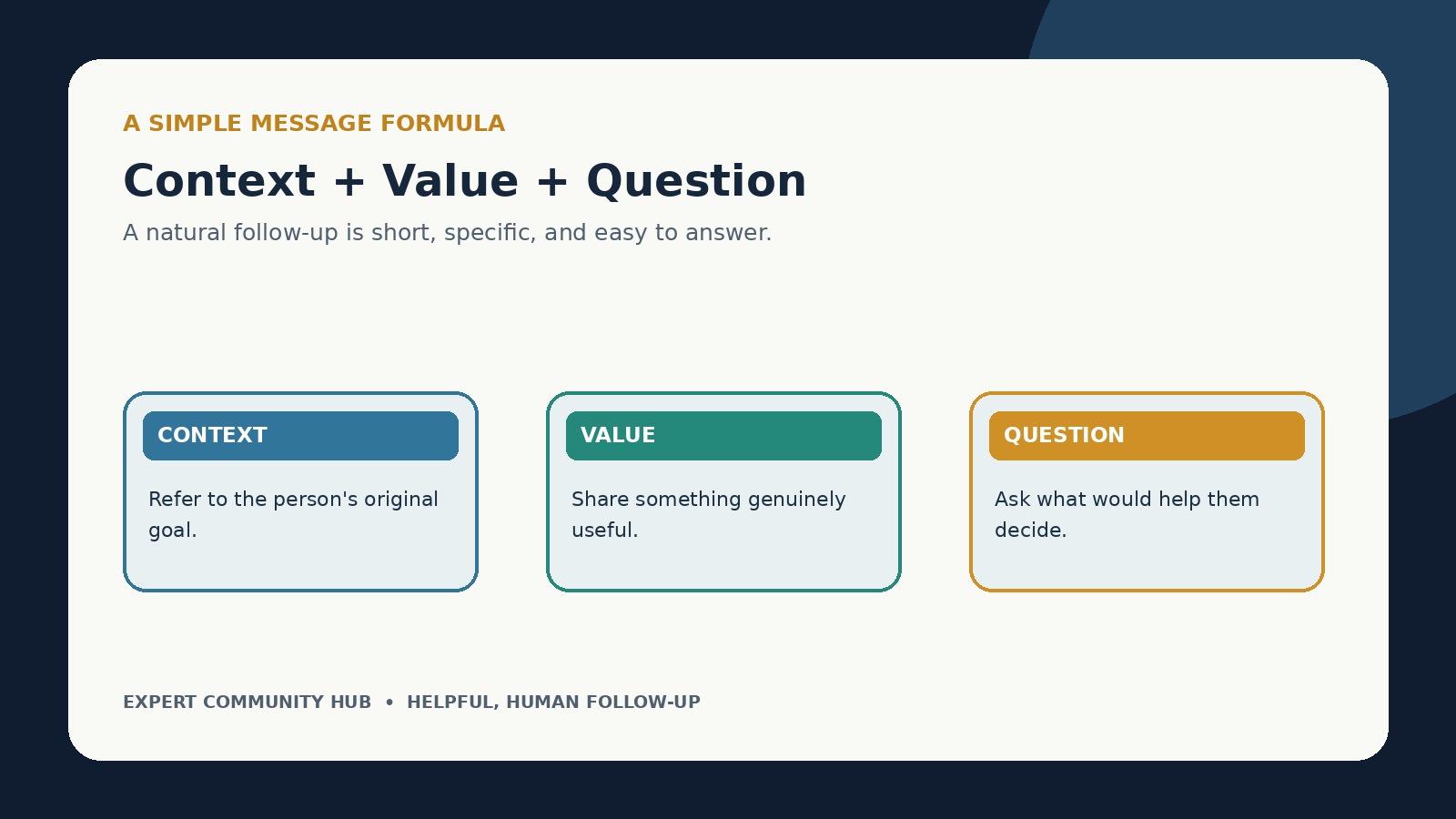
The three-part follow-up framework
1. Start with context
Remind the person what you were discussing. Keep it natural and specific.
Instead of a vague “Just checking in,” mention the goal or question they shared.
For example:
“Hi Priya, when we spoke, you mentioned wanting a more consistent way to get enquiries for your coaching business…”
This shows that you remember the person, not just the opportunity to sell.
2. Add something useful
Give them a reason to read the message beyond responding to you.
You could share a short checklist, clarify a common concern, point out a useful resource, or explain one practical step related to their goal.
Keep it relevant. Do not send a long article or a generic motivational quote just to fill the silence.
3. Ask one easy question
Finish with a question that is simple to answer and helps you understand what they need.
For example:
“Would it help if I shared the three steps I would start with in your situation?”
Or:
“Is your main concern the time required, the investment, or whether the approach will fit your business?”
Do not use a question to corner someone. Give them a comfortable way to clarify their situation—or tell you that now is not the right time.
Copy-and-adapt follow-up messages
Use these as starting points. Personalize them to the actual conversation rather than sending them as a sequence to everyone.
Message 1: After someone asks for details
“Hi [Name], thanks for asking about [program/service]. You mentioned that your main goal is [specific goal]. One thing that may help is to start with [relevant insight or first step]. Would you like me to explain how that could work in your situation?”
Message 2: When they said they need time to think
“Hi [Name], I wanted to give you some space to think through our conversation. Is there anything about the approach, time commitment, or investment that you would like me to clarify? No pressure either way—I want you to have the information you need to make the right decision.”
Message 3: When they have gone quiet
“Hi [Name], I know things can get busy. I’m sharing this because you mentioned [specific challenge]: [brief helpful resource or idea]. If solving that is still a priority, I’m happy to talk through a possible next step. If your focus has changed, that’s completely fine too.”
Message 4: A respectful final follow-up
“Hi [Name], I’ll close the loop here so I don’t keep filling your inbox. If [goal/problem] becomes a priority again, feel free to reach out. Wishing you the best with it.”
A final message like this protects the relationship. It also helps you stop spending energy on a conversation that is not moving forward.
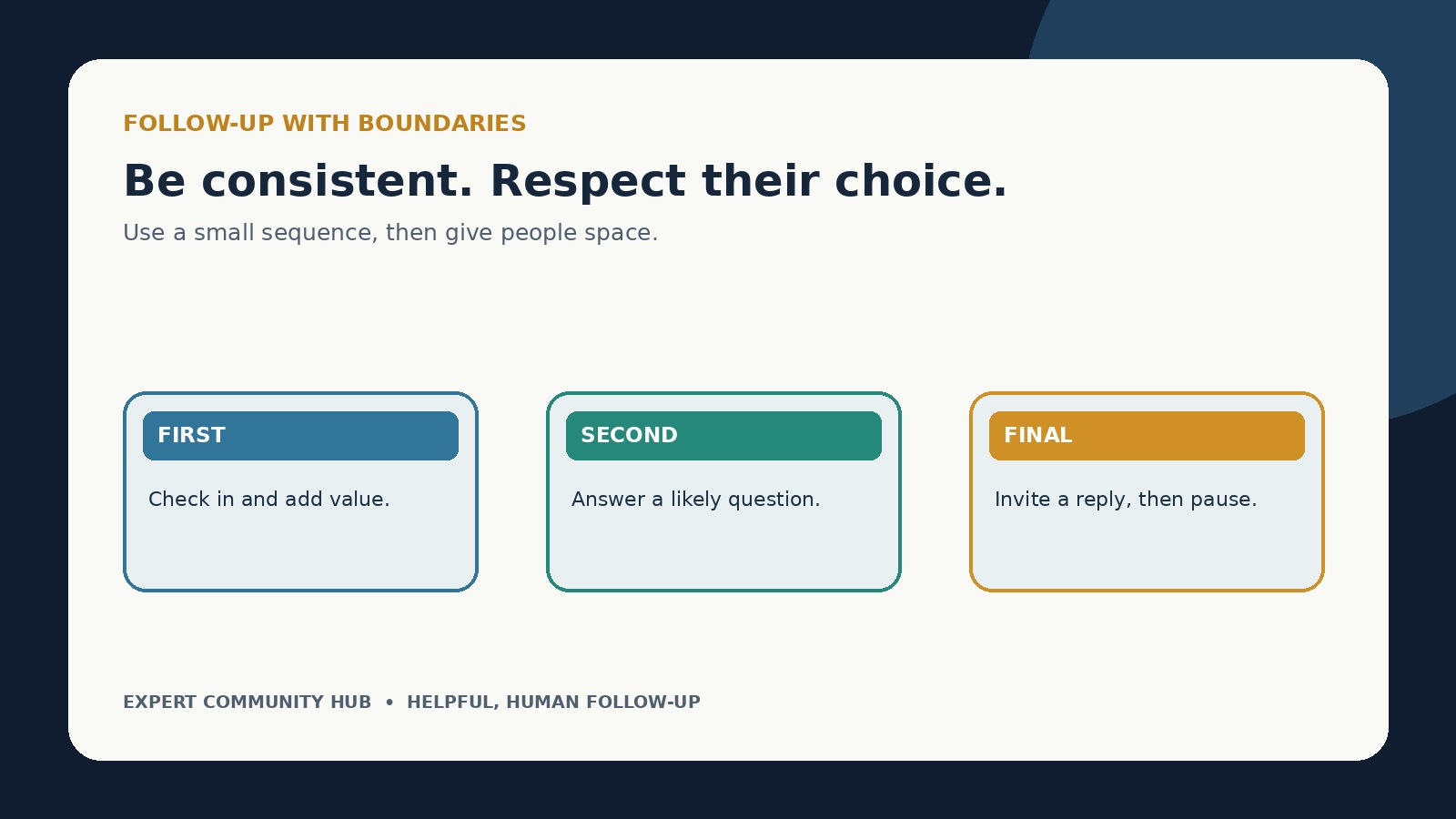
A simple follow-up sequence
You do not need to message every day. Use a reasonable rhythm based on the conversation and the prospect's expectations.
- First follow-up: refer to their goal and offer useful context.
- Second follow-up: answer a likely question or share a relevant resource.
- Final follow-up: invite a response, make it easy to say “not now,” and then pause.
If someone asks you not to contact them, respect that immediately. If they tell you they are not interested, thank them and stop pursuing the sale.
The aim is a better conversation, not endless chasing.
What if they still do not reply?
Let the silence be information—not a verdict on your worth or your expertise.
They may not have the budget. The problem may not be urgent. They may have chosen another option. Or they may simply not be ready.
You cannot control their decision.
You can control whether your communication is clear, relevant, and respectful. You can also build a simple system to record who needs a follow-up, when you last spoke, and what the next useful step should be.
That way, you are not relying on memory or sending the same message to everyone.
Your 10-minute follow-up reset
Choose three prospects who previously showed genuine interest.
For each person, write down:
- What goal or challenge did they mention?
- What question might still be unresolved?
- What small piece of value could you offer?
- What one question would help them decide their next step?
Send only the messages that are relevant and appropriate. Personalize each one. Then record the date and next step.
This is how follow-up becomes a professional habit instead of an uncomfortable last-minute task.
Follow up like a guide, not a pursuer
You do not need clever tricks to make people buy.
You need to understand their situation, communicate the value of your work, and help them decide whether moving forward makes sense.
A good follow-up says:
“I listened. I remember what matters to you. Here is something useful. What would help you from here?”
Sometimes the answer will be yes. Sometimes it will be no. Sometimes it will be not now.
All three answers are more useful than leaving every conversation unfinished.
Your turn: Which part of following up feels hardest for you—knowing what to write, choosing when to send it, or handling the possibility of rejection?
Written for coaches, consultants, and knowledge-based entrepreneurs by Expert Community Hub.