
You may have years of experience and real expertise—but if the right people cannot find you, understand you, or remember you, your business can remain invisible.
You spent years becoming good at your work. But how many people outside your existing circle know what you can actually do?
You have experience.
You have solved difficult problems. Helped people make decisions. Built skills that took years to develop. You may have certificates, case studies, professional achievements, and lessons that could save someone else months of frustration.
Yet when you look at your business, something feels wrong.
People with less experience seem to get more attention. Their posts attract comments. Their names appear in conversations. Prospects reach out to them.
Meanwhile, you keep doing good work—but much of it happens quietly, behind the scenes.
It can feel unfair.
But here is a truth worth considering:
Being good at what you do and being known for what you do are two different things.
Expertise creates value. Visibility helps the right people discover that value.
If people cannot find you, understand what you help with, or remember you when they need that help, your experience may remain a hidden asset.
The pain of being capable but invisible
For many coaches, consultants, and independent experts, invisibility does not mean nobody has ever heard of them.
It means the people who could benefit from their work do not consistently think of them when a problem appears.
Your colleagues may respect you. Friends may ask for advice. Past clients may appreciate your work.
But your business needs more than occasional recognition from people who already know you.
It needs a way for new, suitable people to discover you and understand why your expertise matters to them.
Without that, you may depend heavily on referrals, wait for opportunities to appear, or repeatedly explain your value from scratch.
Over time, this creates a frustrating cycle:
- You have knowledge but struggle to communicate it clearly.
- You create content but are unsure who it is meant to reach.
- You hesitate to promote yourself because it feels uncomfortable.
- You wait for people to notice your ability.
- When enquiries slow down, you question whether your expertise is enough.
The problem may not be your ability. It may be the gap between what you know and what the market can see.
The hidden reason: your expertise is difficult to recognize
Imagine two consultants.
The first says, “I have extensive experience in business, marketing, strategy, technology, and growth.”
The second says, “I help independent coaches build a repeatable process for attracting and following up with potential clients.”
The first may have broader experience. But a potential client struggling to generate enquiries can immediately understand why the second consultant may be relevant.
The second consultant has made the connection easier to recognize.
This is the visibility gap: your audience cannot value a solution it does not understand.
Being visible does not mean posting every day or trying to become famous. It means making three things clear:
- Who you help.
- Which problem you help them solve.
- How your perspective or process helps them move forward.
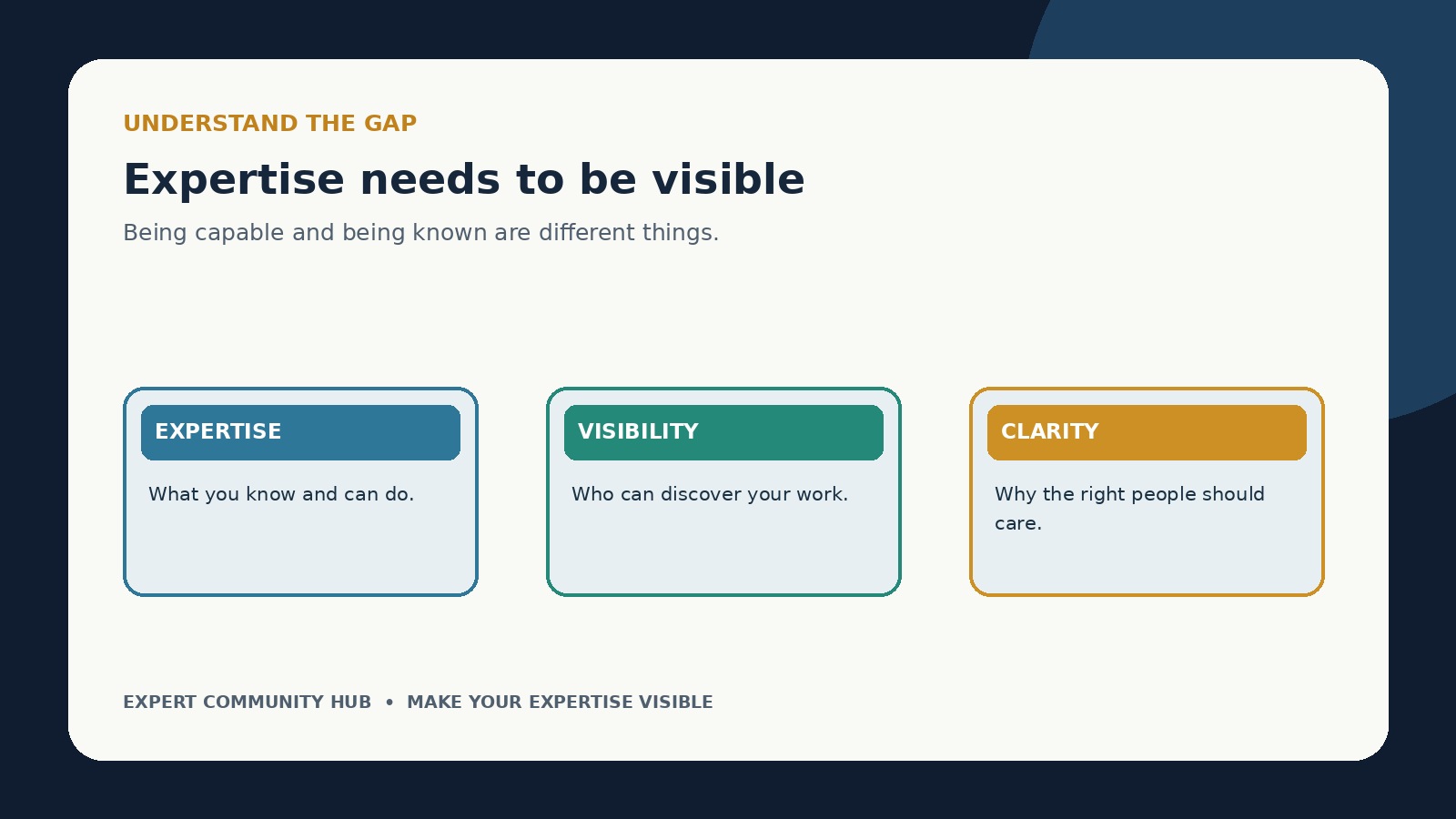
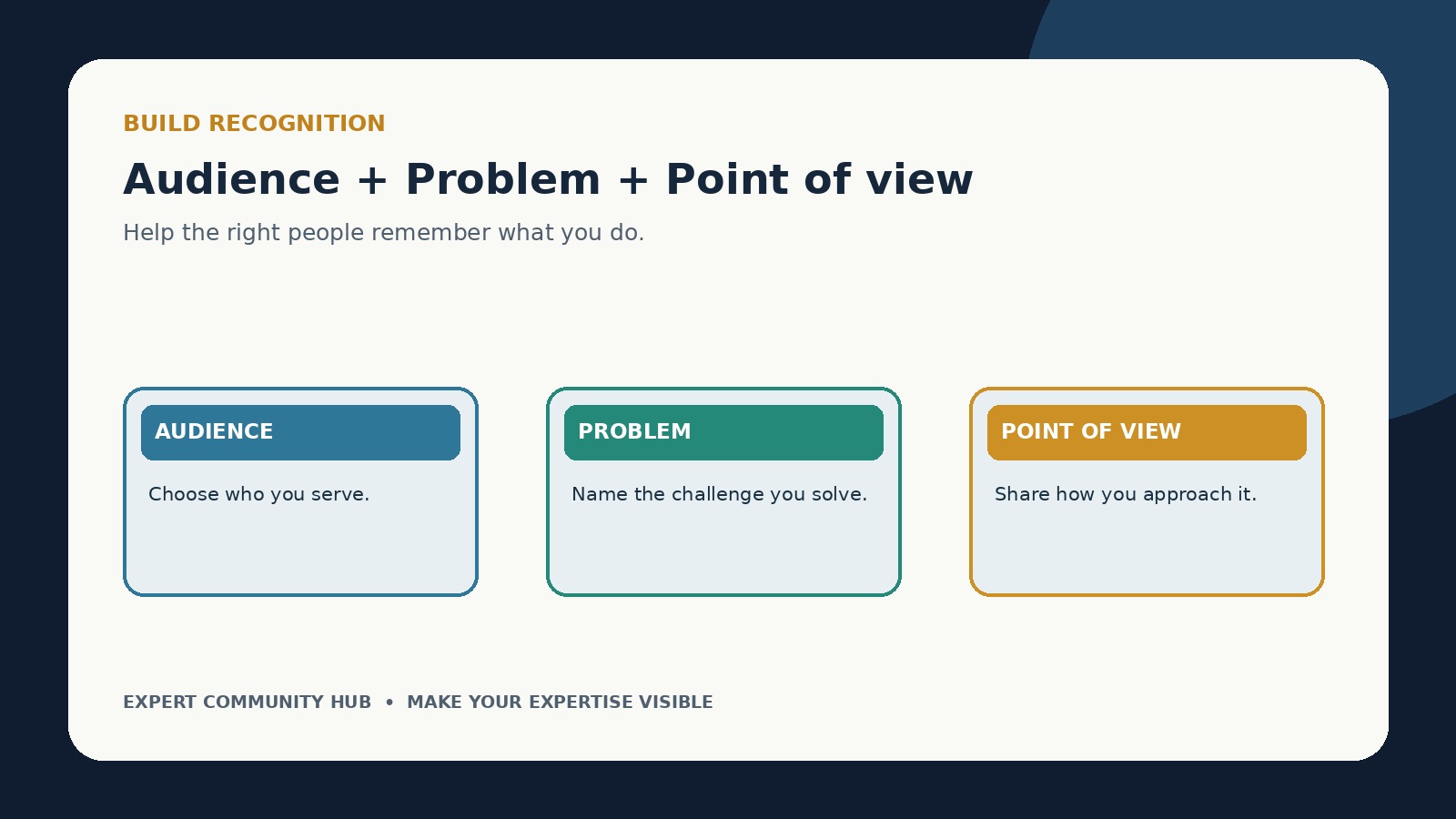
The Recognition Framework: Audience + Problem + Point of View
You do not need to become a different person to become more visible. You need a clearer way to communicate the value you already have.
1. Choose the audience you want to be known by
You can have experience across many areas. But your public message becomes easier to remember when it speaks to a recognizable group of people.
Instead of saying “I help everyone grow,” choose a group you understand and can genuinely help.
For example:
- Coaches who struggle to generate consistent enquiries.
- Consultants who rely entirely on referrals.
- Professionals who want to turn their knowledge into a service.
- Small business owners who need a clearer customer-acquisition process.
This does not mean you must refuse every other client. It gives your communication a clear starting point.
2. Name a problem that audience recognizes
Avoid describing your work only through credentials, titles, or broad promises.
Describe the problem from the audience's perspective.
Instead of “I provide strategic business consulting,” you might say:
“I help independent experts identify why their marketing is not producing enough qualified conversations and build a simpler process to improve it.”
A specific problem helps the right person recognize themselves in your message.
3. Share your point of view
Your point of view is how you think about the problem.
What do you believe people misunderstand? What mistake do you see repeatedly? What process do you use to diagnose the situation? What would you do first—and why?
You do not need a controversial opinion for every post. A useful, clear perspective is enough.
When people repeatedly see how you think, they begin to understand more than your knowledge. They begin to understand your approach.
How to make your expertise visible without becoming an influencer
You do not need to dance on camera, chase every trend, or publish ten times a day.
Start with a manageable visibility system.
Share one useful idea consistently. Answer a real question your audience asks. Explain a common mistake, offer a practical checklist, or show how you approach a problem.
Demonstrate your thinking. Use examples, short case studies, walkthroughs, or lessons from your work. Be honest about what is proven and what is only a hypothesis.
Make your service discoverable. Your profile, website, and content should make it easy to understand what you do and how someone can explore working with you.
Build relationships, not just reach. Respond thoughtfully to relevant conversations, collaborate with complementary experts, and reconnect with people who may benefit from your work.
Repeat your core message. People rarely remember a message they see once. Repetition across useful content helps people associate your name with a problem you understand.
Visibility is not one viral moment. It is a series of clear, credible signals over time.
Your 30-minute visibility action plan
You do not need to redesign your entire personal brand today.
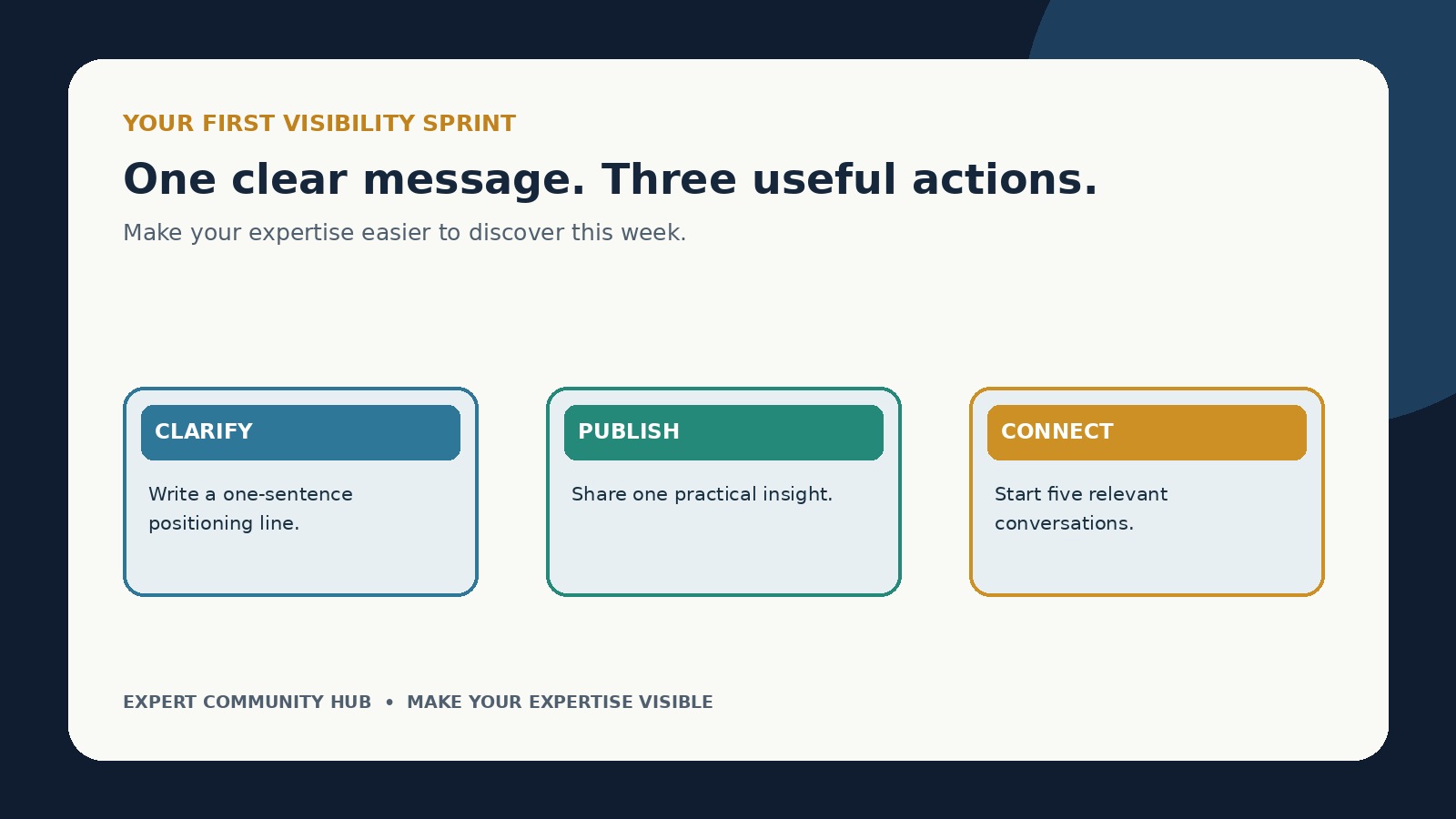
Set aside 30 minutes and complete these three actions.
Minutes 1–10: Write your positioning sentence
Complete this sentence:
“I help [specific audience] solve [specific problem] through [your approach].”
Keep it clear enough that someone outside your industry can understand it.
Minutes 11–20: Publish one useful insight
Write a short post answering a question your audience frequently asks.
Use this simple structure:
- The problem they recognize.
- Why it may be happening.
- One practical step they can take.
- A question that invites a genuine response.
You do not need to sell in every post. Help people understand how you think.
Minutes 21–30: Start five relevant conversations
Reach out to five people in your professional network or participate thoughtfully in relevant discussions.
Do not send a generic pitch. Ask about their work, share a useful resource when appropriate, or continue a conversation that already exists.
The aim is to become more connected to the people you want to serve—not to pressure five strangers into buying.
What if you are uncomfortable promoting yourself?
You may believe that talking about your work is boastful.
You may worry that colleagues will judge you, that your content will receive little engagement, or that you will look inexperienced while learning in public.
Those concerns are understandable.
But there is a difference between exaggerating your ability and explaining how you can help.
You do not need to claim you are the best. You do not need to promise extraordinary results. You can simply share useful knowledge, show your process, describe your experience honestly, and invite suitable people to learn more.
Think of visibility as helping the right person find a useful resource.
If you have a skill that can genuinely help someone, communicating it clearly is a service—not a performance.
The real goal is to be remembered for the right reason
You do not need everyone to know your name.
You need the right people to remember what you help with when the relevant problem appears.
That happens when your positioning is clear, your content is useful, your communication is consistent, and your next step is easy to understand.
Your years of experience matter. Your knowledge matters. Your work matters.
But the market cannot respond to value it never sees.
Start by making one thing clear to one audience. Share it consistently. Build genuine relationships. Improve based on the questions people ask.
You do not need to become famous to build a meaningful expert business.
You need to become easier for the right people to discover, understand, and trust.
Your turn
What do you think is keeping your expertise invisible right now: unclear positioning, inconsistent content, discomfort with self-promotion, or not knowing where to find the right audience?
Share your answer in the comments. Your experience may help another expert who is facing the same challenge.
Your next step
If you are a coach, consultant, or knowledge-based professional who wants to turn expertise into a more structured business, explore the resources and learning opportunities from Expert Community Hub.
Start with one clear audience, one problem you can help solve, and one repeatable way to make your expertise visible. Build from there—one useful step at a time.
Written for coaches, consultants, and knowledge-based entrepreneurs by Expert Community Hub.