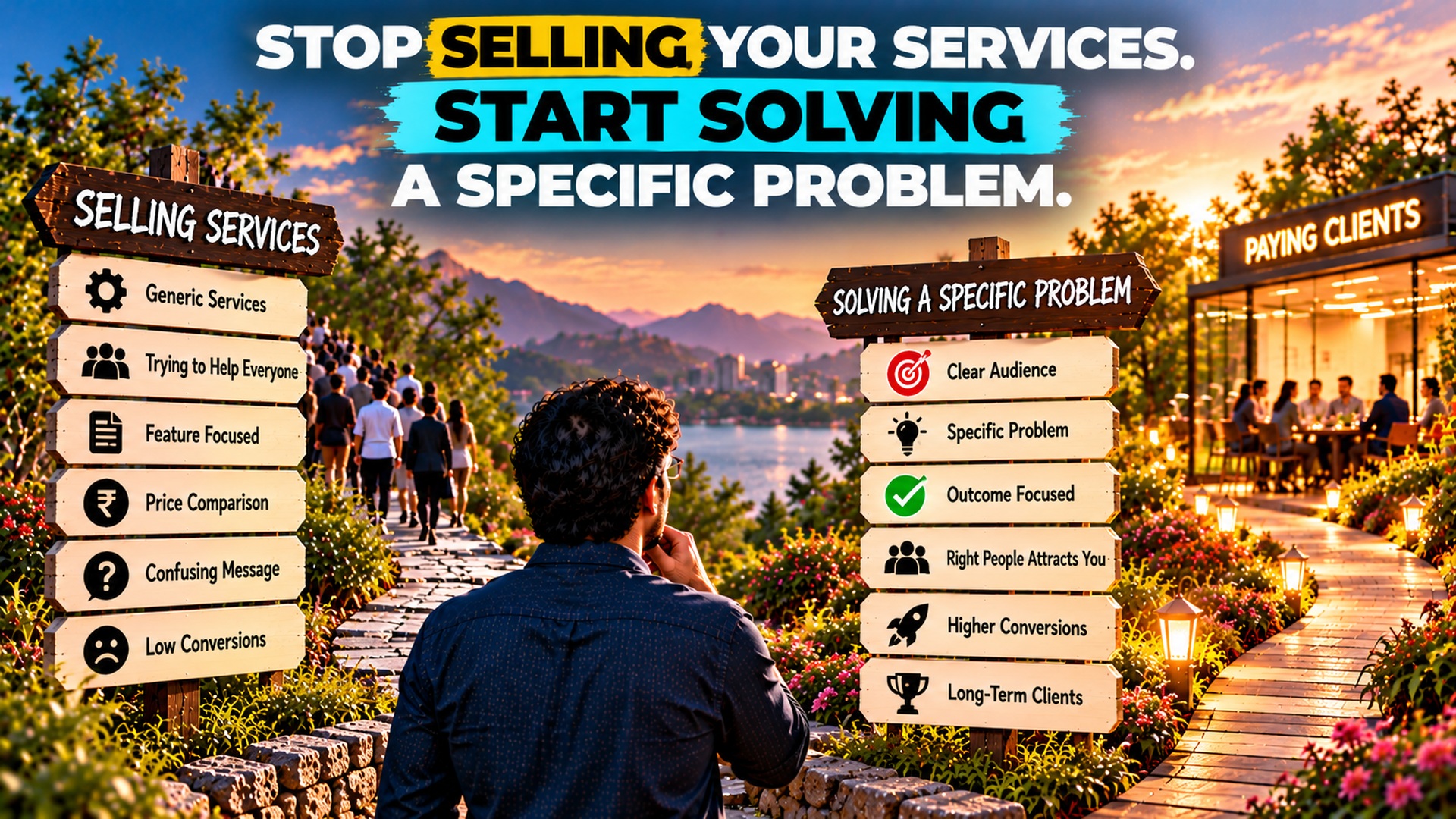
A long list of services can leave potential clients unsure what to choose. Learn how to shape a problem-focused offer that makes your audience, process, and value easier to understand.
“I offer coaching, consulting, strategy, workshops, digital marketing, and business growth support.”
That may be an accurate description of your skills.
But a potential client is still left wondering: “Which of these do I need? And what will it actually help me solve?”
When your marketing focuses on a list of services, people have to do the hard work of connecting those services to their own problems.
A stronger approach starts with the problem.
People do not buy a service simply because it exists. They consider it when they understand how it may help with something that matters to them.
You do not need to hide your skills or reduce your business to one task forever. You need to make the value of your offer easier to understand.
Why a list of services can weaken your message
Imagine a consultant's website says:
- Business coaching
- Marketing strategy
- Content creation
- Funnel building
- AI automation
- Sales training
The list may look impressive. It may also create a difficult decision for a visitor who simply wants to stop losing potential clients after an enquiry.
They do not necessarily know which service to choose. They may compare each item by price or assume the consultant is selling tasks rather than helping solve a business problem.
Now imagine the same consultant says:
“I help independent experts create a clearer process for turning enquiries into client conversations.”
The services can still be part of the delivery. But they now have a purpose: they support a problem the client recognizes.
This does not guarantee a sale. It gives the prospect a clearer starting point for deciding whether the consultant is relevant.
The difference between a service and a solution
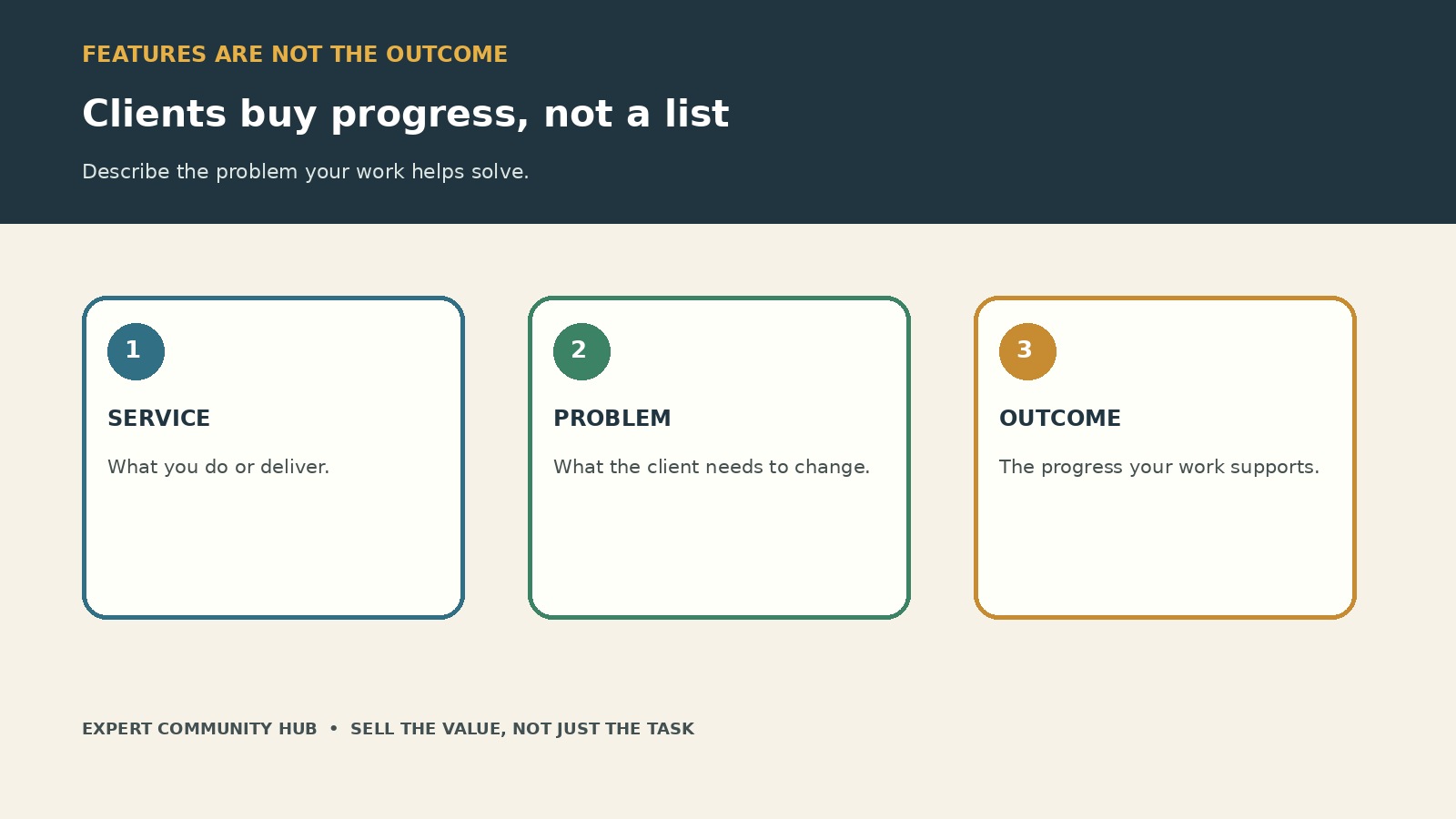
A service describes what you do.
A problem-focused offer connects your expertise to a specific challenge, explains the process, and sets realistic expectations about the progress it is designed to support.
For example:
- Service: “I provide content creation.”
- Problem-focused offer: “I help busy consultants turn their expertise into a consistent set of useful posts, so they can communicate their value without starting from a blank page every day.”
Or:
- Service: “I provide business coaching.”
- Problem-focused offer: “I help early-stage coaches clarify their audience, offer, and next steps for finding suitable clients.”
Notice that the second version is not a guarantee of revenue or success. It explains the intended audience, problem, and support more clearly.
The SOLVE Framework
Use this five-part framework to turn a broad service into a focused offer.
S — Select one audience
Start with a group whose situation you understand and whose problem matches your expertise.
“Everyone who wants to grow” is difficult to speak to. “Independent coaches who struggle to explain their offer clearly” gives you a more concrete starting point.
You can serve other groups too. Choose one primary audience for this offer so your message has a clear focus.
O — Outline the specific problem
Describe the problem in the words your audience might use.
Avoid vague phrases like “unlock your potential” when you can name the actual issue: unclear positioning, inconsistent follow-up, confusing onboarding, or difficulty turning expertise into useful content.
The problem should be meaningful to the audience and within the scope of your expertise.
L — Link your process to the problem
Explain how your service helps address the issue.
Will you diagnose the current situation, guide the client through a framework, review their work, provide templates, or help them implement a system?
Be specific about what you do. Do not rely on broad promises or assume the prospect knows what “strategy” or “transformation” means in practice.
V — Visualize realistic progress
Describe what the client should be able to understand, create, improve, or implement through the work.
For example, they may leave with a clearer offer statement, a documented follow-up process, or a workable content plan.
Distinguish deliverables you control from business results that depend on many factors. Be honest about what you can and cannot promise.
E — Explain the next step
Tell interested prospects how to evaluate the offer, ask questions, or begin.
A useful next step could be a short discovery conversation, a workshop, a detailed service page, or a relevant resource. Explain what happens next and avoid pressuring people into decisions they are not ready to make.
Build your offer around a real problem
Before writing sales copy, answer these questions:
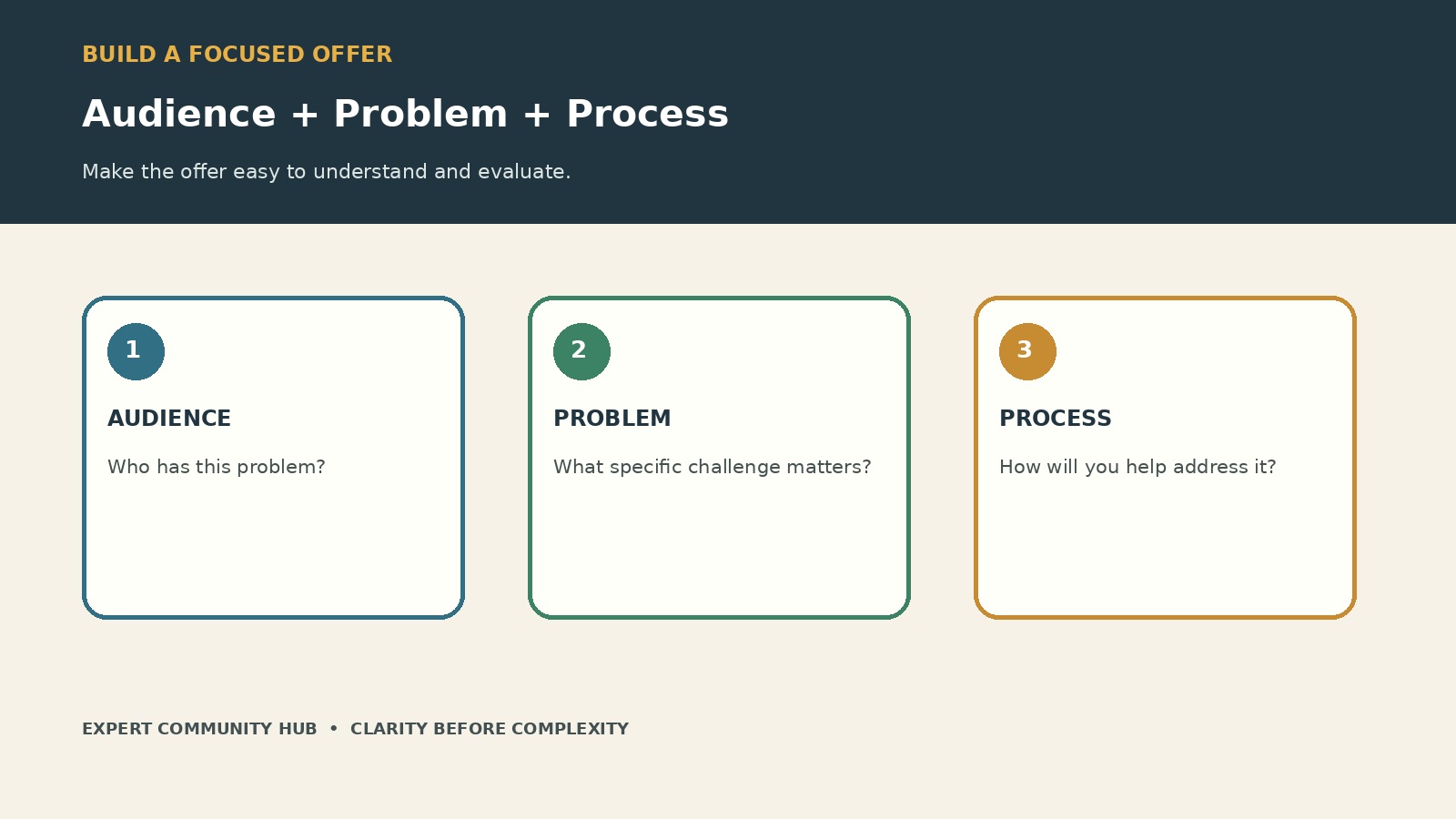
Who is this for? Describe the audience's situation.
What problem are they trying to solve? Focus on a recognizable challenge rather than your preferred method.
Why does it matter to them? Understand the practical consequences, frustrations, or opportunities involved.
How do you help? Explain your process and what the client receives.
What does progress look like? Name realistic outcomes, milestones, or deliverables.
Who might not be a fit? Clarify prerequisites, boundaries, and situations where another service would be more appropriate.
These answers can become the foundation of your offer page, webinar, sales conversation, and content strategy.
Example: From generic service to focused offer
Suppose you are a digital coach who offers marketing advice, content support, and funnel consulting.
A broad message might be:
“I help coaches grow their business with digital marketing.”
It is not necessarily wrong. It is simply difficult to evaluate because “grow” can mean many things.
A more focused version might be:
“I help independent coaches who receive inconsistent enquiries build a simple content and follow-up process, so they can communicate their offer clearly and handle interested prospects more consistently.”
This version gives the prospect more information:
- The audience is independent coaches.
- The problem is inconsistent enquiries and follow-up.
- The process includes content and follow-up.
- The intended progress is clearer communication and more consistent handling of prospects.
The offer still needs details about scope, time, price, and support. But the core value is easier to understand.
Do not add more bonuses to fix an unclear offer
When people hesitate, it is tempting to add another template, extra session, or bonus.
Bonuses can be useful when they help clients implement the core offer. But they cannot replace clarity.
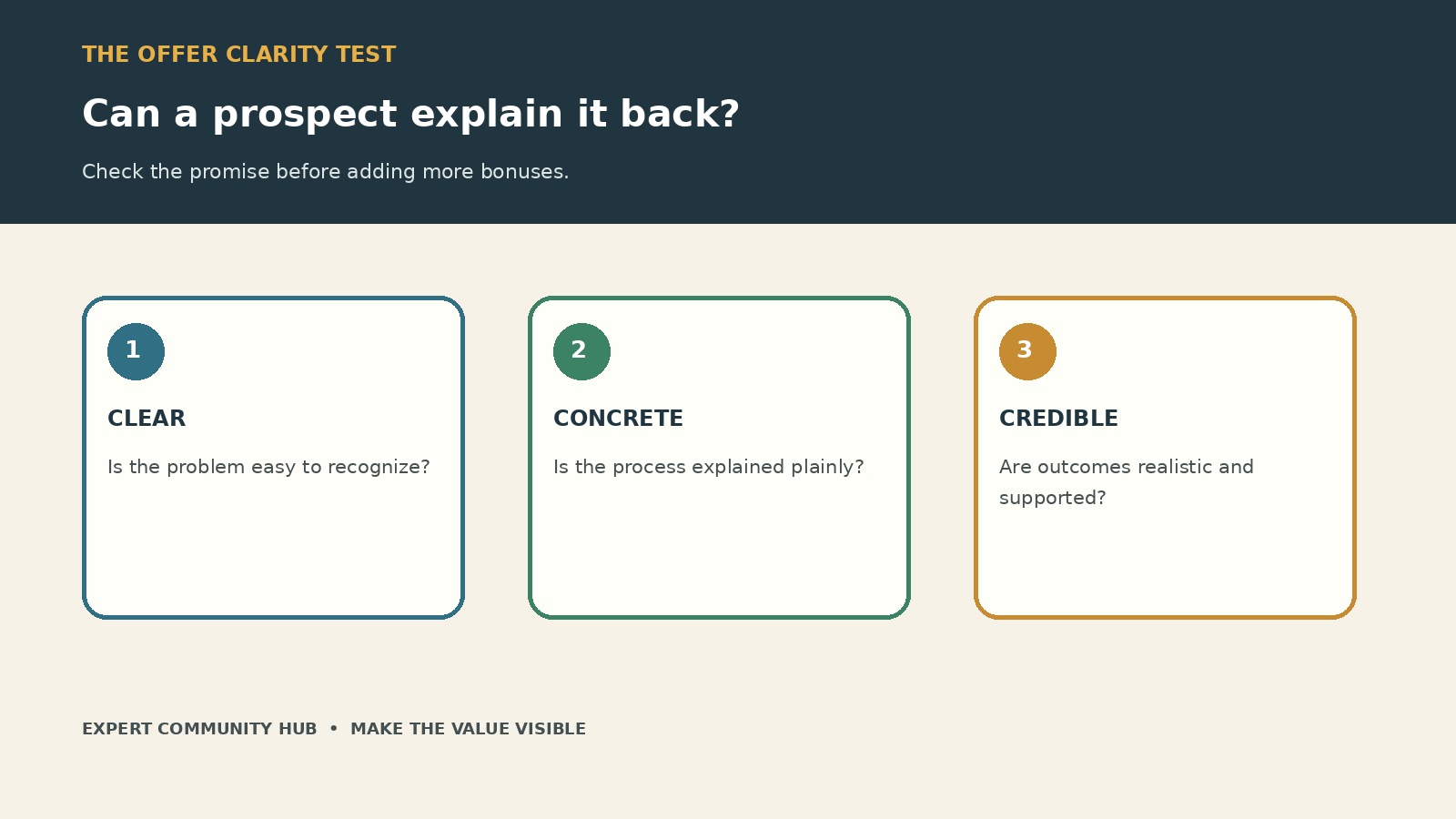
Before adding anything, check whether the prospect understands the problem you solve, the process you use, what is included, and what kind of person the offer is designed for.
A smaller, clearer offer can be easier to evaluate than a large bundle of disconnected deliverables.
Your 20-minute offer reset
Choose one service you currently promote.
Minutes 1–5: Write down the three most common problems clients ask you to help with.
Minutes 6–10: Choose one problem that matches your expertise and is specific enough to explain in plain language.
Minutes 11–15: Complete this sentence:
“I help [audience] address [specific problem] through [process], so they can work toward [realistic progress].”
Minutes 16–20: Check the sentence against your current offer page. Make one improvement to clarify the audience, problem, process, or expected deliverables.
Ask one person from your intended audience to explain what they think the offer does. If their interpretation is far from what you intended, simplify the message.
A focused offer does not limit your expertise
You may have many skills. You may provide different services over time. Focus does not mean pretending otherwise.
It means giving each offer a clear reason to exist and making it easy for the right person to understand why it might help.
Once one offer is clear, you can create other offers for other needs. Each can have its own audience, problem, process, and next step.
Start with clarity. Add complexity only when it genuinely helps the client.
Your turn
If you had to describe your main offer by naming one specific problem it helps solve, what would you say?
Share your version in the comments. Try to describe the audience, problem, and progress in one or two clear sentences.
Your next step
If you are a coach, consultant, or knowledge-based professional, Expert Community Hub can help you explore how to clarify your offer, communicate your expertise, and build a more structured approach to client acquisition.
Do not just list what you can do. Help the right people understand the problem you are equipped to solve—and give them a clear, honest way to explore working with you.
Written for coaches, consultants, and knowledge-based entrepreneurs by Expert Community Hub.