
You know what needs to be done. Yet you keep putting it off. Discover why capable coaches and consultants delay important work—and how to take the next step without waiting for motivation.
You know what to do. So why are you still waiting?
By Dharmendra Singh | Expert Community Hub
The task you keep postponing
You know you should publish that post.
You know you should follow up with the prospect.
You know your offer page needs attention.
Yet you open another tab. You check your messages. You watch one more video. You tell yourself you will start after lunch.
Then the day ends.
The task is still there.
This can be frustrating, especially when you care deeply about building your business. You have ideas. You have skills. You know what matters.
But your actions do not always match your intentions.
And the longer you delay, the heavier the task feels.
Procrastination is not always a lack of discipline. Sometimes it is a way to avoid discomfort.

The pain behind the delay
You may think you are wasting time.
But often, something deeper is happening.
You might fear that your post will get no response. You may worry that a prospect will reject your offer. Perhaps you are unsure whether your idea is good enough.
So you delay the moment when reality can give you an answer.
Planning feels safe. Action creates uncertainty.
This is why capable people can spend weeks preparing for a task that might take an hour to begin.
The cost is more than lost time.
You start doubting yourself. You make promises you don't keep. You feel busy, yet your confidence slowly falls.
The solution is not to shame yourself.
It is to understand what makes the task hard, then make the first step easier.
Four reasons you keep putting things off
1. The task feels too big
"Build my coaching business" is a huge task.
It has many moving parts. You may not know where to begin.
Break it down.
Instead of "build my business," write "draft my one-sentence offer." Then write "share it with three people." Small steps create a clear starting point.
2. You want it to be perfect
You want the right words. You want the perfect design. You want every detail to be correct.
But perfection can delay useful feedback.
Create a good first version. Share it with the right people. Improve it after you learn what works.
3. You are afraid of the result
You may worry that nobody will respond.
You may fear hearing no.
But avoiding the task does not protect your business. It only delays the information you need.
Measure success by the action you took, not only by the response you received.
4. You have too many priorities
Every task feels urgent. Your attention jumps from one idea to another.
Choose one meaningful task for the day. Finish it before adding more work, when possible.
Focus is not doing everything. It is deciding what matters now.
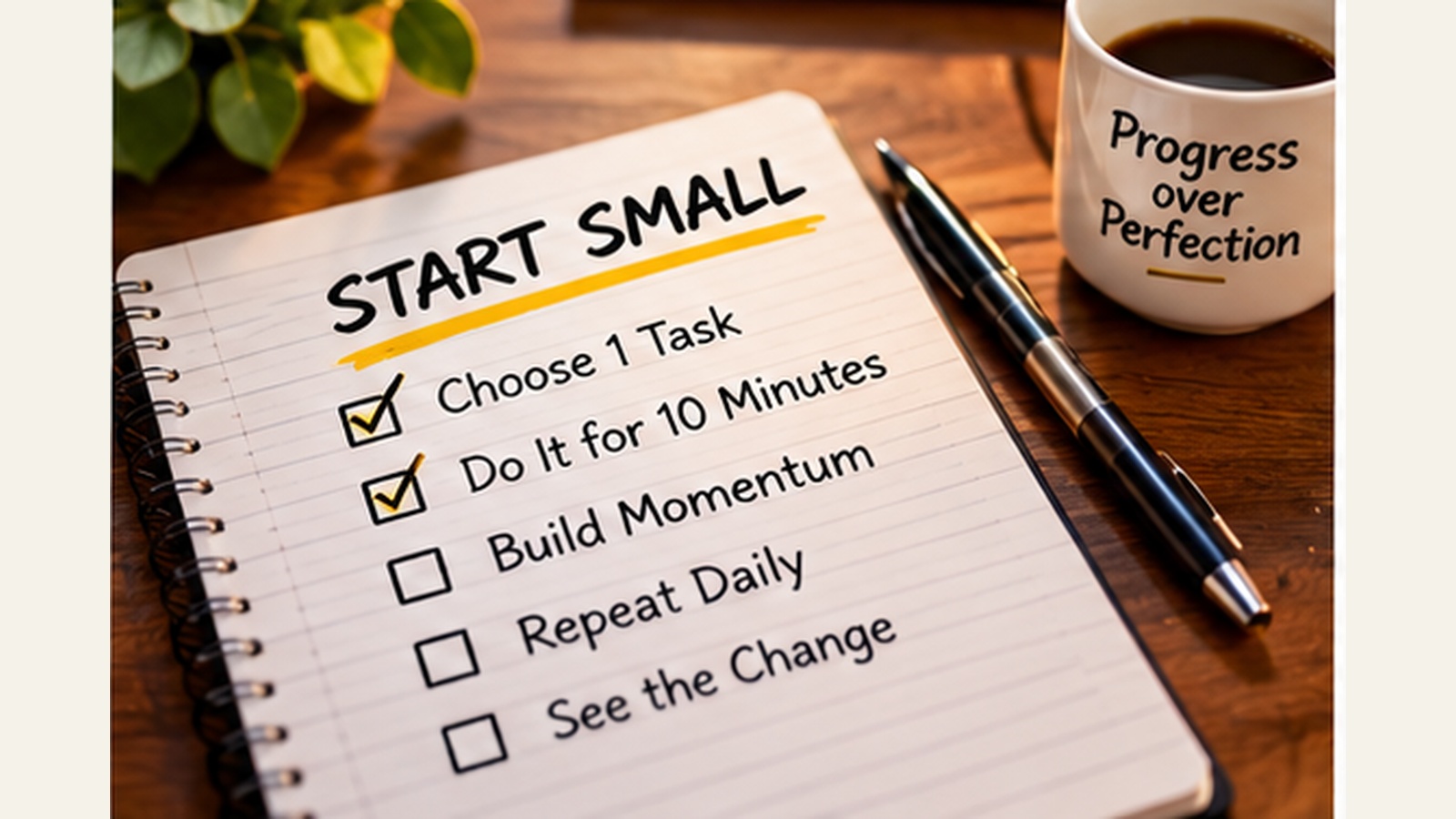
Try the 10-minute start
When a task feels difficult, don't promise yourself that you will finish it today.
Promise yourself that you will work on it for ten minutes.
Set a timer.
Open the document. Write the first paragraph. Draft the follow-up message. Outline the offer. Make the first call.
When the timer ends, you can stop or continue.
The goal is to reduce the resistance to starting.
Often, beginning makes the next step clearer. Even if you stop after ten minutes, you have moved forward.
Turn vague intentions into clear actions
A vague intention is easy to postpone.
A specific action is easier to start.
Try changing these statements:
- "I need to create content" becomes "I will draft one LinkedIn post at 10 AM."
- "I need more clients" becomes "I will follow up with three interested prospects today."
- "I need to improve my website" becomes "I will rewrite the headline on my offer page."
- "I need to learn marketing" becomes "I will apply one lesson to my current campaign."
Notice the difference.
Each new statement has a clear action. You can tell whether you completed it.
You don't need a complicated productivity system. You need a next step that is specific enough to begin.
A simple daily system for busy experts
Use this short routine at the start of each workday.
Step 1: Choose one important result
Ask yourself: "If I complete one business task today, which one will make the biggest difference?"
Pick one. Keep the list short.
Step 2: Define the first physical action
Write what you will actually do.
"Grow my audience" is not an action. "Draft and publish one helpful post" is.
Step 3: Schedule a short focus block
Choose a realistic time. Start with 15 or 25 minutes if a longer session feels difficult.
Put your phone away. Close unrelated tabs. Work on one task.
Step 4: Make progress visible
At the end, record what you completed.
A small checklist can help you see that you are moving. It also makes it easier to restart tomorrow.
Step 5: Review without judgment
If you did not finish, ask why.
Was the task too large? Was the time unrealistic? Did something urgent interrupt you?
Adjust the plan. Don't turn one difficult day into a verdict about yourself.

A seven-day challenge
Try this for one week.
Day 1: Write down the business task you have delayed the longest.
Day 2: Break it into a step that takes ten minutes.
Day 3: Complete that step before checking social media or unrelated messages.
Day 4: Choose one task that supports client acquisition.
Day 5: Take one action that makes your expertise more visible.
Day 6: Review what helped you start. Notice what distracted you.
Day 7: Choose a small daily action to repeat next week.
Don't aim for a perfect week.
Aim to build evidence that you can take action even when you don't feel fully ready.
Key takeaways
1. Procrastination often protects you from discomfort. Identify the feeling behind the delay.
2. Make the first step smaller. A ten-minute start is better than another week of waiting.
3. Replace vague goals with specific actions. Decide what you will do and when you will do it.
4. Focus on one priority at a time. Too many competing tasks make it harder to begin.
5. Review without shame. Use missed goals as information. Adjust your system and try again.
Final thought: start before you feel ready
You don't need to fix your entire business today.
You don't need to feel confident before taking action.
You don't need the perfect plan.
You need one clear next step.
Send the message. Draft the post. Finish the outline. Ask the question.
Small actions may look insignificant on their own. Repeated over time, they can build skills, confidence, and momentum.
At Expert Community Hub, we help coaches, consultants, and experts turn their knowledge into a structured digital business with clear positioning, practical systems, and AI-supported client acquisition.
The goal is not to stay busy all day.
It is to take meaningful action on the things that matter.
Your turn
What is one task you have been postponing?
Write it down. Make the first step small enough to complete in ten minutes. Then take that step today.