
People may like your content and respect your expertise without becoming clients. Learn how need, timing, offer fit, perceived risk, and a clear next step influence buying decisions.
They like your posts. They recommend your advice. They tell you that you are good at what you do. Yet when you invite them to work with you, they hesitate.
It can feel personal.
You may wonder whether your offer is wrong, your price is too high, or your audience is only interested in free advice.
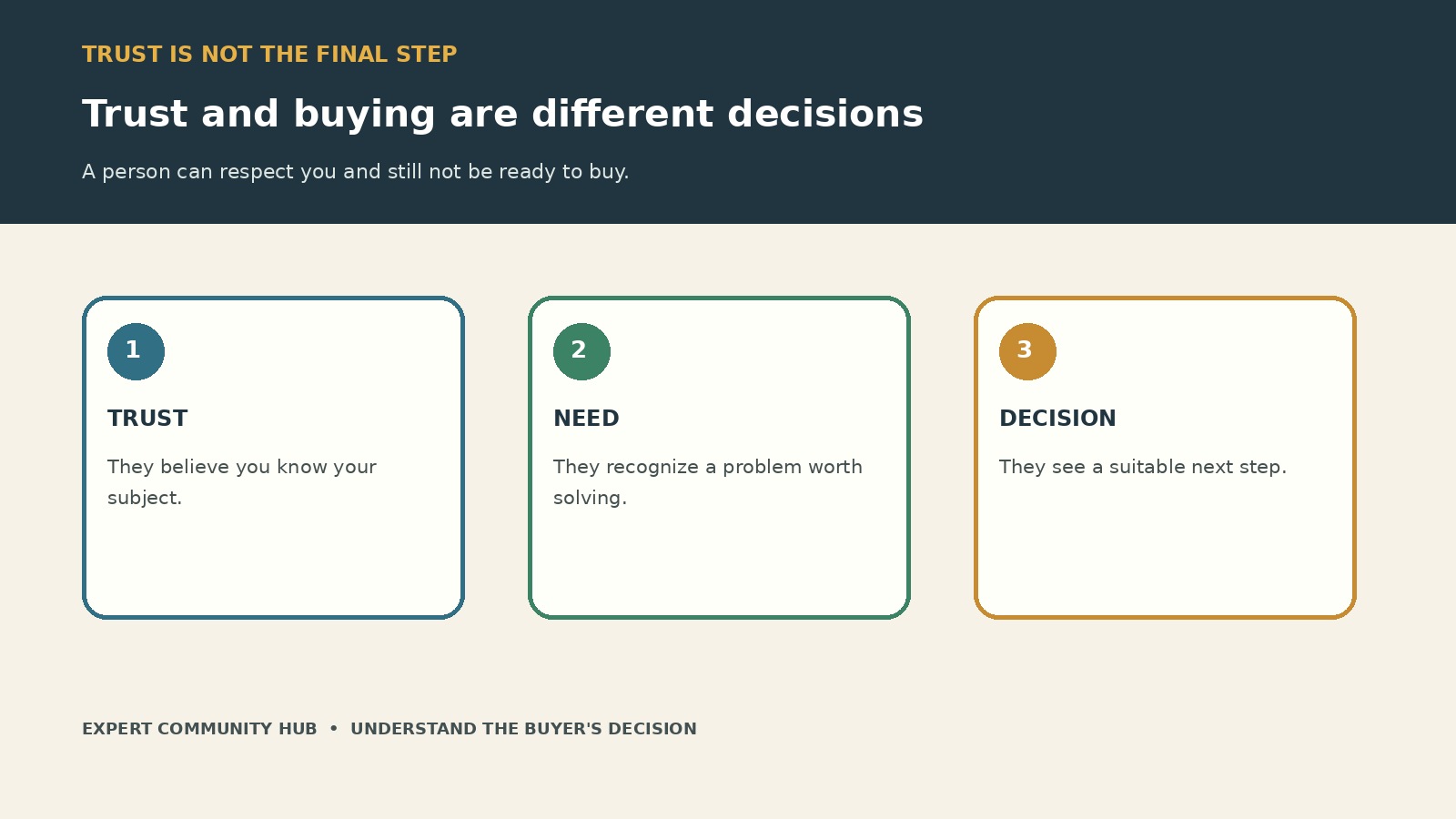
But trust is not the same as readiness to buy.
Someone can respect your expertise and still have no urgent need for your service. They may be interested but unable to afford it now. They may not understand how your offer fits their situation. Or they may simply prefer another solution.
Trust opens the door. A clear need, suitable offer, timing, and informed decision help someone walk through it.
Your job is not to convince every person who trusts you to buy. It is to understand what suitable prospects need in order to make a good decision.
The frustration of being trusted but not chosen
You have spent time sharing useful content. People engage with your posts and ask for advice. Some even say, “I should work with you someday.”
Then weeks pass. Nothing happens.
It is tempting to keep educating them, add more bonuses, create a discount, or send another sales message.
But without understanding the reason behind the hesitation, you may be solving the wrong problem.
More trust-building content will not necessarily help someone who has no immediate need. A discount will not fix an unclear offer. A stronger sales pitch will not make an unsuitable service the right fit.
Start by separating the signals you see from the conclusions you draw.
A compliment means someone appreciates something. It does not automatically mean they are a qualified prospect or ready to purchase.
Five reasons trust may not turn into a sale
1. The problem is not urgent enough
A person may agree that an issue matters but still have more pressing priorities. They may intend to improve it later.
You cannot manufacture genuine urgency. You can help them understand the implications of the problem and decide whether addressing it now is worthwhile.
2. Your offer does not feel specific enough
They may trust your knowledge but still be unsure what they would receive or how it relates to their situation.
Explain the audience, problem, process, deliverables, and realistic outcome in plain language.
3. They do not know what happens after buying
Uncertainty creates friction. Prospects may wonder how onboarding works, how much time is required, what support is available, or what they need to do.
Make the experience clear before asking them to commit.
4. The perceived risk is too high
A prospect may be concerned about wasting money, choosing the wrong approach, or failing to implement what they learn.
You can reduce uncertainty through transparent expectations, relevant examples, a clear process, and honest explanations of who the offer suits. Do not promise guaranteed results you cannot control.
5. They are not the right fit right now
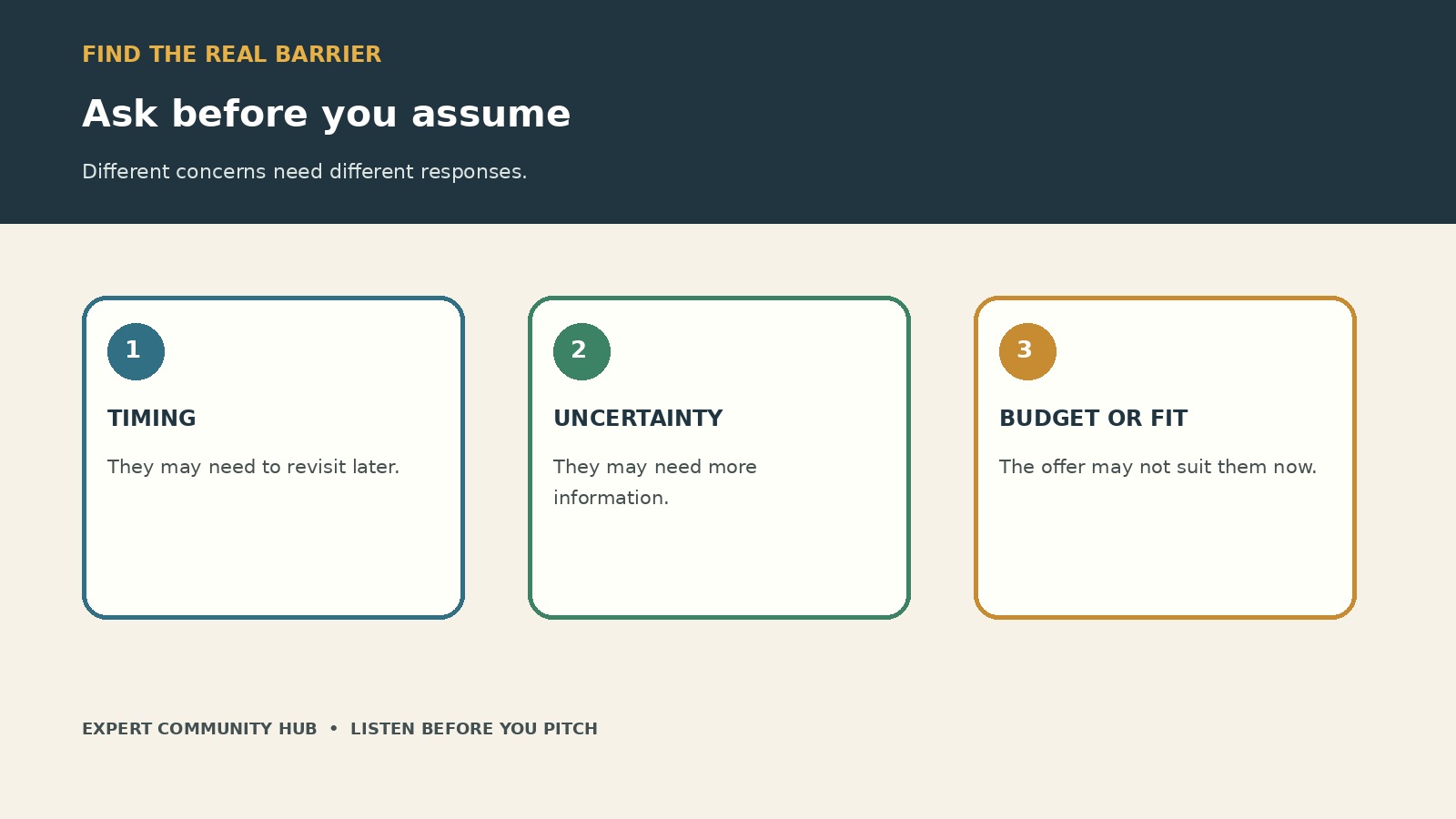
Budget, timing, authority to decide, existing commitments, and personal circumstances can all affect a purchase.
Sometimes the most professional response is to suggest a smaller resource, invite them to return later if appropriate, or acknowledge that your service may not be the right fit.
The READY Framework
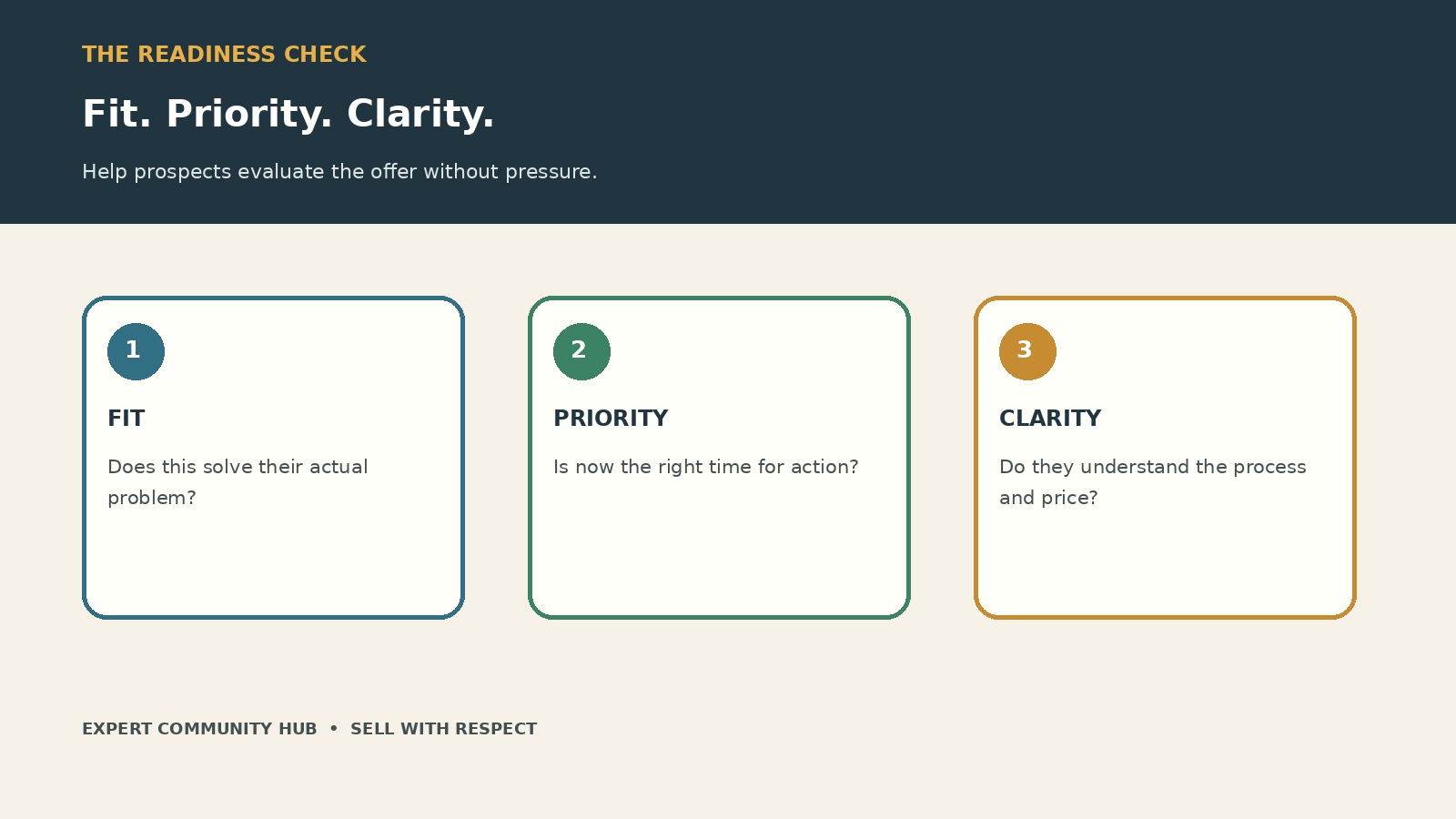
Before changing your price or pushing harder, use this framework to understand whether a prospect is ready for your offer.
R — Recognize the real need
What problem is the person actually trying to solve? Is it a problem your service is designed to address?
Ask thoughtful questions instead of assuming that every person who engages with your content has the same need.
E — Establish the fit
Explain who the offer is for, what it covers, and what it does not cover.
A clear boundary can help someone realize that your service is suitable—or that they need something different.
A — Address uncertainty
Invite questions about the process, timeline, support, price, and expectations. Respond honestly. If you do not know something, say so rather than inventing reassurance.
D — Discuss timing and priorities
Ask whether this is something they want to address now or revisit later. Respect the answer.
A person who is not ready today should not be treated as a problem to overcome.
Y — Yield a clear next step
If there is a fit and the person wants to proceed, explain how to do so. If they need more information, provide it. If they decline, close the conversation respectfully.
The goal is a clear decision—not a forced yes.
Questions that reveal the real barrier
Instead of sending another generic pitch, try a respectful question in a conversation where the person has shown genuine interest.
- “What would you most like to solve first?”
- “Which part of the offer would be most useful for your situation?”
- “Is there anything about the process or expectations you would like me to clarify?”
- “Is this a priority you want to address now, or would a later time be more suitable?”
- “Would you like to explore the next step, or would you prefer to leave it here for now?”
Use these questions naturally. Do not turn every interaction into an interrogation, and do not keep contacting someone who has declined or asked you to stop.
Listen to the answer. A genuine concern deserves a genuine response, not a rehearsed objection-handling script.
Make the buying decision easier to understand
Review your offer page or sales presentation from the perspective of someone who trusts you but has never purchased from you.
Can they quickly find:
- Who the service is designed for.
- The problem it helps address.
- The process, deliverables, and support included.
- The time and effort expected from them.
- The price and payment terms.
- The realistic expectations and limitations.
- The next step if they want to proceed.
You do not need to create artificial scarcity or pressure people with countdowns. You need to provide enough information for an informed decision.
Your 20-minute conversion review
Choose one offer you want to improve.
Minutes 1–5: Write down the three most common questions or concerns prospects raise.
Minutes 6–10: For each concern, identify whether it relates to need, fit, timing, uncertainty, or budget.
Minutes 11–15: Improve one part of your offer page or presentation to answer the most common genuine question.
Minutes 16–20: Prepare one respectful question you can use in future conversations to understand a prospect's needs before recommending a next step.
Do not assume every hesitation means your sales message is weak. Look for patterns across multiple conversations and use evidence to guide changes.
Trust is valuable even when someone does not buy
Not every person who trusts you will become a client. Some may recommend you to others. Some may return when their situation changes. Some may benefit from your free content and never need your paid service.
That is normal.
Your goal is not to convert every follower or admirer. It is to help suitable prospects understand the value of your offer and decide whether it is right for them.
When the fit is strong, clarity and a respectful buying process can help. When the fit is not strong, honesty protects both the prospect and your reputation.
Your turn
When someone appreciates your content but does not buy, what do you usually do next: keep sharing value, explain your offer more clearly, ask what they need, or move on?
Share your experience in the comments. Your answer may help another coach or consultant understand the difference between trust and buying readiness.
Your next step
If you are a coach, consultant, or knowledge-based professional, Expert Community Hub can help you explore how to clarify your offer, communicate value, and build a more structured approach to client acquisition.
Build trust generously. Make the offer clear. Ask before assuming. And help people make a decision that genuinely fits their needs.
Written for coaches, consultants, and knowledge-based entrepreneurs by Expert Community Hub.