
Likes, saves, and kind comments can feel encouraging, yet interested readers may never enquire. Learn how to spot the gap between engagement and intent and design a natural next step.
Let’s imagine two creators.
The first posts a short video. It gets thousands of views, hundreds of likes, and a flood of “So true!” comments.
The second gets fewer views. But three people ask thoughtful questions, one downloads a guide, and another books a conversation.
Which creator is doing better?
There is no universal answer. It depends on the goal. If the aim is broad awareness, the first post may have done its job. If the aim is to start relevant client conversations, the second may be more useful.
The mistake is treating every kind of engagement as if it means the same thing.
People can enjoy your content without needing your service. They can save a post and never return to it. They can agree with your advice without knowing what to do next.
Instead of asking only, “Did people like this?” ask, “What did this post help the right person understand or do?”
The story behind the silent audience
You publish consistently. You teach generously. You answer comments. You try new formats.
And still, the inbox is quiet.
It is tempting to blame the algorithm or decide that your content is not good enough. Sometimes reach is the issue. Sometimes your audience is still learning. Sometimes your offer is unclear.
But there is another possibility: your content gives people a useful moment, then leaves them to figure out the next step alone.
Imagine a reader learns how to write a better follow-up message. What might they need after that? Perhaps a checklist to review their whole follow-up process. Perhaps an example sequence. Perhaps a workshop to implement it.
You do not need to push them toward a purchase. You can simply make the next useful option visible.
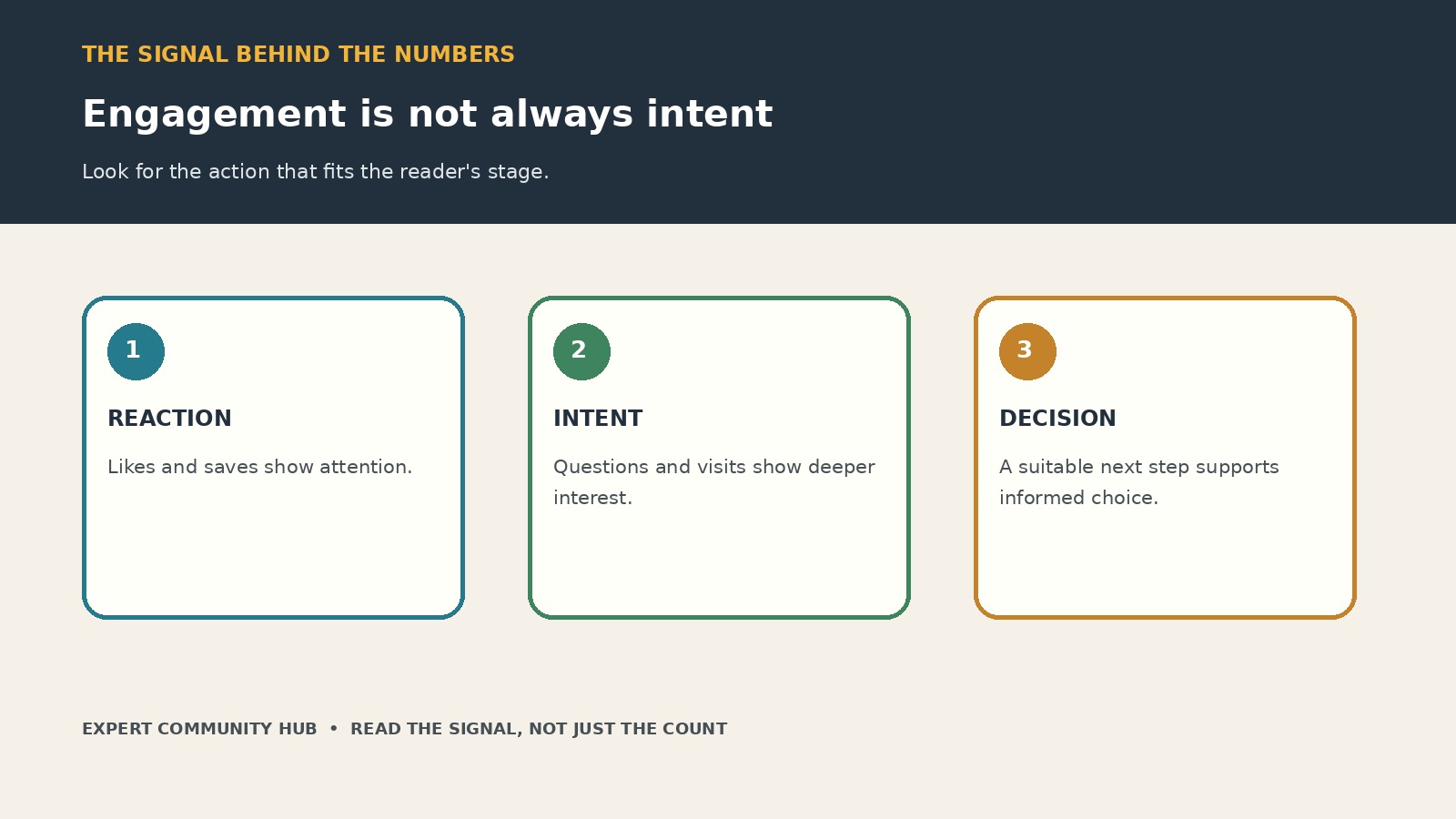
Three different signals hiding inside engagement
The reaction signal
Likes, quick comments, and shares can indicate that a topic caught attention or resonated emotionally. These are useful signals, but they do not necessarily show buying intent.
The learning signal
Saves, detailed questions, return visits, and thoughtful replies may suggest that someone wants to understand the subject more deeply. Context matters; no single action proves intent.
The decision signal
A person visits a relevant service page, registers for a workshop, asks about scope or price, or requests a conversation. These actions are closer to a business decision, though they still do not guarantee a sale.
The point is not to dismiss likes. It is to interpret each signal according to what it can reasonably tell you.
The STEP Method
Use this method when you want a piece of content to lead somewhere useful.
S — Start with one specific problem
Avoid trying to solve five problems in one post. Choose a question your intended audience recognizes.
For example: “Why do potential clients stop replying after asking about your service?”
A specific problem helps you create a more focused lesson and makes it easier to choose a relevant next step.
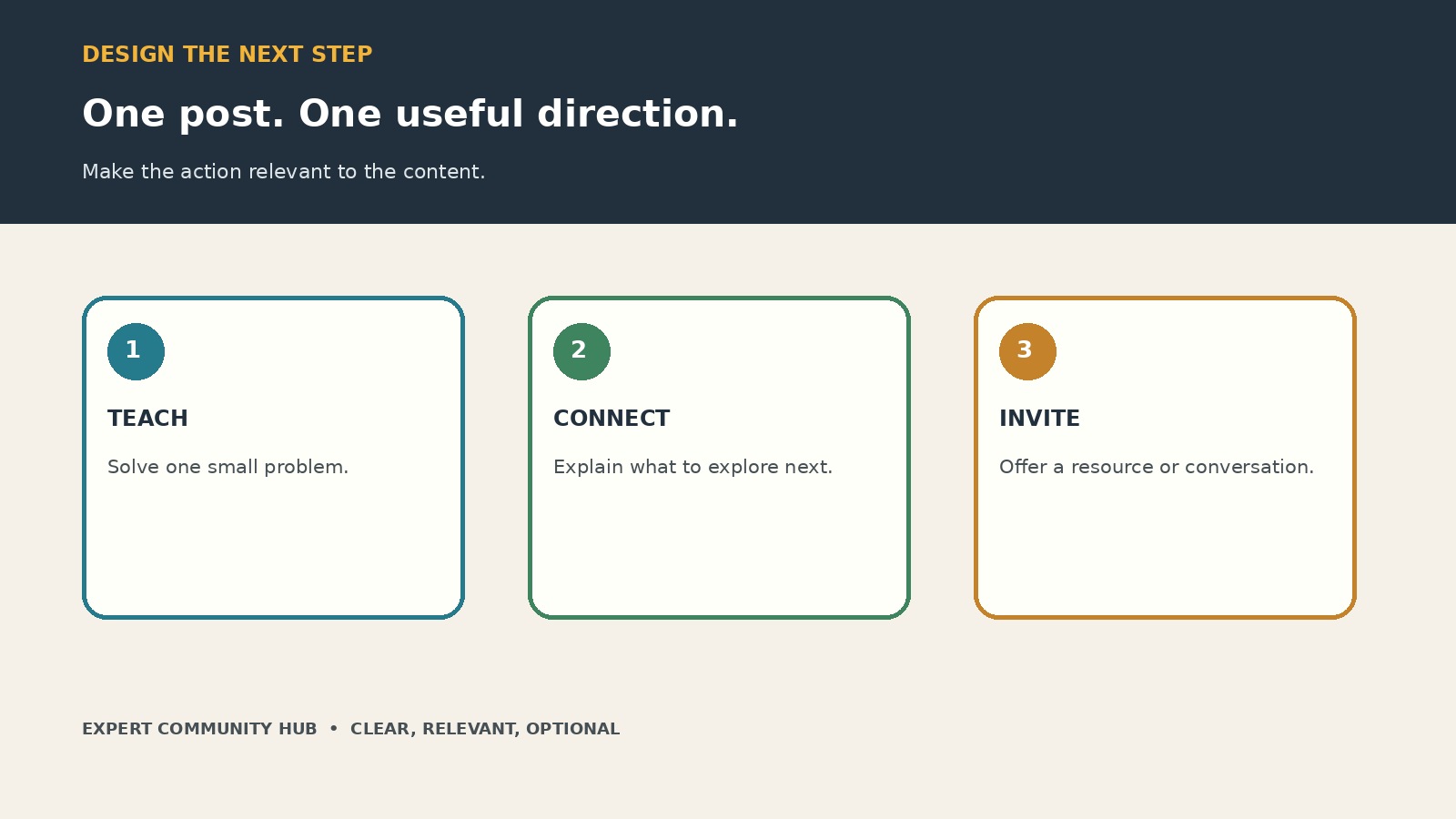
T — Teach one useful idea
Give the reader something they can understand or try. Explain a principle, demonstrate a method, or show a small example.
Do not make the content deliberately incomplete just to force a click. The post should be valuable even if the reader takes no further action.
E — Explain what comes next
Ask what a reader might reasonably need after learning this lesson.
A post about follow-up might lead to a checklist. A post about positioning might lead to an offer-clarity worksheet. A post about a complex topic might lead to a workshop or longer guide.
Make the connection obvious. A random invitation to join an unrelated program will feel disconnected.
P — Provide one clear invitation
Tell readers what they can do next and what they will get from it.
“Download the follow-up checklist to review your current process” is clearer than “Click here to know more.”
Use one primary invitation where possible. Too many options can make the next step harder to choose.
Make the next step feel like a continuation, not a pitch
Consider a post about why a coaching offer is hard to explain.
A natural next step could be a short worksheet that helps readers describe their audience, problem, and process. The worksheet might then invite people who want feedback to attend a workshop or explore your service.
The journey makes sense because every step addresses the same problem.
A poor next step would be to jump from that post to an unrelated offer simply because you want to promote it.
The question to ask is: “Would this invitation genuinely help someone who found the post useful?”
If the answer is no, choose another action—or leave the post without a CTA.
A practical example for coaches and consultants
Suppose you publish a post titled “Three Reasons Your Enquiries Go Cold.”
Here is one possible journey:
- The post: Explain three common causes and offer one practical adjustment.
- The resource: Invite readers to use a follow-up checklist.
- The conversation: Ask readers which part of follow-up is hardest to manage.
- The deeper support: Explain your workshop or service for people who want help building a repeatable process.
Some people will read only the post. Others may use the checklist and stop there. A few may want more support.
That is a healthy outcome. The purpose is to create a useful path, not to force everyone along it.
Run a small experiment instead of guessing
For your next three relevant posts, try a simple test.
- Give each post one clear audience problem.
- Offer one practical lesson.
- Choose one relevant next step.
- Track the action that matches the invitation.
If you offer a guide, track guide downloads. If you invite a conversation, track relevant replies. If you share a workshop, track registrations and attendance.
Do not compare posts as if they were identical experiments when their topics, reach, and audiences differ. Look for patterns over time and use what you learn to improve the next post.
The 15-minute next-step audit
Choose one recent post that received a positive response.
Minutes 1–5: Write down the main idea and the audience it was intended to help.
Minutes 6–10: Decide what a reader might reasonably need next. Choose a resource, related article, discussion, workshop, or service page.
Minutes 11–15: Write one invitation that explains the benefit and what happens after the reader clicks or responds.
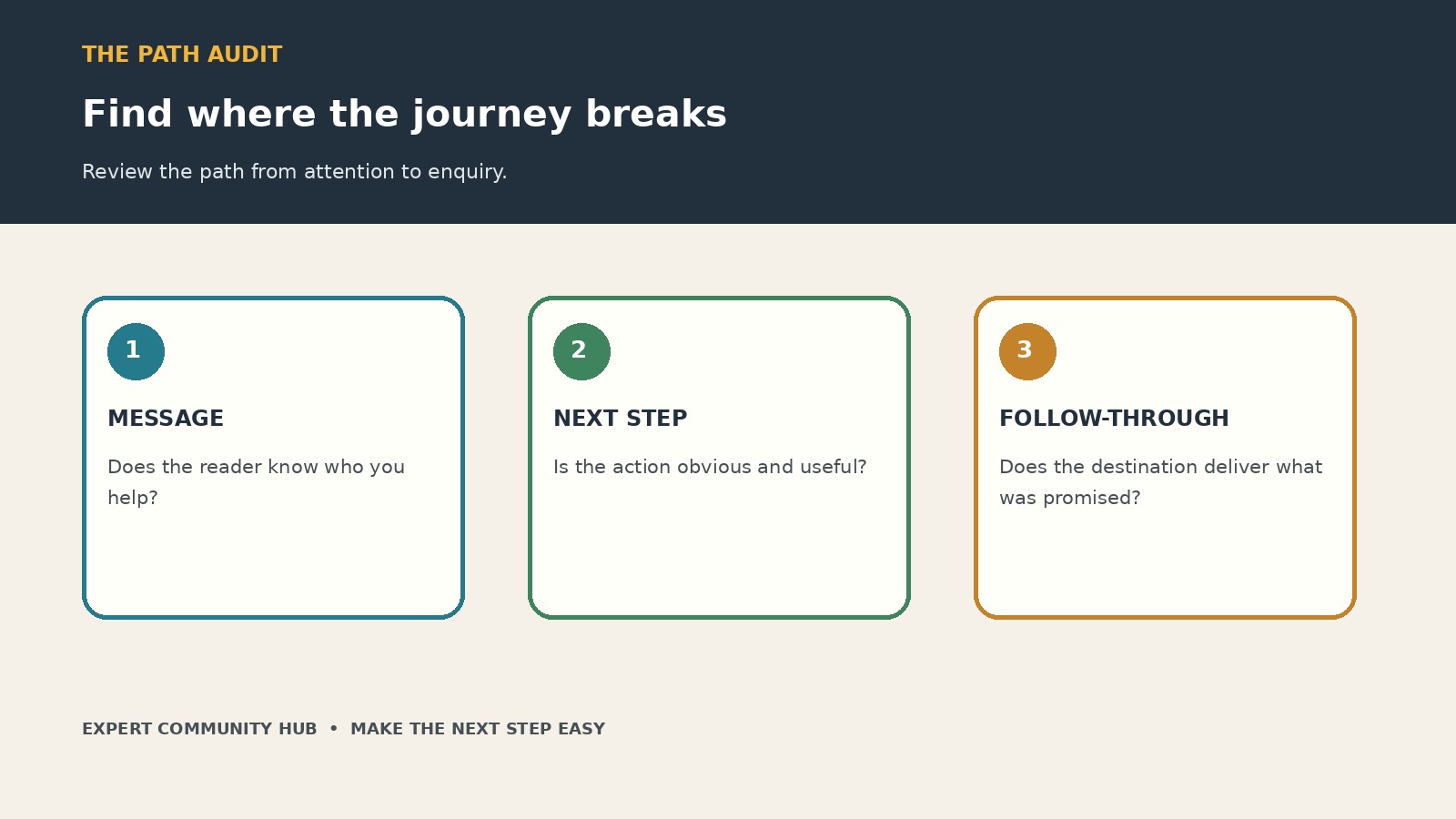
Then test the journey yourself. Does the link work? Does the destination match the promise? Is it clear whether the next step is free or paid? Can the reader make a choice without pressure?
Small gaps can break an otherwise useful journey. Fix one before creating ten more posts.
When the right next step is simply to stop
Not every post needs to lead to a resource or offer.
A reflective story may be valuable because it helps people feel understood. A quick tip may be complete on its own. A community question may be designed to start a discussion rather than generate leads.
The goal is intentionality, not turning your entire content library into a funnel.
Give each post a job. Let some build awareness, some teach, some start conversations, and some explain your services. Together, they can support a clearer experience for your audience.
Your turn
Think about the last post you published that received positive feedback.
Did it simply earn a reaction, or did it help the right person take a useful next step?
What is one small change you could make to your next post?
Share your experience in the comments. Another expert may learn from the experiment you try.
Your next step
If you are a coach, consultant, or knowledge-based professional, Expert Community Hub can help you explore how to communicate your expertise, clarify your offer, and build a more structured approach to client acquisition.
Keep creating genuinely helpful content. Then, when it makes sense, build a clear bridge from that lesson to the next useful action.
Written for coaches, consultants, and knowledge-based entrepreneurs by Expert Community Hub.