
Your expertise matters, but listing everything you know may not help people decide. Learn how to connect your knowledge to a clear, realistic outcome your ideal client cares about.
Your expertise is the engine. The change it helps someone make is the reason they pay attention.
Imagine two experts offering a workshop.
The first says: “My program includes twelve modules, five templates, three live calls, AI tools, a workbook, and lifetime access.”
The second says: “I help independent coaches create a clearer client follow-up process, so fewer promising enquiries are forgotten.”
Both may have valuable material. But the second explanation makes it easier to understand the problem being addressed and why the service might matter.
This is a common challenge for knowledgeable professionals. They know so much that they describe the contents of their offer instead of the change the offer is designed to support.
People need to understand not only what you teach, but why it matters in their real lives or businesses.
The frustration of having expertise that does not sell itself
You may have spent years building your skills. You have completed training, developed frameworks, collected tools, and learned from experience.
When you create an offer, you naturally want to show all that value. So you list every module, bonus, session, and resource.
But the potential client is asking a different question:
“What will this help me do?”
If the answer is unclear, a long list of features can make the decision harder. The buyer has to connect the dots between your material and their own situation.
They may like your content and respect your experience, yet still postpone buying because they cannot see how the offer fits their immediate need.
The answer is not to hide your expertise. It is to connect it to a clear and relevant purpose.
Features, benefits, and outcomes are not the same
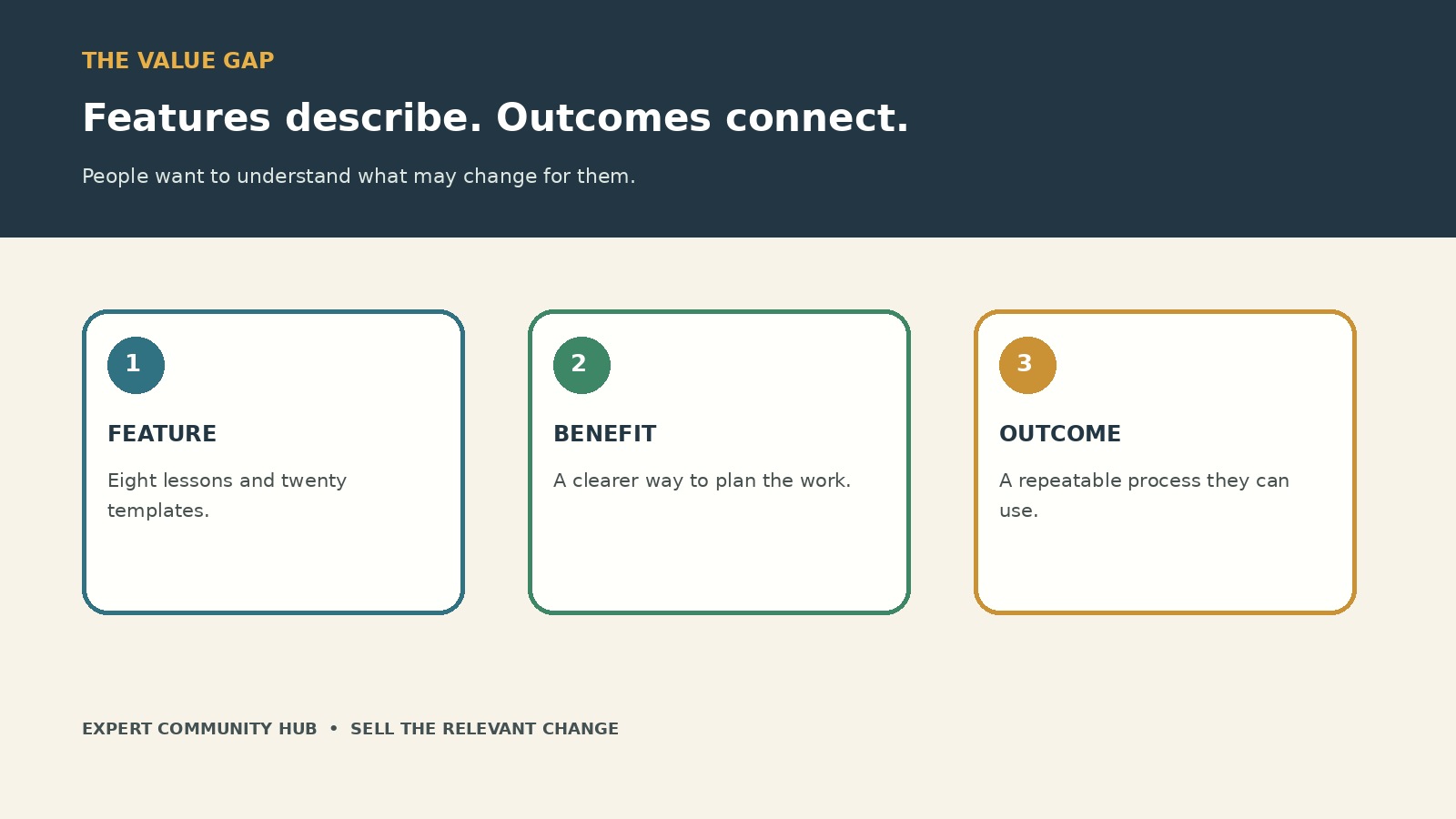
Features describe what is included: six lessons, weekly calls, templates, worksheets, or a private community.
Benefits explain how a feature may be useful: more structure, easier planning, clearer decisions, or guided practice.
Outcomes describe the change the client is working toward: a repeatable follow-up process, a clearer service offer, a more organized onboarding experience, or greater confidence in a specific task.
An outcome is not a guarantee. Results may depend on the client's situation, effort, resources, and other factors. Your job is to describe the intended change honestly and explain how your service supports it.
The Outcome Bridge Framework
Use this four-step framework to connect your expertise to something your audience cares about.
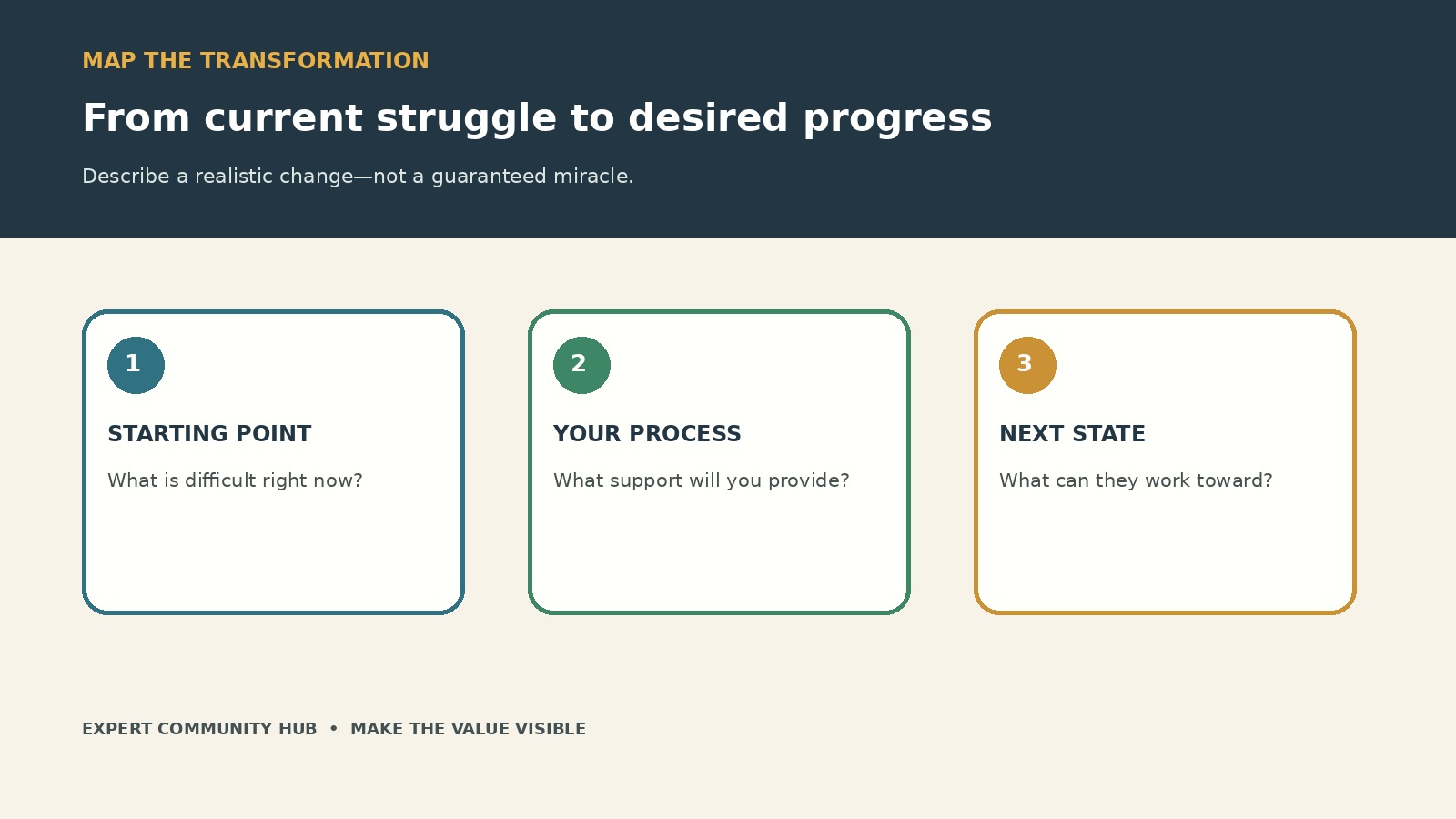
1. Start with the client's current situation
Describe the problem in language your audience would use.
For example: “I get enquiries, but I forget to follow up consistently.”
Avoid beginning with a technical method or a product name. Start with the situation the person recognizes.
2. Name the progress they want
What would a useful improvement look like?
The client might want a simple way to track enquiries, know when to follow up, and keep conversations organized. This is more concrete than a vague promise to “grow your business.”
3. Explain the process you provide
Describe how your coaching, consulting, workshop, or product helps them make progress.
You might teach a weekly review routine, provide a follow-up template, and help them adapt the process to their own workflow.
The process makes your offer tangible. It shows that the outcome is connected to actual work—not just an attractive headline.
4. Set realistic expectations
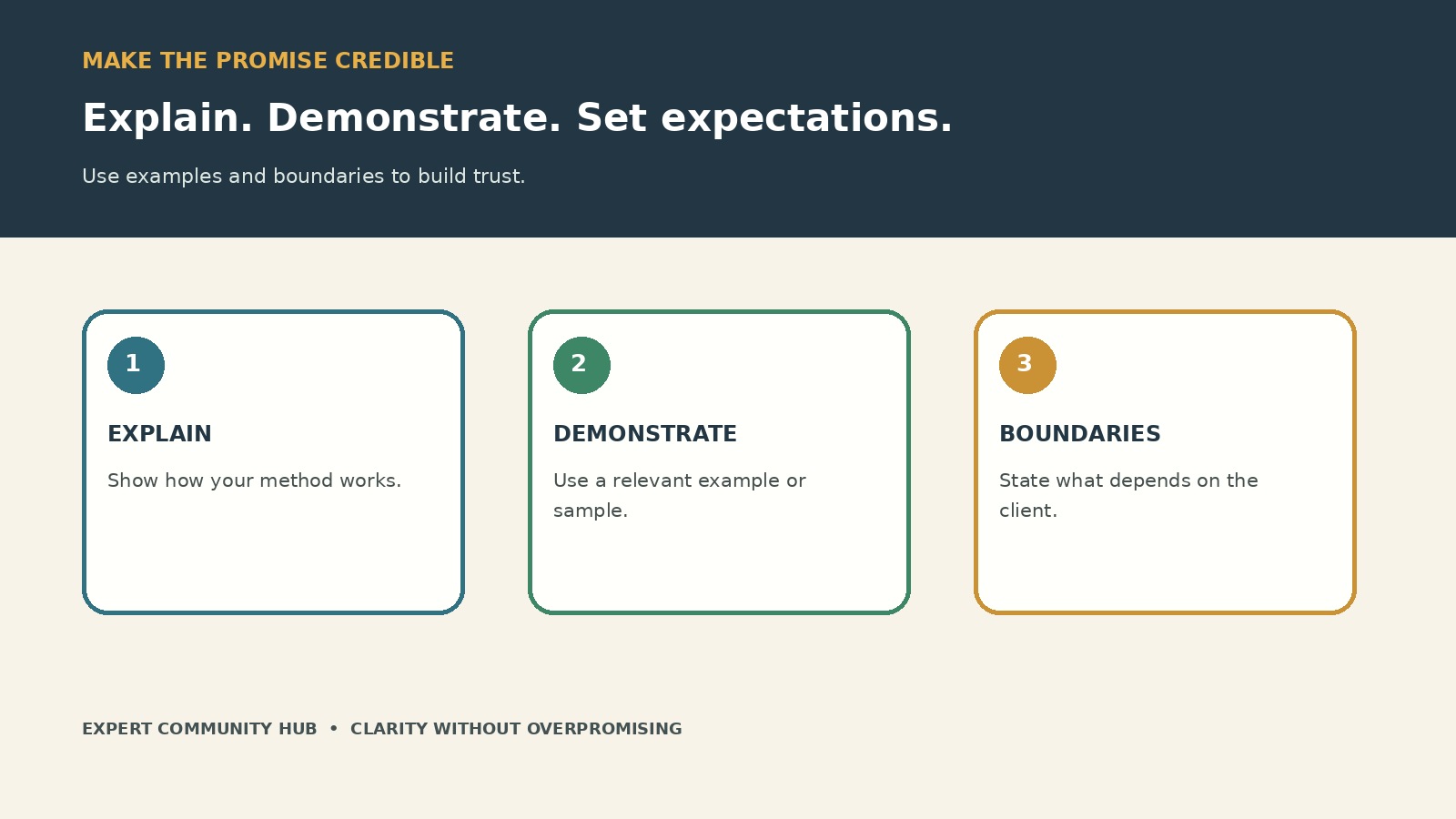
Be clear about what the client will receive, what they will need to do, and what you cannot guarantee.
You can promise the delivery of a defined service. You should not promise a specific revenue result unless the claim is substantiated and appropriately qualified.
A credible offer makes the intended outcome understandable without pretending that every client will get identical results.
Turn a feature-heavy offer into a clearer message
Try these examples as inspiration. Adapt them to what you can genuinely deliver.
Instead of: “My course has ten modules on digital marketing.”
Try: “Learn how to plan a focused marketing routine that connects your content to a clear next step for potential clients.”
Instead of: “I provide four consulting calls and a strategy document.”
Try: “Work with me to identify the biggest gaps in your customer journey and leave with a prioritized improvement plan.”
Instead of: “My coaching includes mindset, productivity, branding, sales, and AI.”
Try: “Build a clearer path from your expertise to a focused offer and a practical plan for reaching suitable clients.”
The clearer versions do not remove the details. They lead with the purpose, then leave room to explain the features.
Use the Outcome Test before publishing an offer
Read your offer description and ask five questions:
- Who is this for? Can the intended client recognize themselves?
- What problem does it address? Is the problem specific enough to understand?
- What change is it designed to support? Can the reader picture a useful result?
- How does your process help? Is there a credible link between the service and the intended outcome?
- What are the boundaries? Have you avoided guarantees or claims beyond your control?
If the offer fails one of these tests, revise it before adding more bonuses or modules.
Show the outcome instead of only talking about it
People often understand value better when they can see an example.
Depending on your service, you could share a sample worksheet or template, a before-and-after example of a process with permission, a demonstration of how you approach a common problem, a case study with accurate context, or a short explanation of what a client will be able to practise or produce.
Do not invent testimonials, exaggerate client results, or present an unusual outcome as typical. A simple demonstration of your process can build trust without dramatic claims.
Your 20-minute outcome exercise
Choose one service, workshop, or product you want to communicate more clearly.
Minutes 1–5: Write down the problem your ideal client faces in their own likely words.
Minutes 6–10: Describe one realistic improvement they could work toward with your support.
Minutes 11–15: List the two or three parts of your process that help them make that progress.
Minutes 16–20: Rewrite your offer in this format:
“I help [audience] work on [problem] through [process], so they can [realistic intended outcome].”
Then remove any phrase that sounds impressive but does not help the reader understand the offer.
What if your audience wants the details?
They will—and that is a good thing.
Outcomes help people understand relevance. Features help them evaluate the offer.
Once a potential client understands why your service may matter, explain the format, schedule, deliverables, support, pricing, and requirements. Be transparent. Let them decide whether the offer fits their needs and circumstances.
You do not need to choose between a compelling message and detailed information. You need to present them in the right order.
Your turn
When you describe your service, do you lead with everything included—or with the change you help people work toward?
Share your current offer in the comments if you like. Try rewriting it to connect the audience, the problem, your process, and a realistic outcome.
Your next step
If you are a coach, consultant, or knowledge-based professional, Expert Community Hub can help you explore how to turn your expertise into a clearer offer and a more structured approach to client acquisition.
Start by identifying one meaningful problem, explaining the progress your service supports, and showing how your process helps. Make the value easier to understand—without overpromising.
Written for coaches, consultants, and knowledge-based entrepreneurs by Expert Community Hub.