
Your niche is not simply a topic you love. Learn how to connect your strengths with a specific audience, a meaningful problem, and evidence that people want help solving it.
Your passion tells you what you enjoy. Real conversations help reveal what people may pay you to solve.
Choosing a niche can feel like choosing your entire future.
Should you become a business coach, career coach, mindset coach, health coach, or leadership coach? Should you serve beginners, executives, entrepreneurs, or small business owners?
You search for ideas. You compare successful coaches. You ask AI for a list of profitable niches. Soon, you have 50 possibilities—and less clarity than when you started.
Here is the important shift:
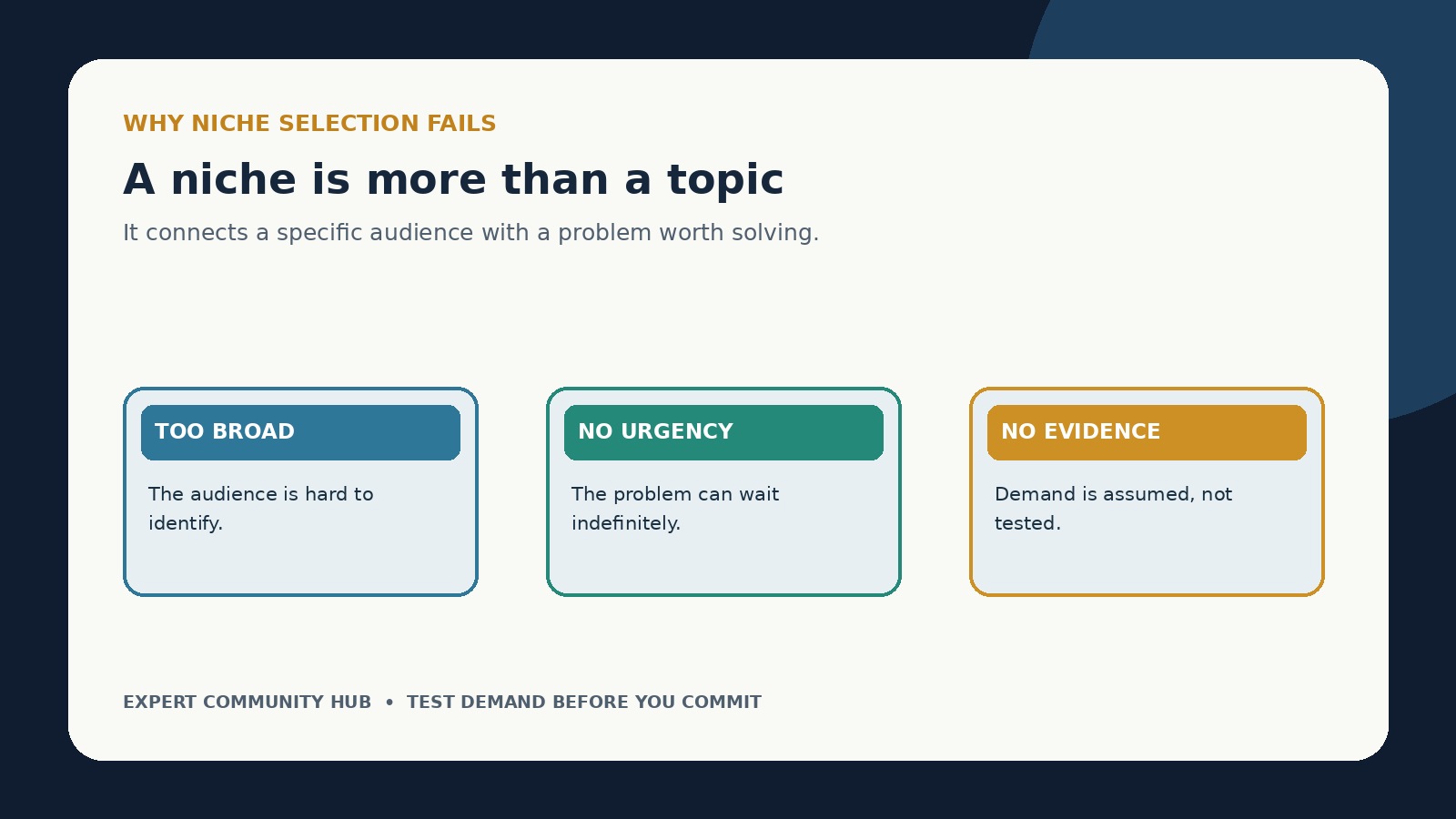
A profitable niche is not just a topic. It is a specific group of people with a problem you can credibly help solve and a reason to seek help.
You cannot guarantee profitability by choosing a clever label. But you can reduce guesswork by testing a few practical signals before investing months in a website, course, or funnel.
Why choosing a niche feels so difficult
Many experts approach niche selection from only one direction.
Some start with passion: “I love mindset, so I will become a mindset coach.”
Others start with money: “Business coaching seems profitable, so I should enter that market.”
Others copy a visible creator: “That coach is successful with this audience, so I will do the same.”
Each approach may offer a useful starting point, but none proves that the niche is right for you.
A topic you love may not connect to a problem people prioritize. A market that looks profitable may be difficult for you to reach or serve credibly. A niche that works for another coach may depend on their experience, reputation, audience, or delivery model.
You need a better way to evaluate the options.
The hidden mistake: choosing a label before understanding the problem
“Business coach” describes a broad category. It does not tell a potential client whether you understand their situation.
Compare these examples:
- “I help businesses grow.”
- “I help independent consultants create a consistent follow-up process for turning enquiries into sales conversations.”
- “I help first-time coaches turn their professional expertise into a clear starter offer and test it with potential clients.”
The more specific versions give a reader a clearer way to recognize their problem.
Specificity does not mean you must use a narrow niche forever. It means your initial message should be clear enough for a suitable person to understand why you may be relevant.
The 4-Fit Niche Framework
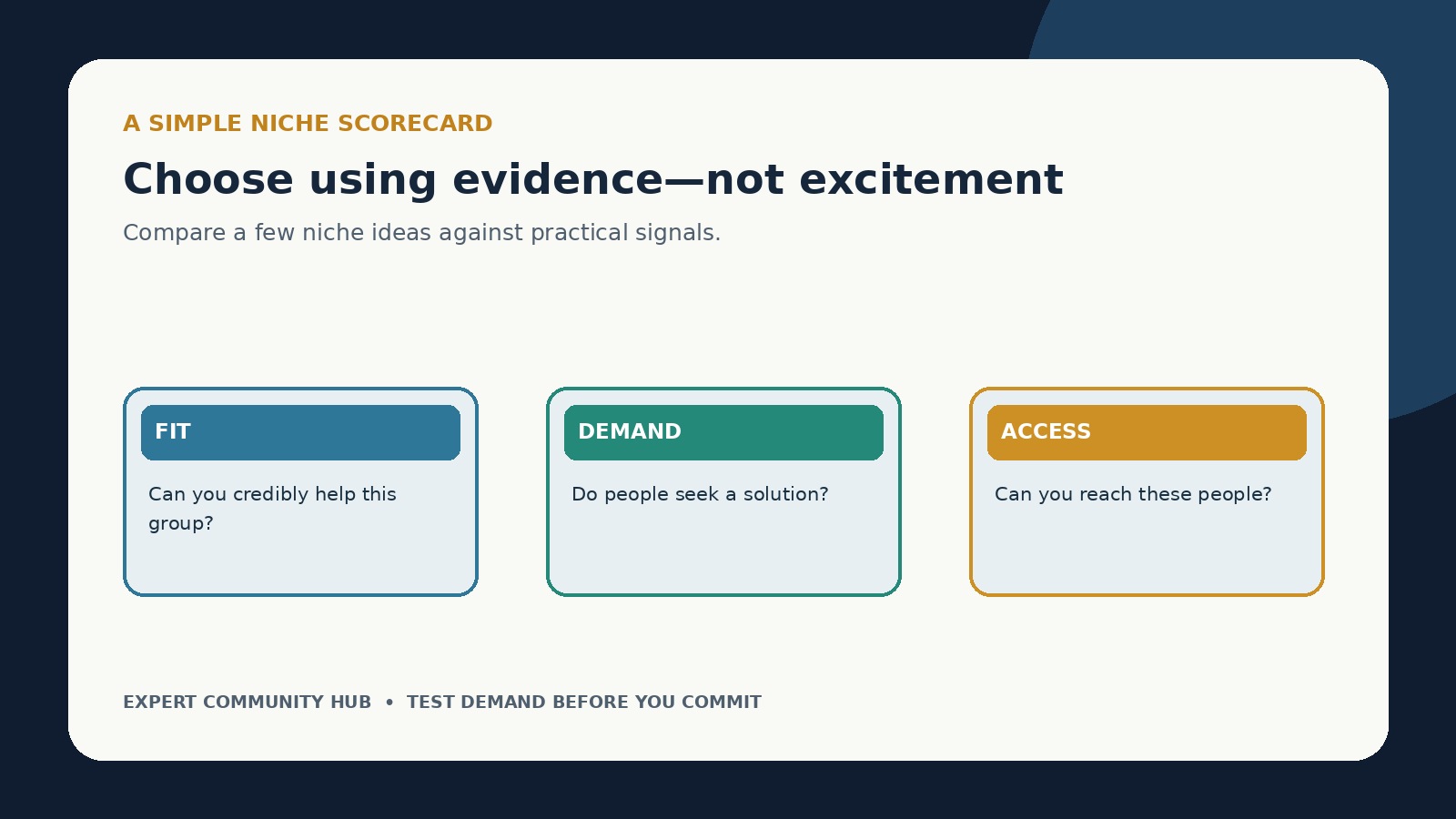
Use four filters to compare your niche ideas: Strength, Problem, Demand, and Access.
1. Strength: Can you credibly help?
Look at your experience, skills, results, training, and lived understanding.
Ask yourself:
- Which problems have I solved repeatedly?
- What do people already ask me for help with?
- What can I help someone do without exaggerating my ability?
- What additional training or boundaries would this area require?
You do not need to know everything. But you should be honest about what you can responsibly deliver.
2. Problem: Does the audience care enough to act?
A niche becomes more meaningful when it connects to a real challenge.
Look for problems that cost people time, money, confidence, opportunities, or peace of mind. Listen for repeated descriptions of the issue and what people have already tried.
Do not assume a problem is urgent just because it seems important to you. Ask potential clients how it affects them and what happens if they do nothing.
3. Demand: Is there evidence people seek a solution?
Demand is not proven by a large list of niche ideas or an enthusiastic reaction from friends.
Look for practical signals:
- People actively ask questions about the problem.
- They have tried other solutions or invested time addressing it.
- They are willing to discuss their situation in detail.
- They request information about your approach.
- Some are willing to take a meaningful next step, such as attending a workshop, requesting a proposal, or paying for a suitable pilot.
No single signal guarantees success. Taken together, they help you make a more informed decision.
4. Access: Can you reach the right people?
Even a genuine problem can be difficult to build a business around if you have no practical way to reach the audience.
Where do these people learn, work, network, and ask questions? Do you have relevant relationships? Can you create useful content for them? Are there communities, partnerships, events, or channels where you can participate appropriately?
Choose a niche you can learn about and reach—not just one that sounds attractive.
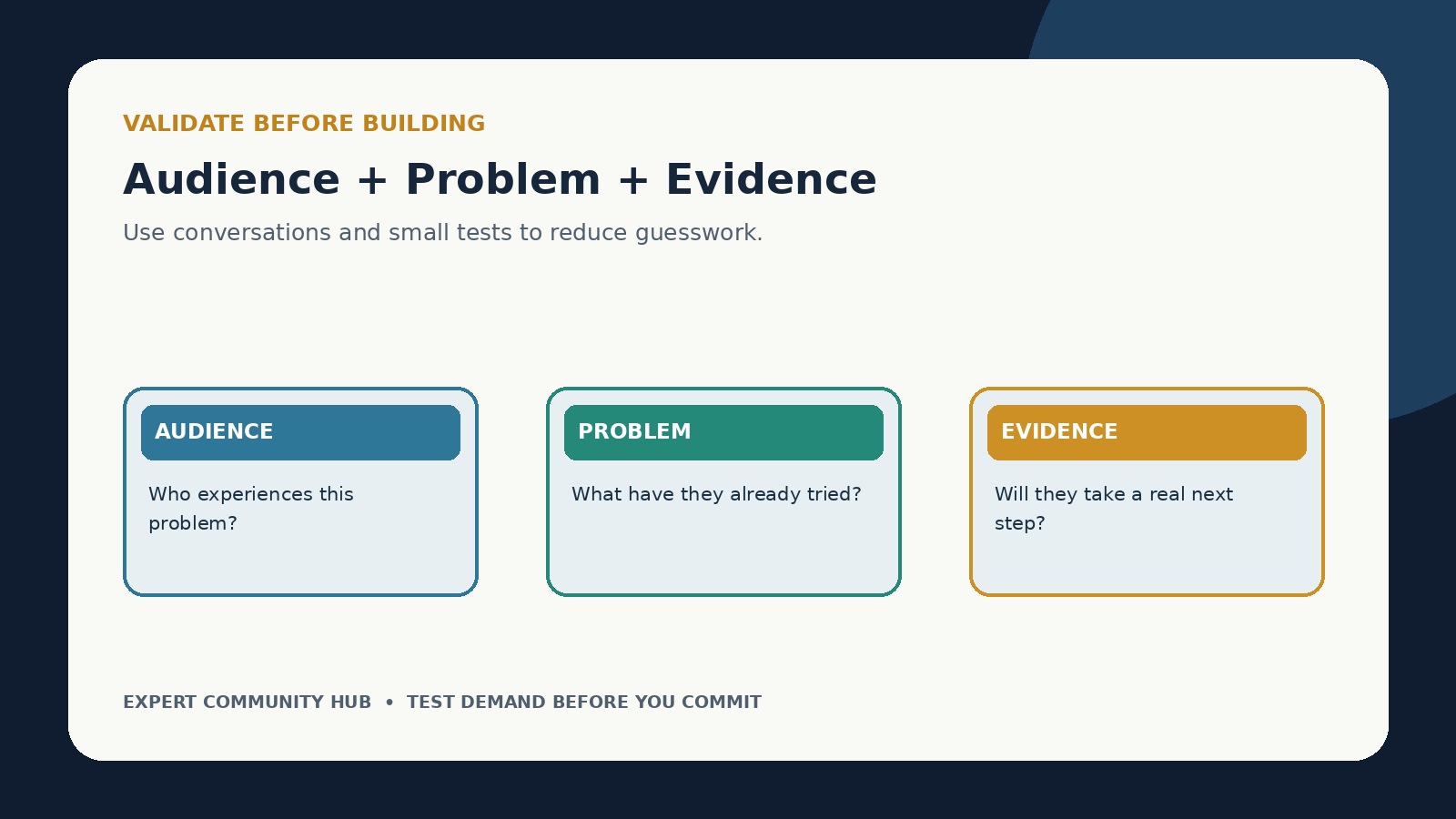
How to test a niche before building a full business
You do not need to build a complete website, course, or automated funnel to start learning.
Step 1: Create a shortlist of three niche ideas
For example:
- Independent coaches who struggle to generate qualified enquiries.
- Experienced professionals who want to turn their knowledge into a consulting service.
- Small business owners who need a clearer customer-acquisition process.
These are starting hypotheses, not conclusions. Adjust them to match your real expertise and audience access.
Step 2: Speak with potential clients
Find a few people who genuinely fit each audience. Ask open questions such as:
- What is the biggest challenge you are facing in this area?
- What have you tried so far?
- What has been difficult about solving it?
- What would a useful improvement look like?
- How do you currently decide whether to pay for help?
Listen more than you pitch. Avoid asking only, “Would you buy my idea?” People may be polite or optimistic when discussing a hypothetical offer. Their past actions and willingness to take a concrete next step can be more informative.
Step 3: Create a simple offer hypothesis
For the most promising audience, write one sentence:
“I help [specific audience] work on [specific problem] through [service or process].”
Keep the promise realistic. Explain what you would provide and what is outside the scope.
Step 4: Test a small next step
Invite suitable people to a focused consultation, workshop, pilot, or other small test. Be transparent about what is ready, what is experimental, and what participants will receive.
You are testing more than whether people say they like the idea. You are learning whether the problem matters, whether the offer is clear, and whether the delivery is useful.
Step 5: Review and refine
Record what people asked, what they misunderstood, what they valued, and whether they took the next step.
You may discover that the audience is right but the problem is too broad. Or the problem is real but your offer needs a different format. You might also learn that a niche is not a good fit for your skills or preferred way of working.
That is useful information. It helps you refine before making a larger commitment.
Use a simple niche scorecard
Score each niche from 1 to 5 against these questions:
- Strength: Can I credibly help?
- Problem: Is the challenge meaningful to this audience?
- Demand: Have I observed evidence of people seeking help?
- Access: Can I reach enough suitable people to test the idea?
- Delivery fit: Can I deliver the service responsibly and sustainably?
Use the scores to compare options, not as scientific proof of profitability. A high score means a niche deserves further investigation—not that revenue is guaranteed.
Your 30-minute niche clarity exercise
Set a timer and complete these four steps.
Minutes 1–10: Write down three audience groups you understand and the problems you could credibly help them solve.
Minutes 11–15: Score each idea against strength, problem, demand, access, and delivery fit.
Minutes 16–20: Choose the strongest hypothesis and write a one-sentence offer.
Minutes 21–30: Identify three people you could speak with to learn more. Draft a short, respectful invitation to ask about their experience—not to pressure them into buying.
This exercise will not prove a niche is profitable in half an hour. It will help you choose the next useful test.
What if your niche changes later?
Your first niche is a starting point, not a lifelong contract.
As you work with people, you may discover that a particular audience has a more urgent problem, that clients respond to a different offer, or that your strongest results come from a narrower segment.
Refining your niche is normal. The goal is to make changes based on learning rather than switching simply because a new idea looks exciting.
Give each reasonable test enough time and attention to generate useful evidence. Then decide what to keep, change, or stop.
Your turn
Which audience do you understand best—and what problem do people in that audience already ask you to help solve?
Share your answer in the comments. It may help you clarify your own niche and give another expert an idea to explore.
Your next step
If you are a coach, consultant, or knowledge-based professional, Expert Community Hub can help you explore how to turn your expertise into a clear offer and a more structured business.
Start with your strengths, listen to real people, test one focused offer, and let evidence guide your next decision.
Written for coaches, consultants, and knowledge-based entrepreneurs by Expert Community Hub.