
If your business feels like a hundred open tabs, the answer may not be more discipline. It may be a simpler system.
You may not have a time problem. You may have a business that depends on you remembering everything.
Open your laptop.
There are messages to answer. Content to create. Leads to follow up with. A course to improve. A landing page to fix.
And somewhere in the middle of all that, you are supposed to find new clients.
You start the day with a plan.
By evening, you have been busy for hours. Yet the important work is still waiting.
This is the quiet frustration many coaches and consultants know well.
The problem is not always laziness. It is not always a lack of motivation.
Often, the business has no simple way to decide what matters, what happens next, and what can run without constant attention.
The hidden cost of keeping everything in your head
When every task depends on your memory, your mind becomes the business's task manager.
You remember to reply to a prospect. You remember to send the resource. You remember to publish the post. You remember to check whether someone booked a call.
Until you forget.
Then you feel guilty. You work later. You promise yourself that next week will be different.
But next week arrives with the same loose ends.
This creates three hidden costs:
- Lost opportunities: a warm lead waits too long for a useful follow-up.
- Scattered attention: you switch tasks so often that meaningful work takes longer.
- Unreliable progress: your results depend on how energetic or organized you feel that day.
The answer is not to build a complicated machine. It is to remove unnecessary decisions.
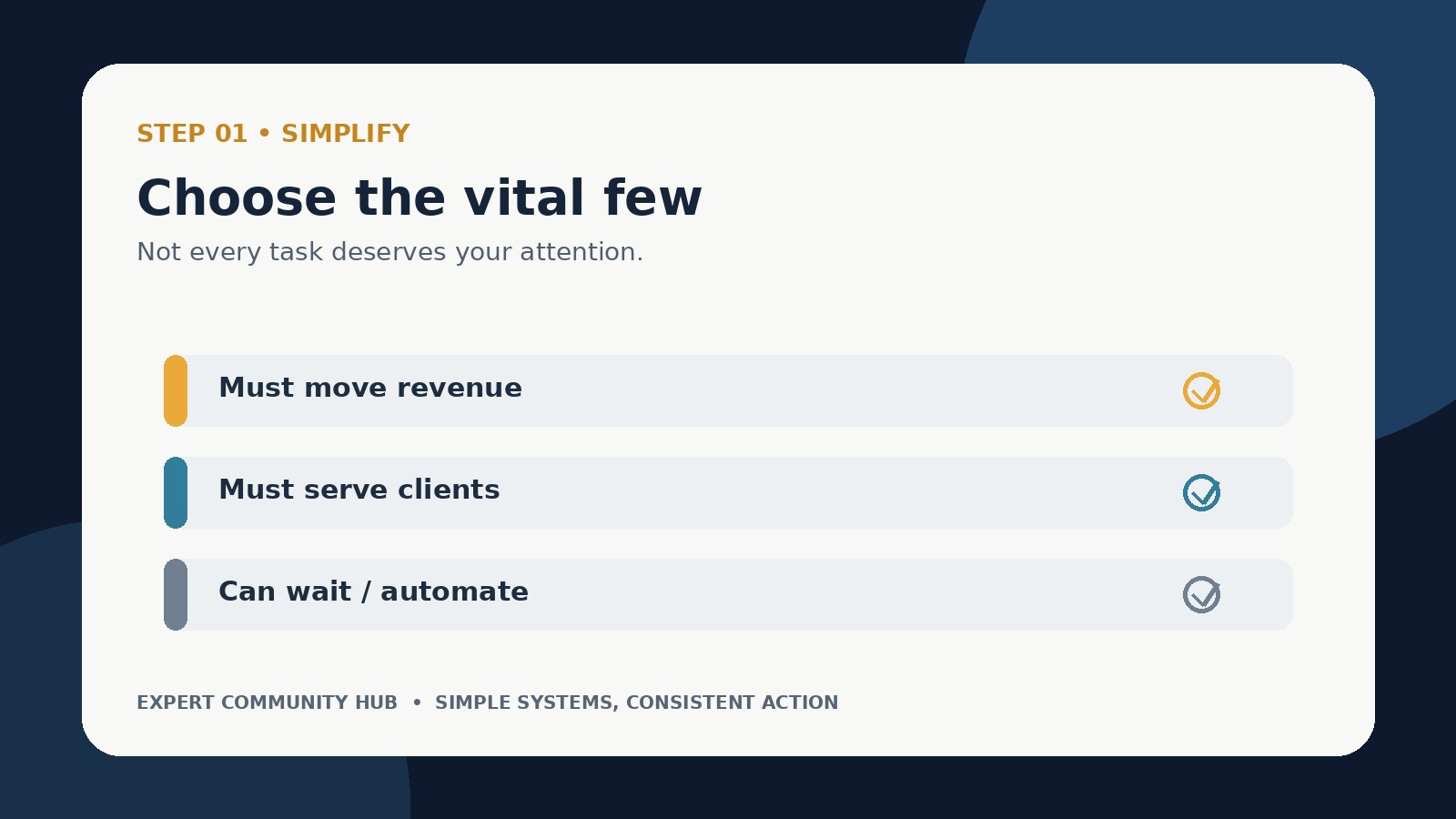
Step 1: Choose the vital few
Before adding another tool, write down the actions that move your business forward.
For many coaches, the list is surprisingly short:
- Start conversations with the right people.
- Follow up with people who show interest.
- Deliver a useful client experience.
- Share proof, ideas, or stories that build trust.
- Review the numbers and improve one thing.
These are the core actions. Everything else should support them.
Use this simple filter when a new task appears:
- Does it help attract or convert a suitable client?
- Does it improve the result clients receive?
- Is it required right now?
If the answer is no to all three, it may not deserve today's attention.
Step 2: Turn repeated work into a loop
A system is not a fancy dashboard.
A system is a reliable sequence that tells you what happens next.
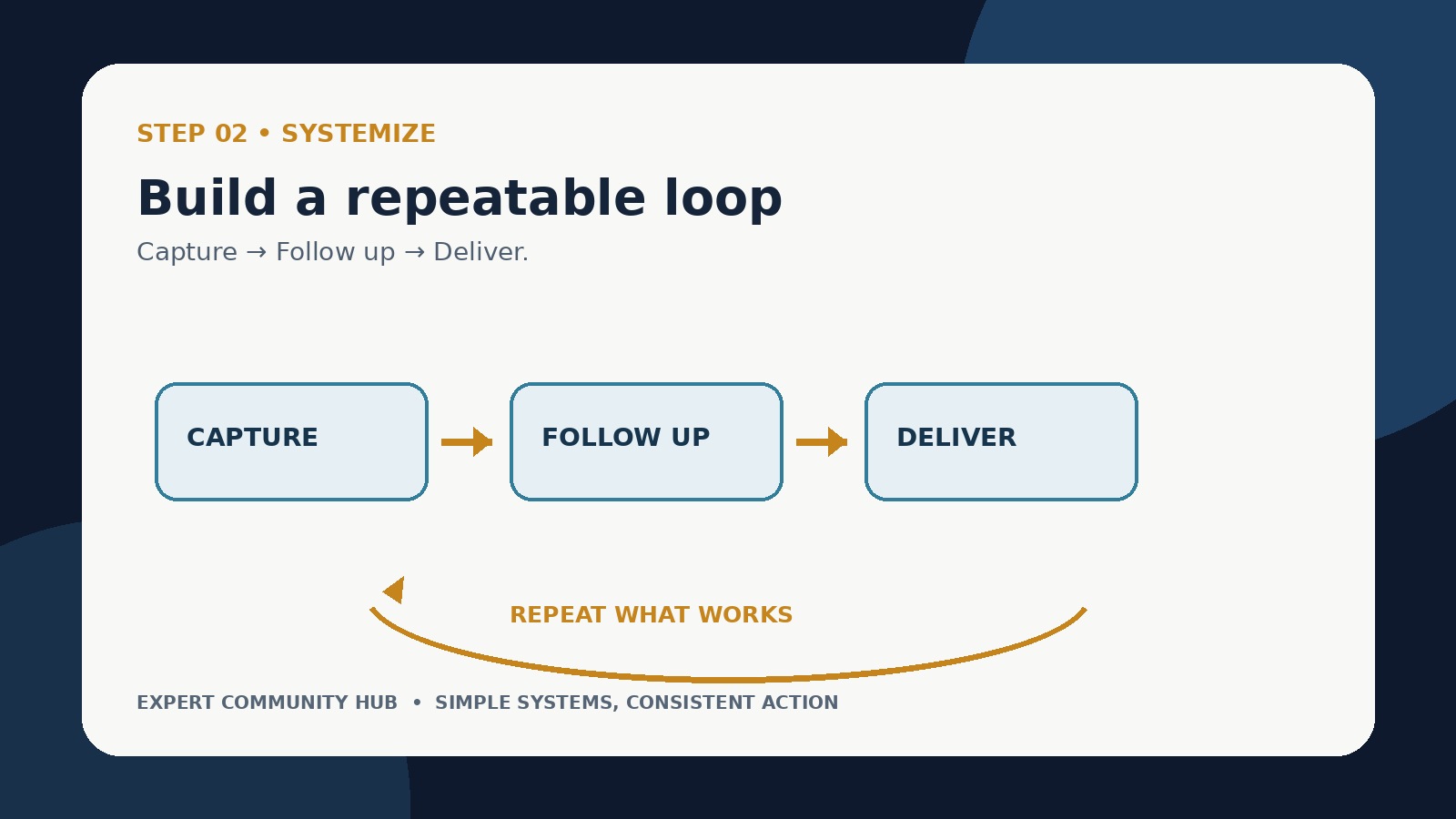
Start with one small loop:
Capture → Follow up → Deliver
Capture: When someone shows interest, record their name, need, and next step in one place.
Follow up: Set a clear date and send a helpful message. Do not rely on remembering.
Deliver: When a person becomes a client, use a consistent onboarding checklist so the experience feels professional every time.
At first, a spreadsheet and calendar reminders may be enough. Later, you can automate repetitive steps with forms, email tools, or AI.
The important thing is to create the process before automating it.
Automation cannot rescue a process that is confusing in the first place.
Step 3: Give your week a rhythm
Many business owners plan every day from scratch.
That means they spend energy deciding what to do before they even begin doing it.
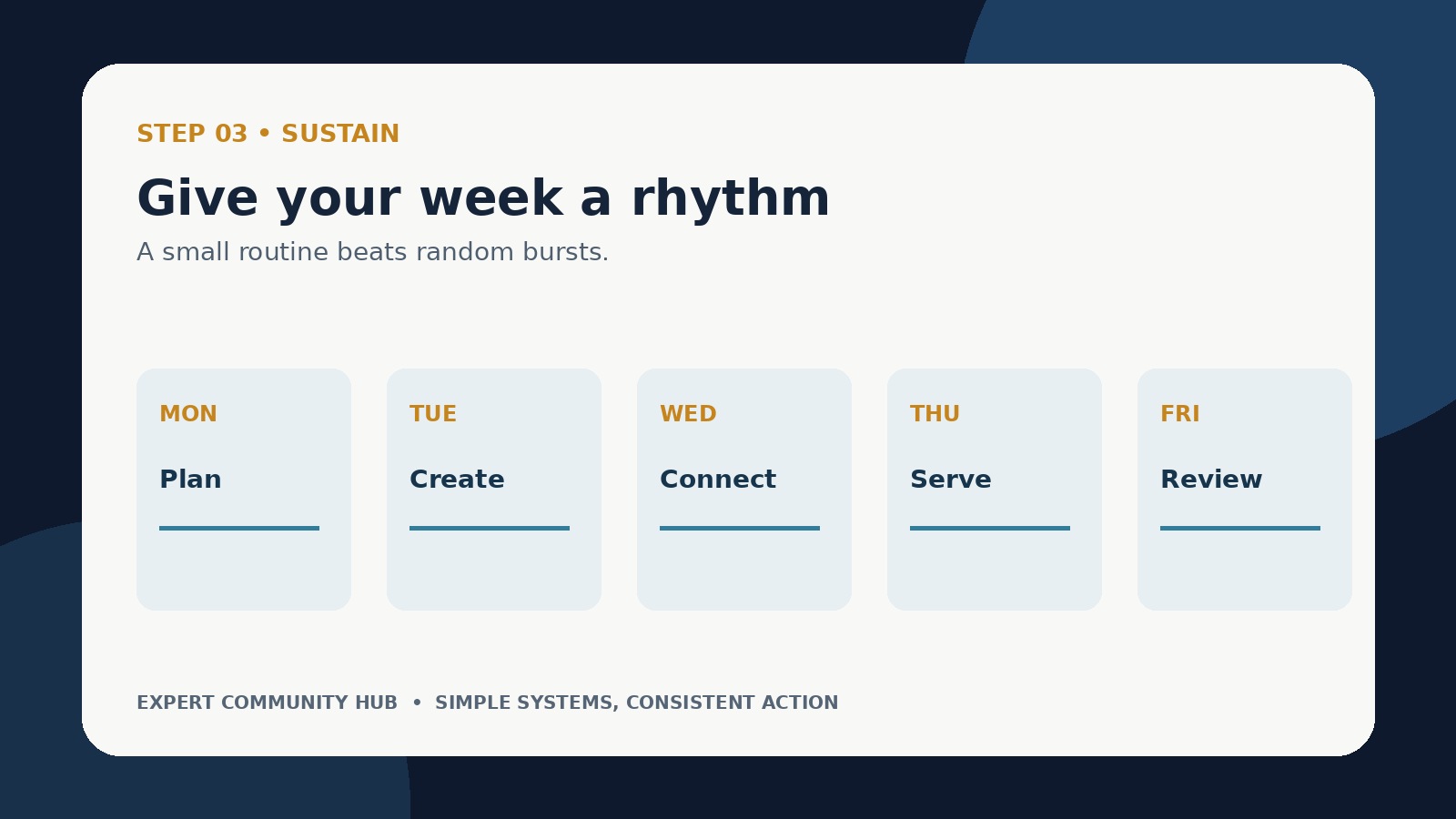
Try assigning a primary focus to each day. Adjust the rhythm to fit your own schedule.
- Monday: plan the week and review key numbers.
- Tuesday: create useful content or improve an offer.
- Wednesday: start conversations and follow up with leads.
- Thursday: serve clients and improve delivery.
- Friday: review what worked and choose one improvement.
This is not a rigid rule. Client work may change your schedule.
The point is to reduce decision fatigue. You should not have to reinvent your business every morning.
Step 4: Automate only after the process works
AI and automation can save time. But adding five new tools at once can create another layer of confusion.
Choose one repeated task first.
For example:
- Use a form to collect the same information from every new lead.
- Use a saved message to acknowledge an enquiry quickly.
- Use AI to turn one useful idea into a draft for multiple platforms.
- Use a calendar link to reduce the back-and-forth of scheduling.
- Use a checklist to make client onboarding consistent.
Run the process manually a few times. Notice where it gets stuck. Then automate the stable parts.
Keep the human touch where it matters: understanding a client's situation, making a promise you can keep, and giving thoughtful guidance.
Your 20-minute system reset
You do not need to rebuild your entire business today.
Set a timer for 20 minutes and do this:
Minutes 1–5: Write down every business task currently occupying your mind.
Minutes 6–10: Circle the three tasks most likely to create clients, improve delivery, or protect revenue.
Minutes 11–15: Choose one repeated task and write its steps in order.
Minutes 16–20: Decide where that process will live—a checklist, spreadsheet, calendar, or simple automation—and schedule the first test.
That is enough for a start.
A small system you actually use is more valuable than a perfect system you keep postponing.
The real goal is freedom, not more efficiency
The purpose of a business system is not to turn you into a machine.
It is to protect your attention for the work only you can do.
Your expertise. Your relationships. Your thinking. Your family. Your life outside the business.
You may still have busy days. You may still need to make difficult decisions.
But your business should not require you to remember everything, solve every problem from scratch, or be available every minute.
Start with one recurring problem. Make the next step clear. Repeat what works. Improve it gradually.
That is how overwhelm begins to give way to control.
Your turn: What is one task in your business that you repeat every week and wish would happen with less effort?
Written for coaches, consultants, and knowledge-based entrepreneurs by Expert Community Hub.