

People like your posts, save your tips, and watch your videos—but few enquire. Here is the missing bridge between engagement and enrolment.
Your content gets attention. So why does your calendar still have empty spaces?
A post gets likes.
Someone saves your carousel. A few people watch your video until the end. Your follower count slowly grows.
For a moment, it feels like progress.
Then you check your enquiries.
Nothing has changed.
If you are a coach, consultant, or expert, this can be deeply frustrating. You are sharing what you know. You are trying to be consistent. You may even be helping people for free every week.
But attention is not automatically trust. And trust does not automatically become a sale.
There is a bridge between someone consuming your content and someone deciding to work with you.
If that bridge is missing, you can keep publishing and still struggle to generate clients.
The hidden gap between useful and buyable
Helpful content answers questions.
Buying decisions require something more. A potential client needs to understand:
- Is this person speaking to someone like me?
- Do they understand the problem I am trying to solve?
- Can they help me reach an outcome I care about?
- Why should I trust their approach?
- What should I do if I want their help?
A person may enjoy your tips without realizing you offer a service. They may admire your knowledge but remain unsure whether your approach fits their situation.
This is not always a content-quality problem.
It may be a connection problem.
Your content teaches. Your offer sits somewhere else. Your audience is left to work out how the two connect.
The five parts of the missing bridge
1. Build trust before asking for commitment
Trust grows when your message consistently reflects the problems your audience recognizes.
Do not only publish broad advice such as “be consistent” or “work smarter.”
Show what those ideas mean in a real situation.
For example, instead of saying, “Follow up with leads,” explain why a warm lead often goes quiet, what a helpful follow-up sounds like, and how to avoid sounding desperate.
Specificity helps people feel understood.
2. Show proof, not just knowledge
Teaching demonstrates what you know. Proof helps people understand what your approach can do.
Proof can include a client story, a before-and-after process, a lesson from your own experience, a sample deliverable, or a clear demonstration of your method.
Be honest. Do not invent results or promise outcomes you cannot guarantee.
If you are early in your journey, show your process. Explain how you diagnose a problem and what a client can expect when working with you.
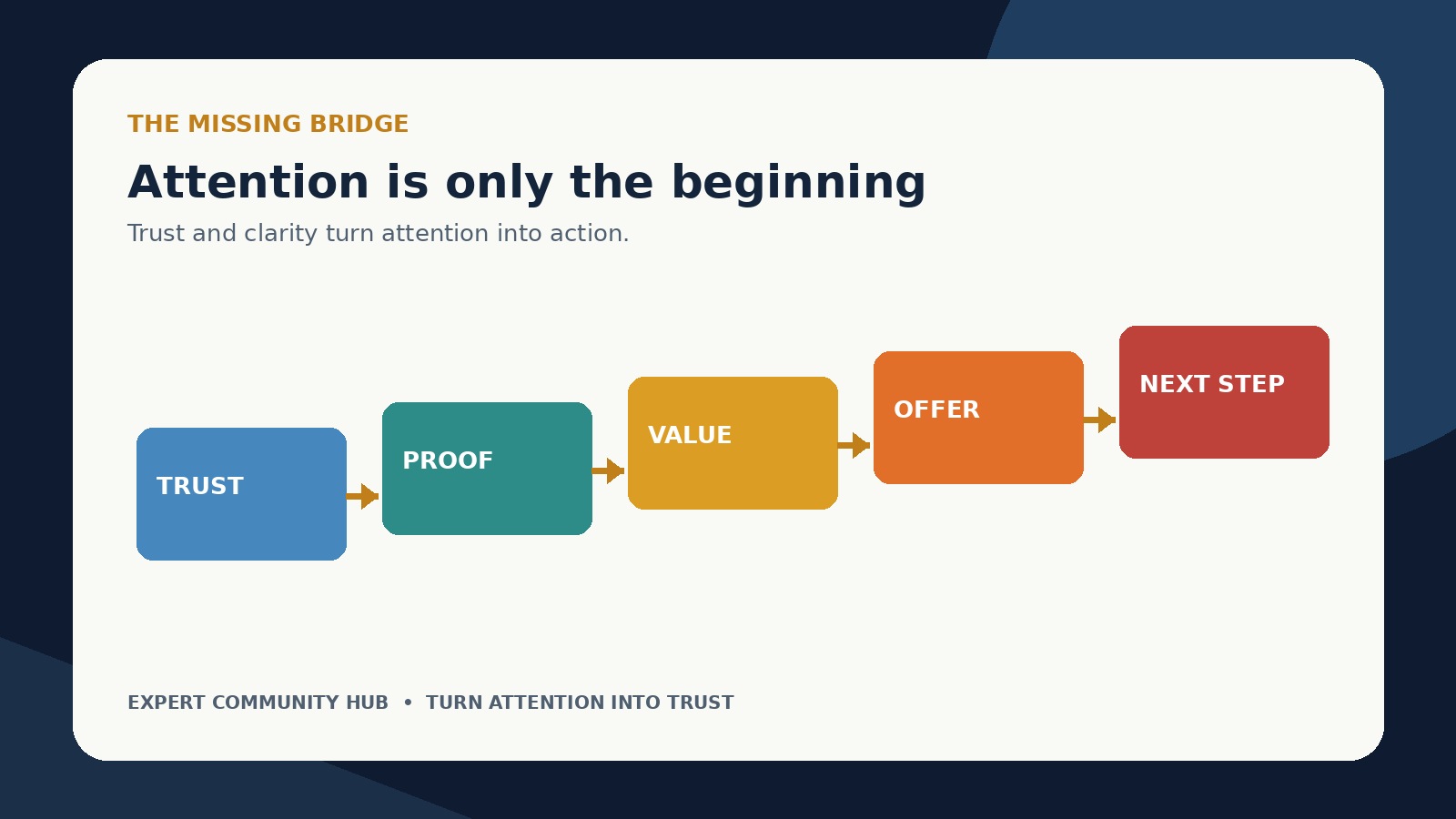
3. Make your offer easy to understand
A potential client should not need to decode your offer.
Try completing this sentence:
I help [specific audience] solve [specific problem] so they can [meaningful outcome] through [your method].
For example:
“I help independent coaches build a simple client-acquisition system so they can generate more consistent enquiries without managing every step manually.”
That is clearer than saying you offer coaching, consulting, digital marketing, AI, automation, and business growth all at once.
Your expertise may be broad. Your entry point should be easy to grasp.
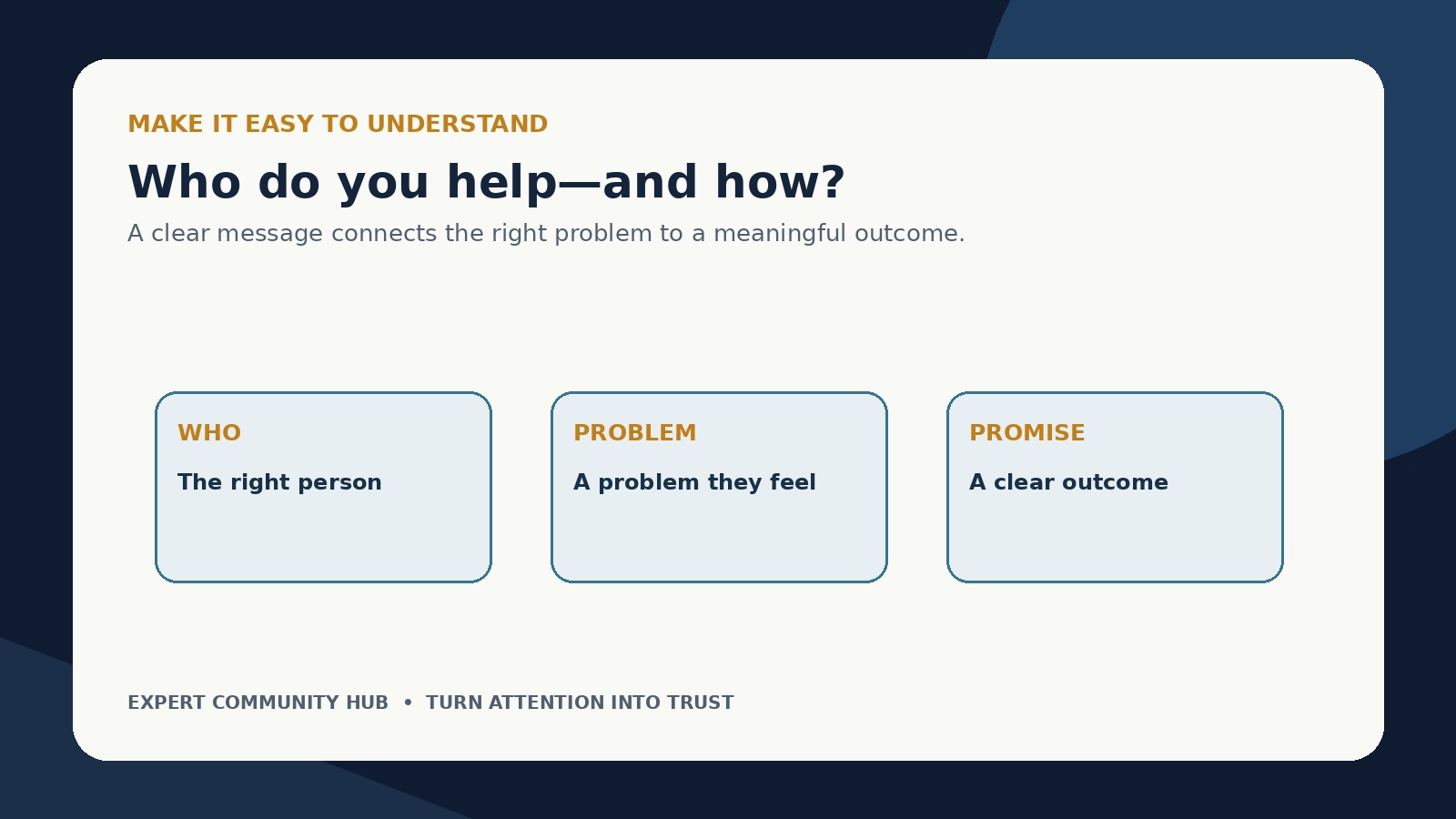
4. Connect each post to a buyer's journey
Not every post needs to sell. But your content should work together.
A simple mix could include:
- Problem awareness: help people recognize what is holding them back.
- Practical education: show a useful way to approach the problem.
- Proof and perspective: explain why your method is credible and how it differs.
- Invitation: offer a relevant next step for people who want support.
If every post is a tip, people may learn from you indefinitely without considering your service.
If every post is a pitch, people may feel that you are only interested in selling.
A balanced sequence helps people move from awareness to consideration.
5. Give people one clear next step
Do not assume your audience knows what to do next.
Invite them to take a relevant action: reply with a keyword, download a useful guide, attend a workshop, book a discovery call, or review your service details.
Choose the step that matches their level of readiness.
Someone who has just discovered you may not be ready for a sales call. Someone who has been following your work for months may welcome a direct invitation.
Make the action clear, and explain what happens after they take it.
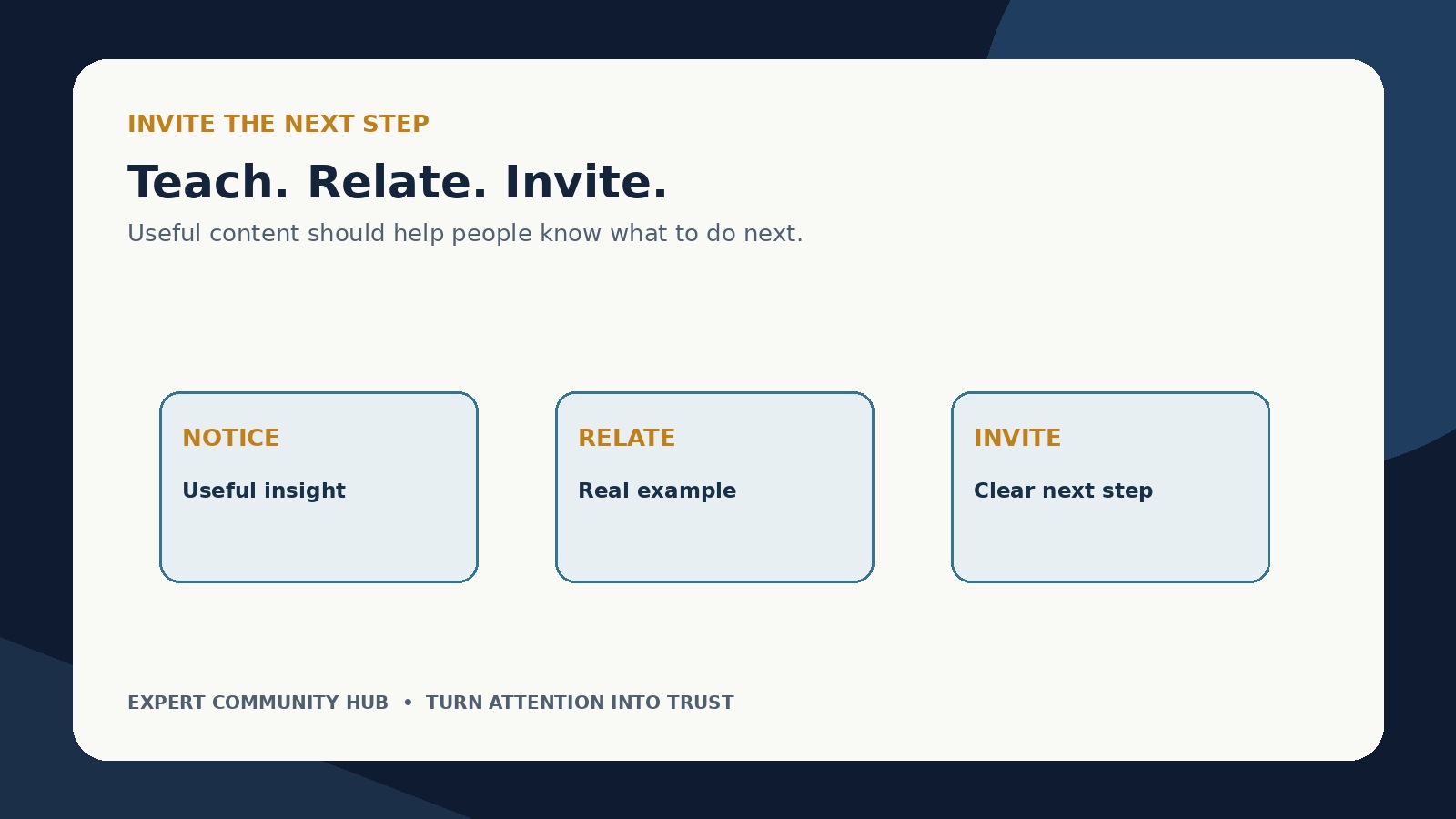
A simple example: change the job of your content
Imagine you help coaches attract clients.
Instead of publishing five disconnected tips, build a short sequence around one problem.
Post 1 — The problem: “Why your followers may not understand what you sell.”
Post 2 — The lesson: Show a simple way to describe an offer in one sentence.
Post 3 — The proof: Share an example of how a clearer message changes the conversation with a potential client. Use a real example or label it clearly as an illustration.
Post 4 — The invitation: Offer an offer-review checklist or invite suitable readers to discuss their current message.
Now your content is doing more than collecting engagement. It is helping the right person recognize a problem, understand your thinking, and take a logical next step.
Your 30-minute content-to-client audit
Open your last ten posts and answer these questions:
- Who was each post specifically meant to help?
- What problem did it help that person understand or solve?
- Does it demonstrate your approach, not just share general information?
- Is there a natural connection to your service?
- Is the next step clear when someone wants more help?
Do not judge every post by likes alone. Look for meaningful signals too: relevant replies, direct enquiries, resource downloads, booked calls, and conversations with suitable prospects.
If you find a gap, do not immediately create more content.
Improve the connection first.
The goal is not to turn every follower into a buyer
Some people will enjoy your content and never need your service. That is normal.
The goal is to help the right people understand your value and make an informed decision.
You do not need to become louder. You need to become clearer.
Create content that reflects real problems. Demonstrate your method. Make your offer understandable. Invite people to take the next step.
That is how content can become part of a client-acquisition system—not just another item on your to-do list.
Your turn: Which part of the bridge is weakest in your business right now: trust, proof, offer clarity, or the next step?
Written for coaches, consultants, and knowledge-based entrepreneurs by Expert Community Hub.