
Likes can feel rewarding, but they do not always lead to business. Learn how coaches and consultants can create useful content that attracts the right people, builds trust, and opens meaningful conversations.
What if your next 100 likes did less for your business than one meaningful conversation with the right person?
You publish a post. You check your phone. A few likes appear.
You publish another. You try a trending audio. You share a motivational quote. You experiment with a carousel.
Some posts perform well. Others disappear without a response.
But when you look at your enquiries, the picture is different. The people engaging with your content are not necessarily the people who need your service. And the people who could become clients may not understand what you actually help them do.
This is the frustrating gap between creating content and creating business opportunities.
The goal is not simply to get attention. It is to help the right people recognize their problem, trust your thinking, and know what to do next.
The content trap: becoming busy without becoming clearer
Coaches and consultants often hear that they must post every day, publish reels, build a personal brand, tell stories, use trends, and stay visible.
Consistency can help. But activity without direction can become exhausting.
You may spend hours producing content without being able to explain what each post is meant to achieve. Your message changes from one topic to another. You attract broad engagement, but potential clients struggle to connect your posts with a clear service.
The problem is not necessarily your creativity or posting frequency.
It may be that your content is designed to earn reactions rather than help a particular audience make progress.
A post can be entertaining and still be useful. A post can receive few likes and still start an important conversation. Metrics need context.
Ask a better question: Did this content help the people I want to serve understand something that matters to them?
Why likes do not always become clients
A like is a small signal. It can mean agreement, appreciation, curiosity, or simply that someone paused while scrolling.
It does not automatically mean the person has the problem you solve, trusts your approach, wants to buy, or is ready to act.
Consider two posts.
The first says, “Never give up on your dreams.” It may resonate with many people.
The second explains three reasons independent consultants lose potential clients during follow-up and offers a simple way to improve the process. It may attract fewer reactions, but it speaks directly to a problem a suitable client may be trying to solve.
Neither format is inherently wrong. The second is simply more closely connected to a defined business problem.
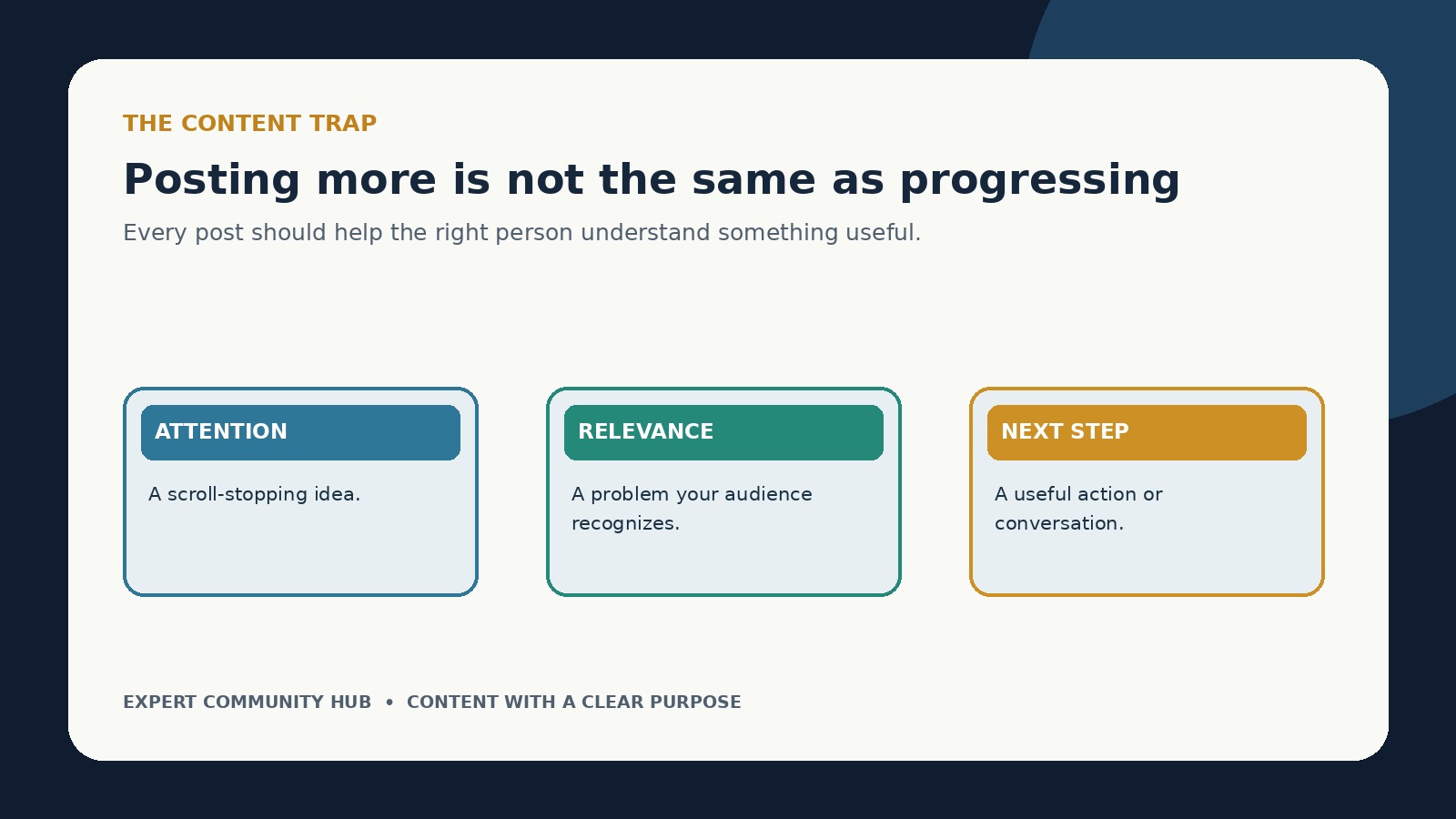
You need a balance of content that earns attention, demonstrates expertise, and creates a relevant next step.
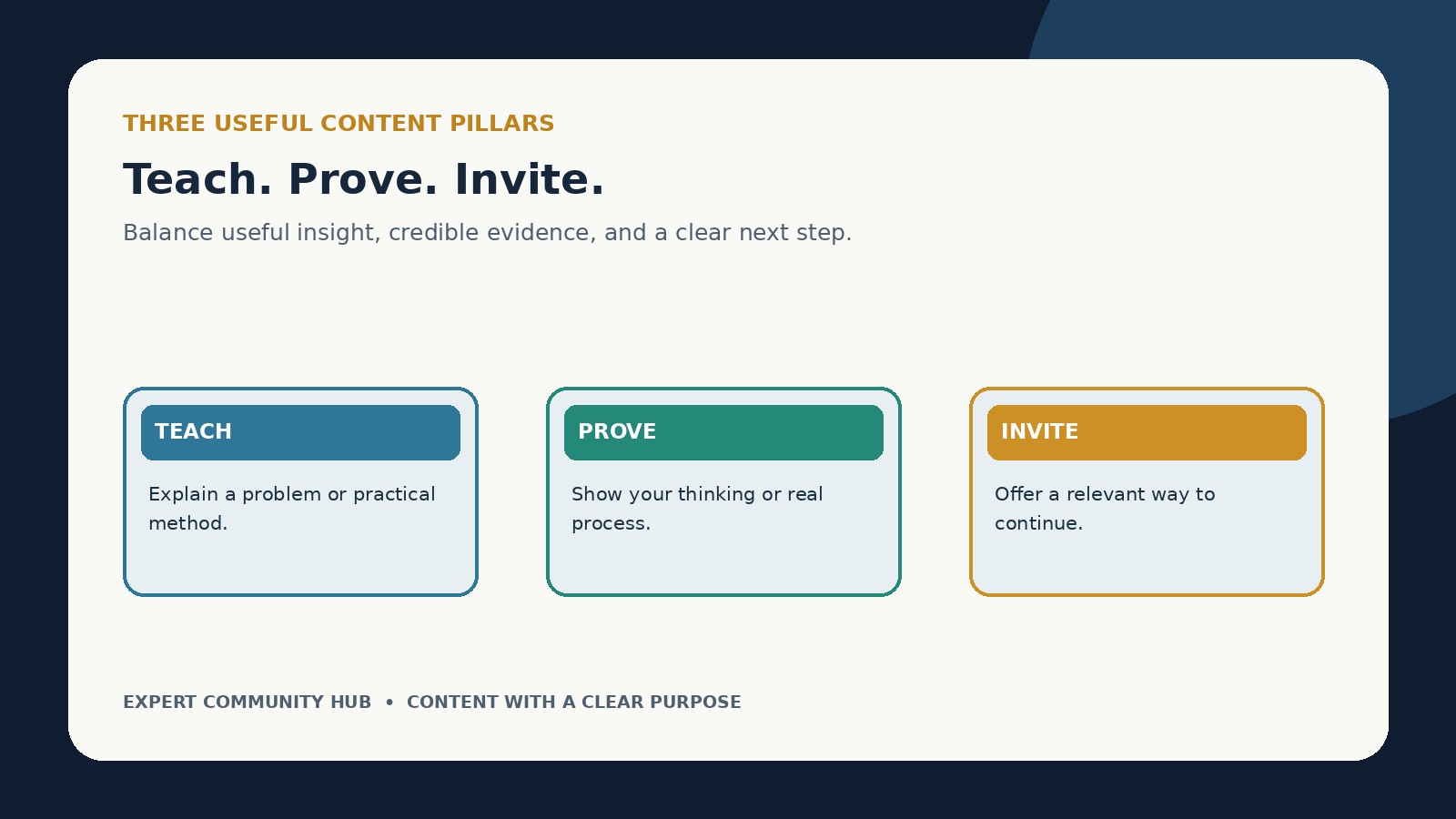
The Ideal-Client Content Framework: Teach, Prove, Invite
Use three content pillars to make your publishing more purposeful.
1. Teach: help people understand a problem
Teach one useful idea at a time.
Explain a common mistake. Break down a process. Share a checklist. Compare two approaches. Answer a question you hear repeatedly from your audience.
For example, a business coach might explain why leads go cold after an initial enquiry and suggest a simple follow-up routine.
The post should leave the reader with a clearer understanding or a practical action—not just a vague feeling of motivation.
2. Prove: make your thinking visible
People need a reason to believe that you understand the problem.
You can demonstrate this through a clear explanation of your process, a relevant example, a lesson learned, a behind-the-scenes look at how you work, or a client result shared with permission and appropriate context.
Proof does not require exaggerated claims or dramatic screenshots. Show your reasoning. Be honest about what you know, what you have tested, and what results depend on circumstances beyond your control.
3. Invite: make the next step clear
Some readers may want to go further.
Invite them to ask a question, download a useful resource, attend a workshop, join a relevant discussion, or explore your service. Choose a next step that matches the content and the reader's level of interest.
Not every post needs a sales pitch. But your overall content should make it possible for an interested person to move from learning to a deeper conversation.
Five questions to ask before publishing
Before you publish, take one minute to answer these questions.
Who is this for? Name the type of person you want to help.
What problem or question does it address? Make the relevance clear.
What will the reader understand or do differently? Give the content a useful purpose.
Why should they trust this explanation? Include sound reasoning, a practical example, or credible evidence.
What is the natural next step? It could be trying an action, replying to a question, or exploring a resource.
If you cannot answer these questions, the idea may need more focus. You do not need to overthink every post, but a little intention can prevent weeks of scattered publishing.
A simple weekly content plan
You do not need to publish on every platform every day. Start with a rhythm you can sustain.
Post 1 — Teach. Answer one real question your ideal client asks.
Post 2 — Prove. Show how you think through a problem, explain a process, or share a truthful example.
Post 3 — Invite. Ask a thoughtful question or offer a relevant next step for people who want help.
You can adapt the format to your strengths: a short video, a text post, a carousel, a newsletter, or a blog article. The platform and format matter less than the connection between the message and the audience.
Reuse a strong idea in different formats when it makes sense. You do not need a completely new insight every time you publish.
Turn content into real conversations
Content should not be a one-way performance.
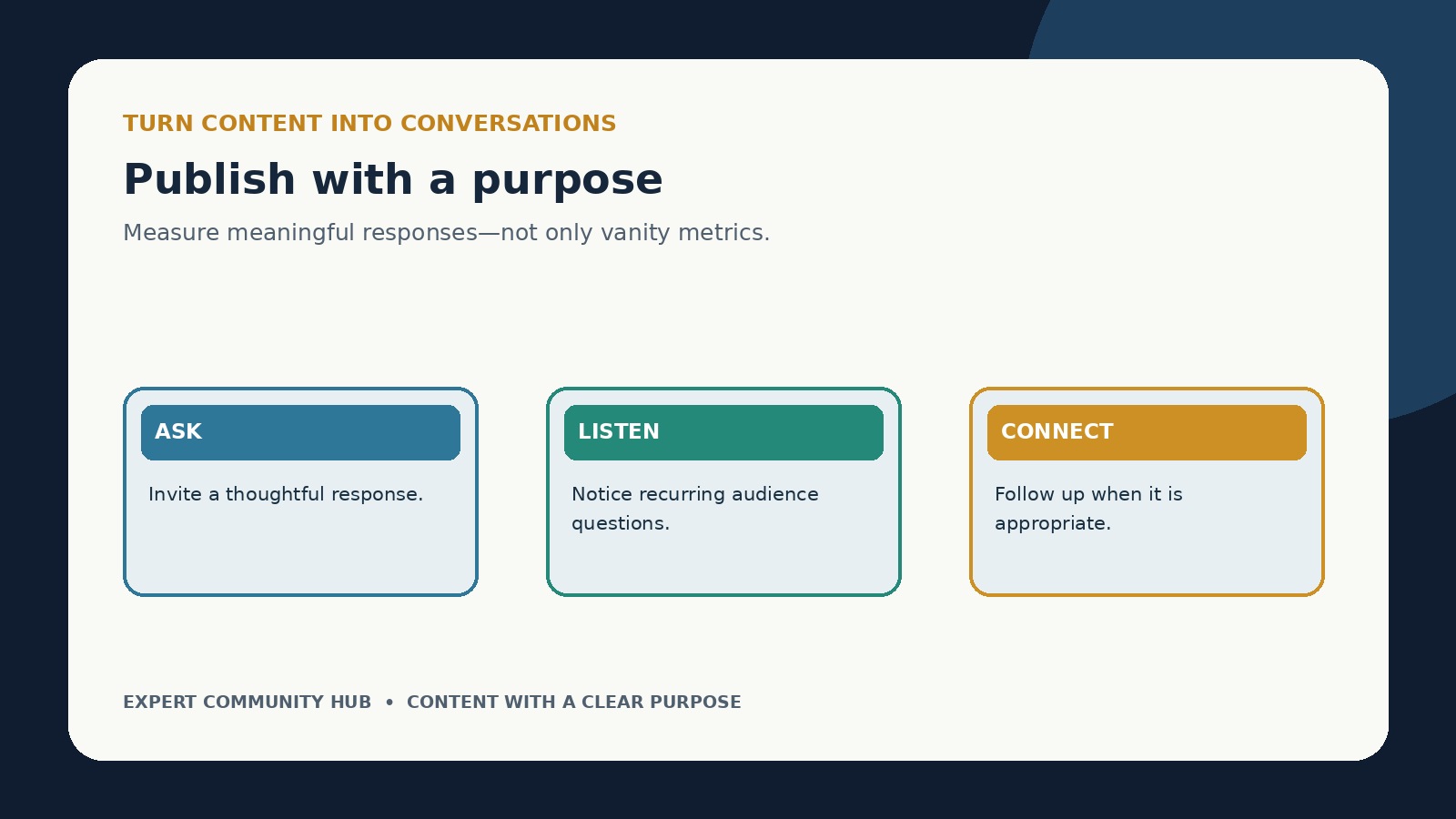
Pay attention to the questions people ask in comments, messages, workshops, and client conversations. Those questions can help you identify what to teach next.
When someone responds with a genuine concern, reply thoughtfully. If the conversation suggests they may need your service, ask whether they would like to explore it. Do not assume every comment is a sales opportunity, and avoid sending unsolicited pitches to people who simply engage with a post.
Your aim is to build trust by being useful and respectful.
A meaningful conversation may lead to a client. It may also reveal that the person is not a fit, that your message is unclear, or that your audience needs a different kind of resource. All of these can be useful learning.
Measure what matters for your goal
Likes and reach can help you understand whether content is attracting attention. They are not the only measures worth watching.
Depending on your current goal, also review:
- Replies and questions from your intended audience.
- Saves or shares when they indicate practical usefulness.
- Visits to a relevant service or resource page.
- Sign-ups for a workshop or newsletter.
- Suitable enquiries and conversations.
- Sales or other outcomes you can reasonably connect to your content.
Do not assume that one post caused a sale just because the timing matches. Look for patterns over time, ask new clients how they discovered you, and use simple tracking where appropriate.
If your content earns attention but not relevant responses, sharpen the audience and problem. If it creates conversations but no enquiries, check whether your offer and next step are clear. If people enquire but do not proceed, review the offer and sales conversation rather than blaming content alone.
Your 20-minute content reset
Choose one service you genuinely want to grow.
Minutes 1–5: Write down the audience and one problem they frequently face.
Minutes 6–10: Draft one teaching idea that helps them understand or address that problem.
Minutes 11–15: Add a real example, a practical process, or a useful piece of evidence that demonstrates your thinking.
Minutes 16–20: End with a natural question or a relevant invitation. Then publish or schedule the post.
For the next few weeks, observe which topics lead to meaningful responses from suitable people. Use that feedback to improve your content—not to chase every trend.
Your content does not need to impress everyone
When you try to appeal to everyone, your message often becomes too broad to feel personal to anyone.
You do not need every post to go viral. You need a clear body of content that helps your intended audience understand the problems you solve and the way you approach them.
Some posts will attract attention. Some will build credibility quietly. Some will start conversations. A healthy content strategy gives each of these roles room.
Stop asking only, “How many people liked this?” Start asking, “Did this help the right person take a useful next step?”
Your turn
If you could change one thing about your content today, would you focus on reaching more people, attracting a more relevant audience, or turning attention into meaningful conversations? Why?
Share your thoughts in the comments. Your answer may help another coach or consultant rethink their content strategy.
Your next step
If you are a coach, consultant, or knowledge-based professional, Expert Community Hub can help you explore how to communicate your expertise, clarify your offer, and build a more structured approach to client acquisition.
Start with one audience, one real problem, and one useful post. Then listen to the response and improve from what you learn.
Written for coaches, consultants, and knowledge-based entrepreneurs by Expert Community Hub.