
Your calendar is full. Your to-do list keeps growing. But are you getting closer to more clients and reliable income? Learn how coaches and consultants can stop confusing activity with progress.
Your calendar is full. So why does your business still feel stuck?
By Dharmendra Singh | Expert Community Hub
Busy all day. Still worried about growth?
You wake up early.
You answer messages. You edit a post. You watch a tutorial. You adjust your website. You check your social media numbers.
By evening, you are exhausted.
Yet one question remains.
"Where are my clients?"
This is a frustrating place to be. You are not sitting idle. You are putting in effort. You care about your business.
But the effort does not always lead to progress.
Being busy can feel productive while the important work keeps getting postponed.
For coaches and consultants, this often means spending hours polishing the business instead of speaking to the people it exists to serve.
The hidden pain behind constant activity
When results are slow, doing more can feel like the safest response.
You add another task. You try another platform. You redesign a page. You create more content.
Every action gives you a small feeling of progress.
But the biggest questions remain unanswered.
Does your audience understand your offer? Are you talking to the right people? Are interested prospects receiving follow-up? Do you know where potential clients drop out of your process?
These questions can feel uncomfortable. They require decisions. They may reveal that a strategy needs to change.
So it is tempting to choose tasks that feel easier.
The cost is not just time. It is the growing gap between how hard you work and the results you hoped that work would create.
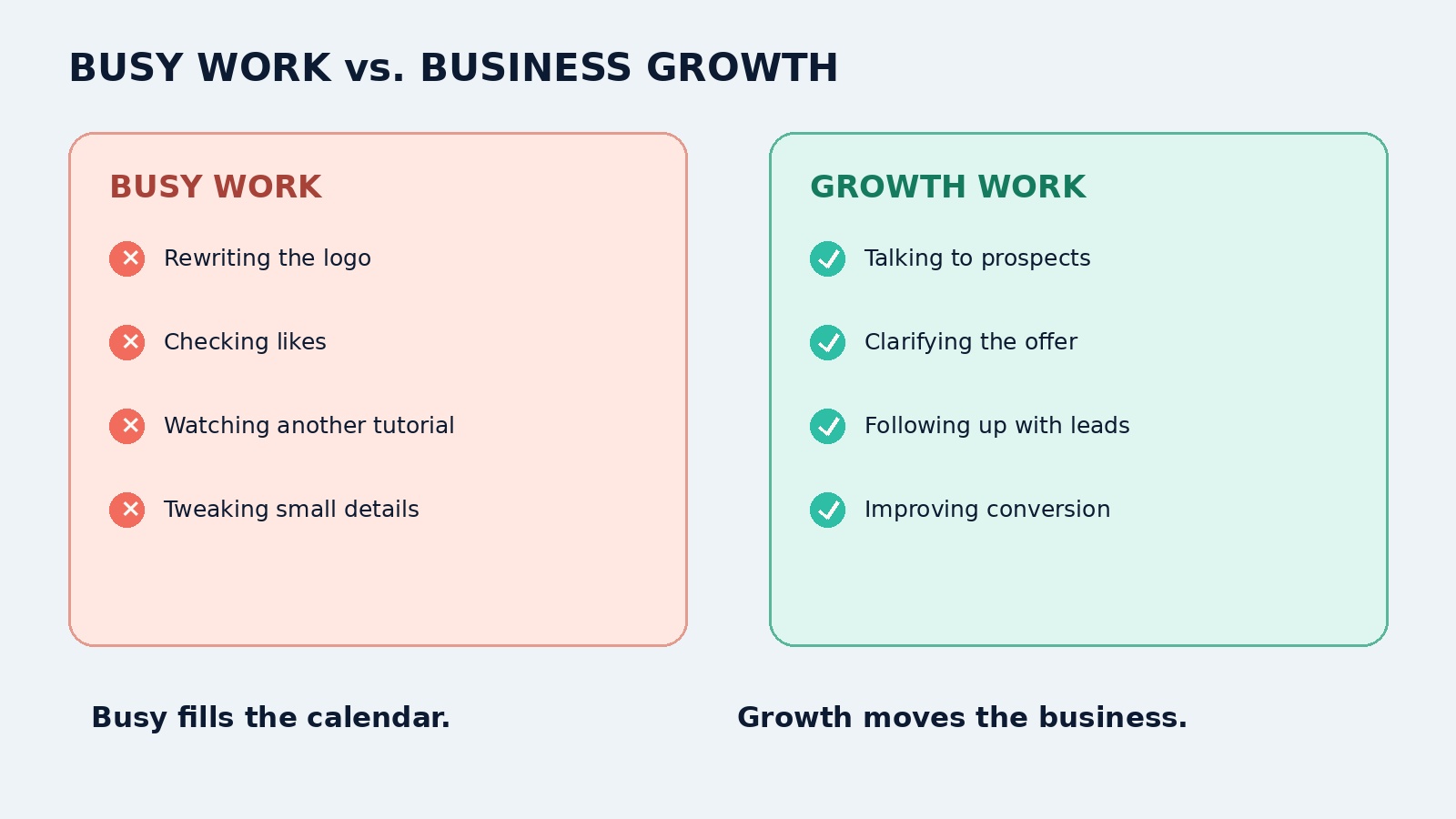
Four signs you are confusing activity with progress
1. You keep improving things nobody has seen
You spend hours perfecting your logo, website, or presentation.
But very few potential clients have seen your offer.
A polished brand can help. It cannot replace market feedback.
Try this: Show your offer to five suitable people. Ask what they understand, what confuses them, and what would make it relevant.
2. You create content without a clear next step
You publish regularly. People may even like your posts.
But they do not know what to do next.
Every useful piece of content does not need a sales pitch. Still, your overall content should guide interested people toward a sensible next step.
Try this: Choose one next step for each content theme. It could be downloading a guide, replying with a question, or booking a discovery call.
3. You keep learning but avoid conversations
Courses can improve your skills. But prospects can teach you what they actually need.
If you rarely speak with potential clients, you may be building your business around assumptions.
Try this: Schedule a few genuine conversations each week. Ask about challenges. Listen carefully. Do not turn every conversation into a pitch.
4. Your to-do list has no clear priority
Everything feels urgent.
You move from email to content to design to admin. Important tasks receive whatever time remains.
Try this: Choose one business result for the week. Decide which actions are most likely to support it. Put those actions on your calendar first.
The difference between busy work and growth work
Busy work is not always useless. Admin, learning, and design all have a place.
The question is whether they deserve your attention right now.
For a coaching business, growth work often includes:
- Speaking with potential clients.
- Improving the clarity of your offer.
- Following up with interested people.
- Publishing useful content for a defined audience.
- Reviewing where leads and sales are getting stuck.
- Improving the client experience so people receive real value.
These actions help you learn from the market.
They do not guarantee immediate sales. But they create useful feedback and help you make better decisions.
Use the 3-question task filter
Before starting a task, pause for a moment.
Ask yourself:
1. Does this help me reach or serve the right people?
If not, it may be a lower priority.
2. Will this produce a useful result or useful feedback?
A conversation, a tested offer, or a completed follow-up has a visible outcome.
3. Is this the most important task I can do today?
A task can be useful without being urgent.
If the task passes this filter, schedule it. If not, consider delaying, simplifying, delegating, or removing it.
Build a simple weekly growth rhythm
You do not need a complicated productivity system.
Start with a weekly rhythm that fits your available time.
Monday: Choose the priority
Pick one business bottleneck. It might be lead generation, offer clarity, follow-up, or conversion.
Do not try to fix everything at once.
Tuesday: Create visibility
Publish one useful piece of content. Make sure it speaks to a real audience problem.
Wednesday: Start conversations
Reach out to suitable prospects or reconnect with people who have shown interest. Be helpful and respectful.
Thursday: Follow up
Review open conversations. Send relevant follow-ups. Make the next step clear.
Friday: Review the evidence
What did you do? What response did you receive? Where did people lose interest? What should change next week?
Adapt this rhythm to your business. The point is to make growth activities consistent rather than occasional.
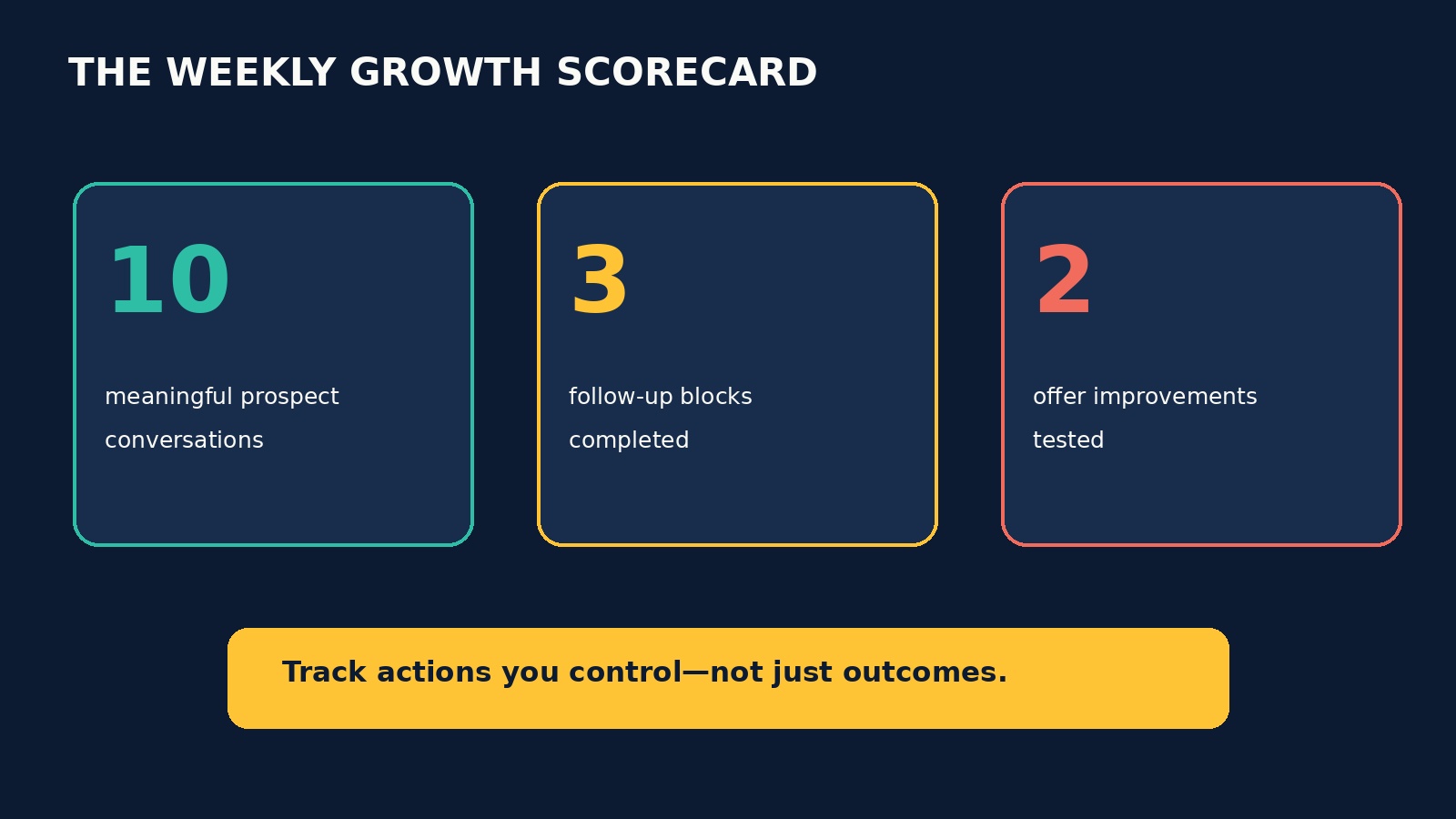
Track actions, not just revenue
Revenue matters. But it is a lagging result.
You also need to track the actions that can influence it.
Choose a few measures that fit your current stage:
- Meaningful conversations started.
- Follow-ups completed.
- Qualified enquiries received.
- Discovery calls booked.
- Offers presented.
- Sales and conversions.
Do not track every number available. Choose the few that help you make decisions.
For example, if many people enquire but few book calls, review your follow-up and booking process.
If calls happen but sales remain low, review the fit between your offer and the prospect's needs.
If hardly anyone enquires, investigate your audience, message, reach, and call to action.
Use the numbers to find the bottleneck. Do not use them to punish yourself.
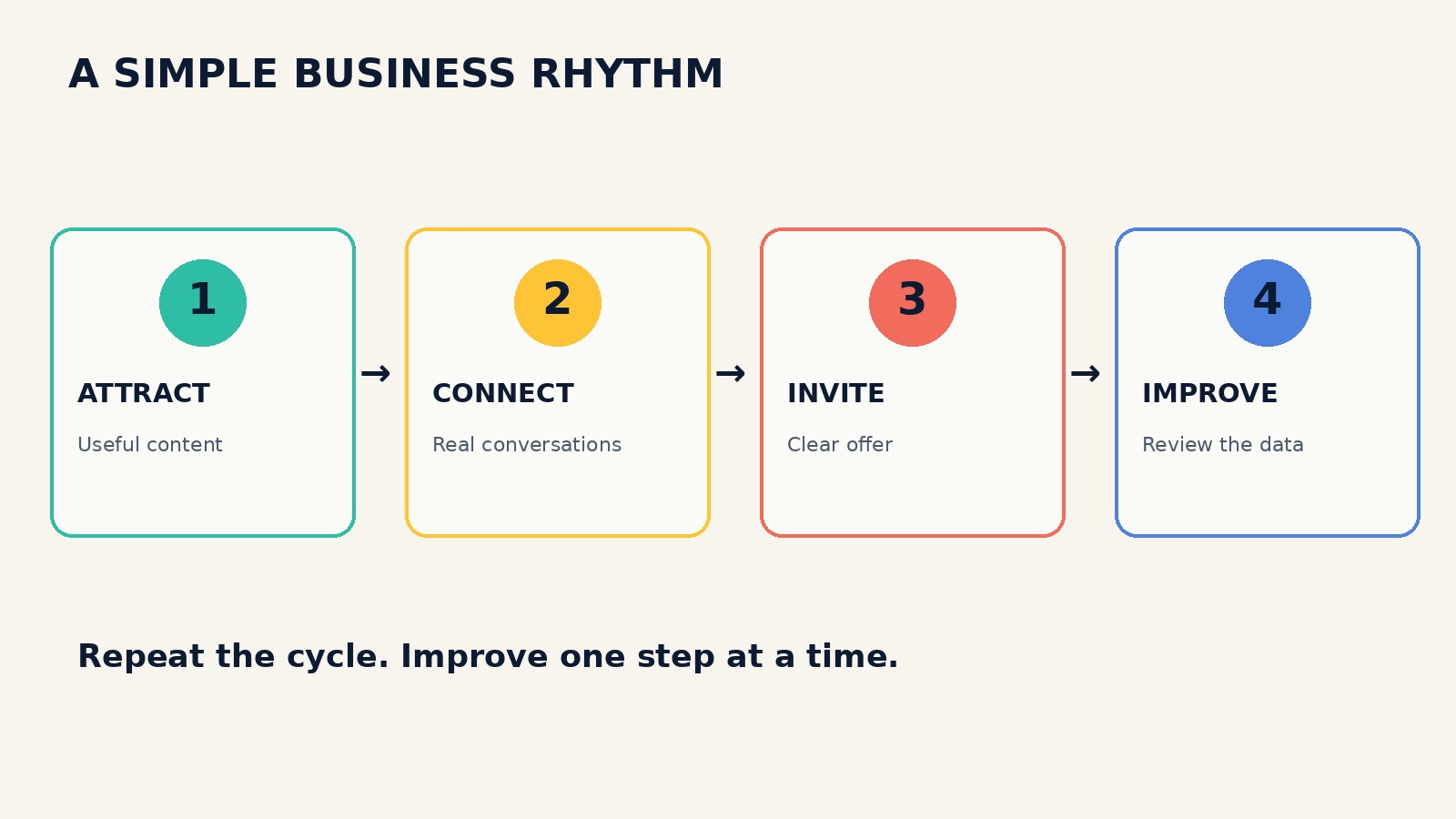
A simple business rhythm beats random bursts
Growth often comes from repeating a small set of useful activities.
Attract the right people. Start conversations. Make a clear offer. Follow up. Deliver value. Review what happened.
Then improve one step at a time.
You do not need to automate everything at once. Start manually if necessary. Add tools when they make a working process easier to manage.
The goal is not to fill every hour.
The goal is to make your limited time count.
Key takeaways
1. A full calendar does not guarantee business growth. Look at outcomes and feedback, not just effort.
2. Do the important work before polishing the details. Get your offer in front of real people.
3. Choose one bottleneck at a time. Focus makes it easier to see what is working.
4. Track a few meaningful numbers. Use them to identify what needs attention.
5. Build a repeatable weekly rhythm. Consistent actions are easier to improve than random bursts of activity.
Final thought: stop proving how hard you work
You do not have to earn success by exhausting yourself.
You need to understand which activities matter most. Then give those activities your best attention.
Some days will still be busy. Unexpected work will happen. Progress will not always be linear.
That is normal.
But you can stop treating exhaustion as proof of progress.
At Expert Community Hub, we help coaches, consultants, and experts build clearer offers, practical systems, and AI-supported client acquisition processes.
The aim is not to do everything.
It is to do the right things more consistently, learn from the results, and build a business that supports the life you want.
Your turn
What is one task that keeps you busy but rarely moves your business forward?
What could you do instead this week?
Write down one change. Test it. Let the evidence guide your next step.