

Deep expertise matters, but clients cannot choose you for value they cannot see or understand. Learn how to connect your knowledge with clear positioning, proof, and consistent communication.
You can know more, have more experience, and deliver excellent work—and still lose the opportunity to someone the client understands more quickly.
Imagine two professionals.
One has years of experience, deep knowledge, and a long list of qualifications. Their online profile describes everything they have learned and every service they can provide.
The other has a simpler message. They explain who they help, what problem they solve, and what working with them looks like.
A potential client visits both profiles.
The first seems impressive. The second feels relevant.
Who gets the conversation?
Often, the person whose value is easier to recognize gets the next opportunity.
That does not mean the second professional is more capable. It means the client can more easily connect their problem with the solution being offered.
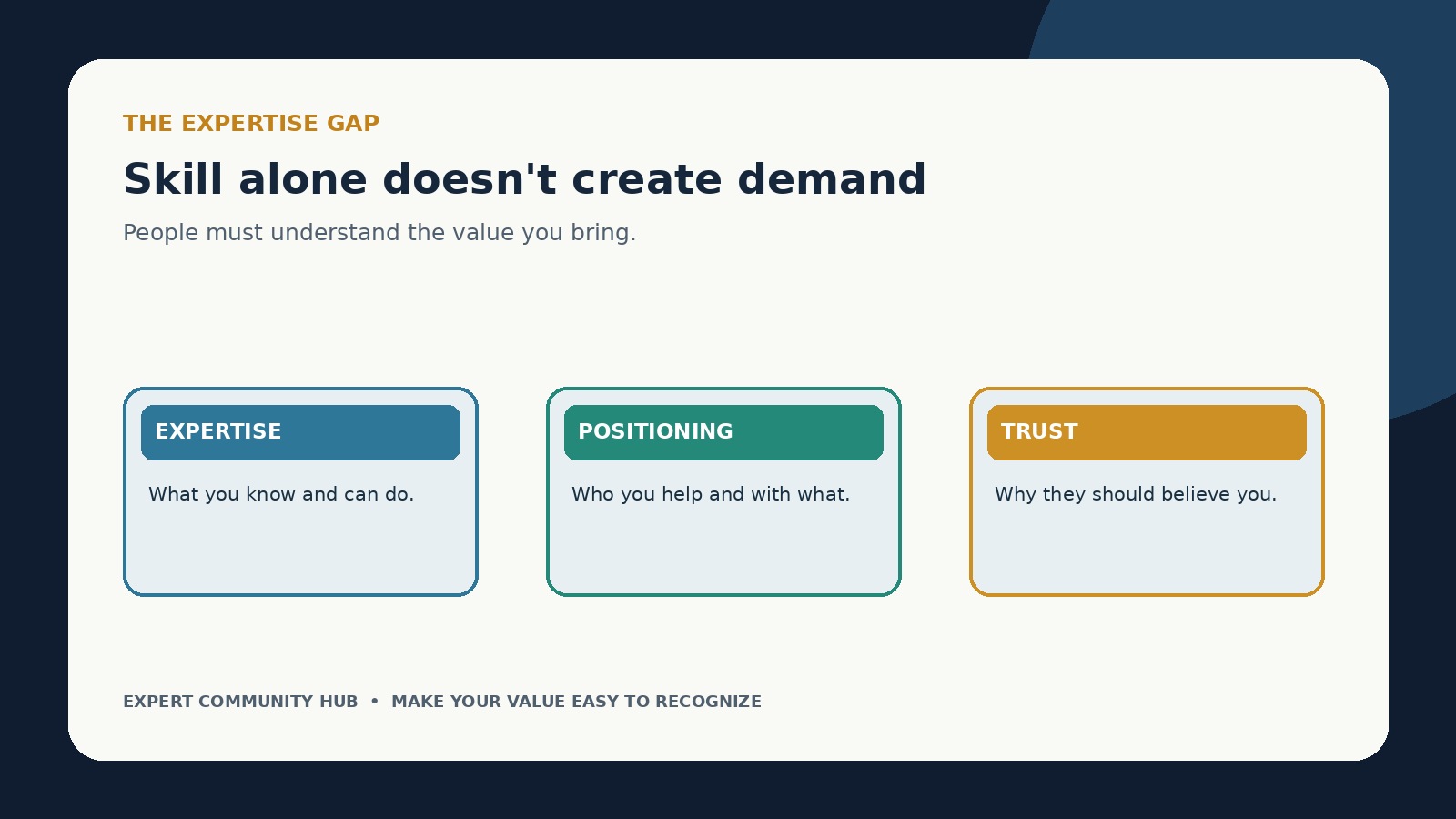
Expertise creates potential value. Clear communication helps people recognize it.
The frustrating gap between being capable and being chosen
Coaches, consultants, and experienced professionals often invest years in becoming good at their craft.
They study. They practice. They solve difficult problems. They help teams, customers, and organizations make progress.
Then they start building an independent business—and discover that doing excellent work is only one part of attracting clients.
People must also discover them. Understand what they do. Trust that they can help. And see a sensible next step.
When those pieces are missing, a capable expert may experience:
- Fewer enquiries than their experience seems to deserve.
- Prospects who struggle to understand the difference between their service and alternatives.
- Content that demonstrates knowledge but does not explain its practical relevance.
- Long sales conversations spent explaining what the offer actually includes.
- Frustration when less-experienced competitors appear to attract more attention.
It is tempting to respond by learning more or adding more qualifications.
Sometimes additional skill is genuinely needed. But when the underlying issue is communication, another certificate will not automatically make your value easier to understand.
The hidden reason: the market cannot see inside your head
You know what you have learned. You understand the complexity of your work. You may recognize a problem in minutes because you have seen it many times.
Your potential client does not have that context.
They may not know which questions to ask. They may not understand your terminology. They may be comparing several options while trying to reduce uncertainty and avoid a costly mistake.
If your message focuses mostly on your credentials, methods, or the many things you can do, the reader has to work hard to figure out whether you are right for them.
Your job is not to make your expertise sound complicated. It is to make its relevance clear.
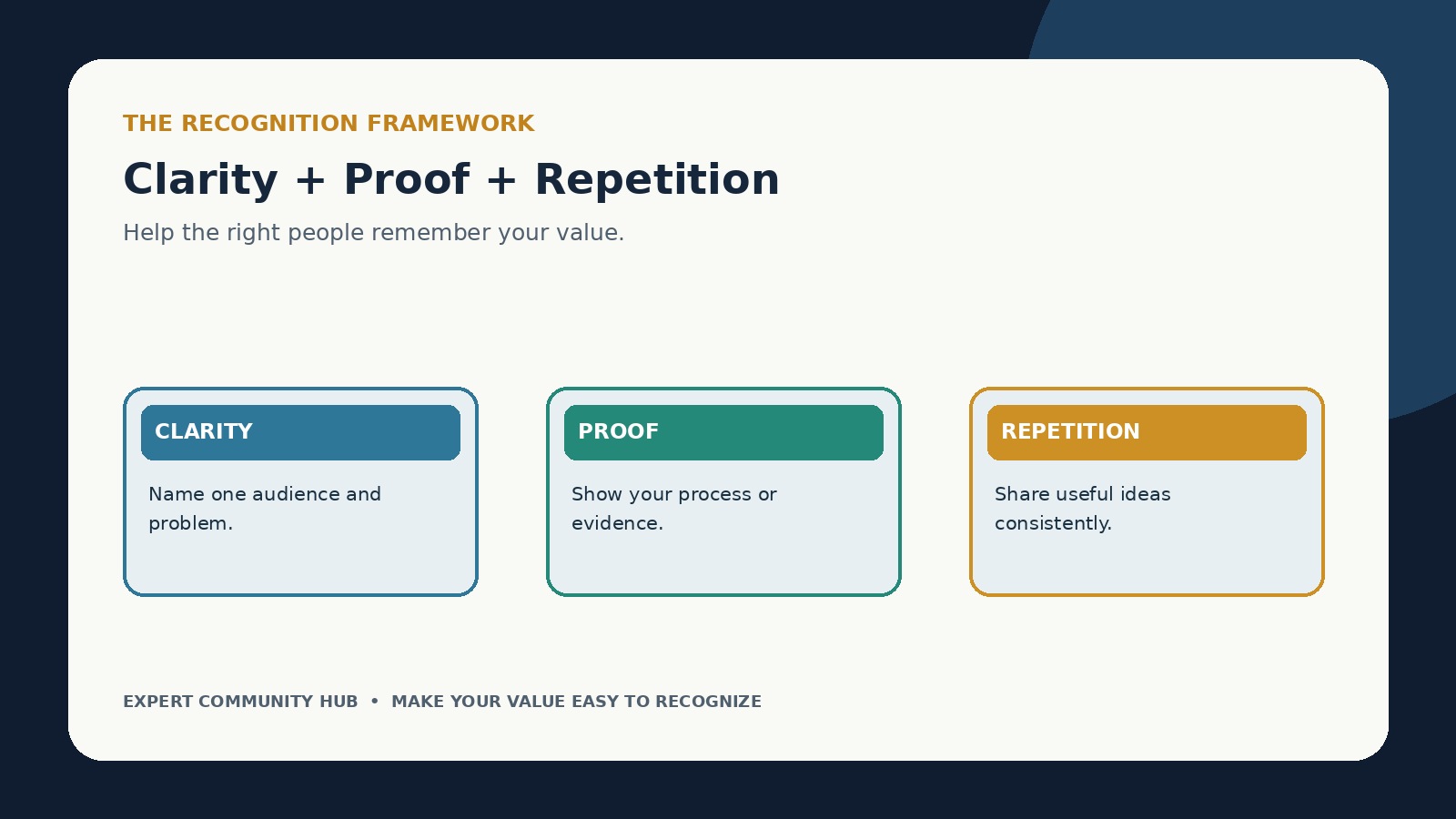
The Recognition Framework: Clarity + Proof + Repetition
You do not need to become the loudest person in your industry. You need to make your value easier for the right people to understand and remember.
1. Clarity: explain who you help and what problem you solve
Try completing this sentence:
“I help [specific audience] solve or make progress on [specific problem] through [your approach].”
For example:
“I help independent coaches create a clearer process for turning interested leads into client conversations.”
That is more concrete than saying, “I provide business growth solutions.”
A focused message gives a potential client something to recognize. It also helps you choose better topics for your content.
You can still have multiple skills and services. Start your public communication with the problem that is most relevant to the audience you want to reach.
2. Proof: show how you think and work
Claims alone rarely provide enough context.
Where appropriate, demonstrate your process with a walkthrough, anonymized example, sample framework, client feedback shared with permission, or a practical explanation of how you approach a problem.
You do not need dramatic claims or guaranteed results. Be accurate about what you have done, what you can support, and what depends on the client's situation.
If you are new to independent work, show your reasoning and demonstrate a small useful process. You can build credible evidence over time without pretending to have results you do not yet have.
3. Repetition: make your message familiar
One excellent post is unlikely to explain your entire value proposition to everyone who sees it.
People encounter information at different times. They may need to see your perspective more than once before they remember it or decide to explore your work.
Repeat your core message through different useful formats:
- Explain a common mistake.
- Answer a frequently asked question.
- Demonstrate a step in your process.
- Share a relevant lesson from experience.
- Discuss a misconception about the problem you solve.
Repetition does not mean copying the same post endlessly. It means exploring the same central problem from different useful angles.
Stop trying to prove everything in one post
Experts often feel pressure to demonstrate the full depth of their knowledge whenever they publish something.
The result can be a dense post with too many ideas, technical terms, and qualifications.
A reader may respect the knowledge but struggle to identify the one thing that matters to them.
Try a simpler approach.
One audience. One problem. One useful insight. One next step.
For example, if you help coaches improve lead follow-up, write a post about one common reason a prospect stops responding. Explain what may be happening, offer a respectful way to follow up, and invite readers to consider how they handle the situation.
You do not need to teach your entire methodology in one article. Give people a useful experience of how you think.
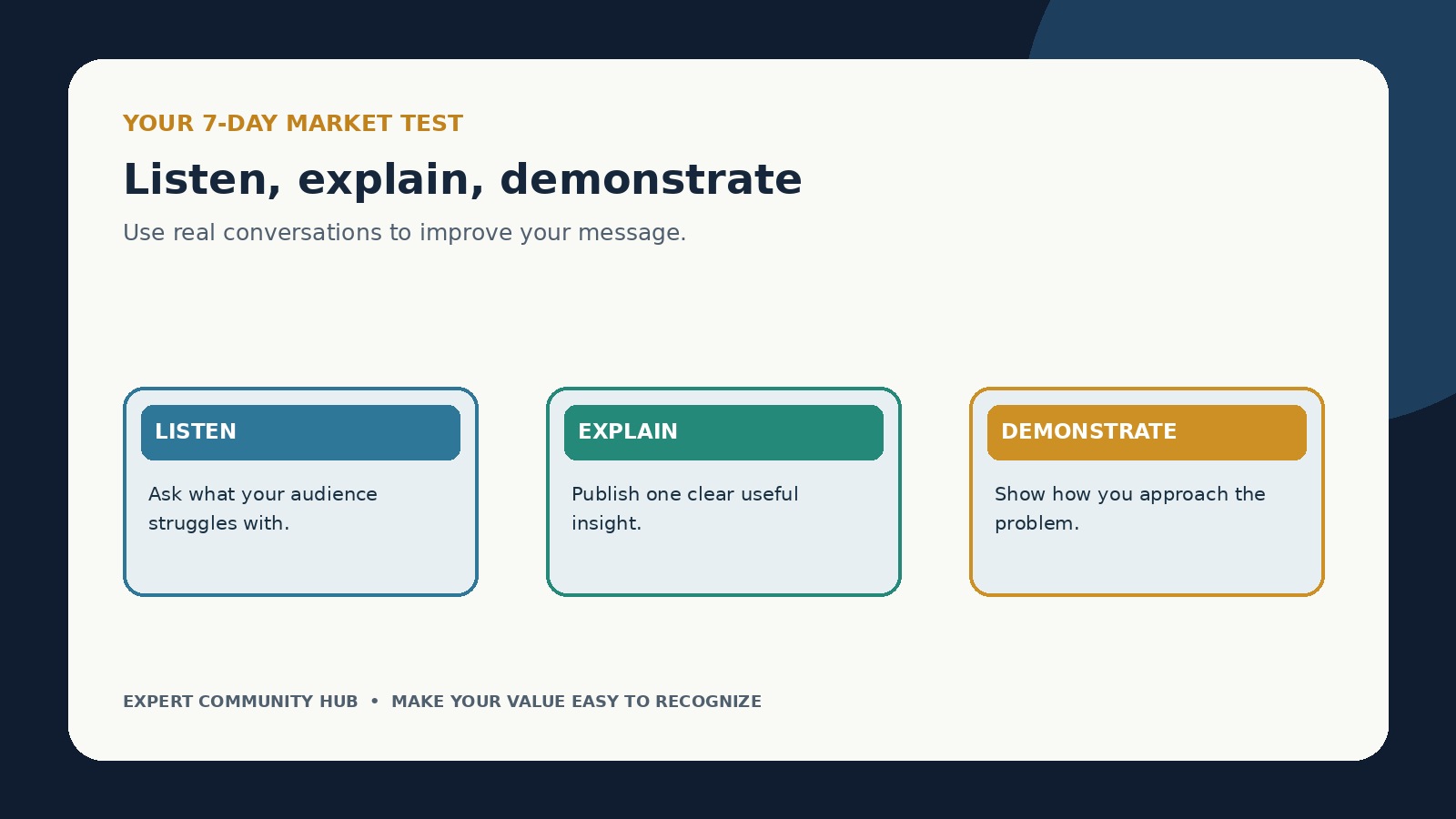
Your seven-day market recognition test
Use this short experiment to find out whether your message is becoming clearer.
Day 1 — Choose your audience. Write down the specific people you want to help and the problem they most need to solve.
Day 2 — Listen. Speak with two or three people who fit that audience. Ask how they describe the problem, what they have tried, and what makes a solution difficult to choose.
Day 3 — Clarify. Rewrite your offer in one or two plain-language sentences using the words your audience naturally understands.
Day 4 — Demonstrate. Create a short post or example that shows one part of your approach.
Day 5 — Invite a conversation. Share the post with a relevant audience or professional network. Ask a genuine question rather than forcing a sales pitch.
Day 6 — Review responses. Notice which questions people ask and where they appear confused. Do not judge the entire experiment by likes alone.
Day 7 — Improve one thing. Refine your message, example, or next step based on what you learned.
The aim is not to become famous in seven days. It is to make your expertise easier to recognize and learn from real responses.
What if a less-experienced competitor is getting more attention?
It is natural to feel frustrated when someone with less experience appears to be doing better in the market.
But attention alone does not tell you the full story. You may not know their revenue, client results, costs, or challenges.
Instead of comparing yourself with their public image, study the parts of their communication that are useful.
Is their offer easier to understand? Do they speak to a clearly defined audience? Do they demonstrate their approach? Do they explain the next step clearly?
Learn from what you can observe without assuming that visibility proves superior expertise.
Then improve your own communication in ways that remain honest and aligned with the quality of work you want to deliver.
Your 20-minute action
Open your website, social profile, or service description.
Give yourself 20 minutes to answer these questions:
- Can a new visitor tell who I help?
- Can they identify the problem I help solve?
- Is there a clear example of how I work or what I know?
- Is the next step easy to understand?
Choose the weakest answer and improve that one thing today.
You might rewrite your opening sentence, add a practical example, or make your service page clearer. Small improvements can make your expertise easier to understand without changing who you are.
Being excellent is important. Being understood matters too.
You do not need to abandon depth, integrity, or the years you have invested in your craft.
You need to connect that expertise with a problem people recognize, communicate it in language they understand, and provide credible reasons to trust your approach.
The market is not a perfect measure of talent. Visibility and sales are influenced by timing, access, relationships, competition, and many other factors.
But clear positioning gives the right people a better chance of recognizing when your expertise may be useful.
Do excellent work. Explain its relevance. Demonstrate your thinking. Keep listening.
Your goal is not simply to be the most knowledgeable person in the room.
It is to help the right people understand why your knowledge matters to them.
Your turn
Have you ever seen someone with less experience attract more opportunities because they communicated their value more clearly? What did that teach you?
Share your perspective in the comments. Your experience may help another expert rethink how they present their work.
Your next step
If you are a coach, consultant, or knowledge-based professional building an independent business, explore the resources and learning opportunities from Expert Community Hub.
Start by making your audience, the problem you solve, and your approach clear. Then build a repeatable way to share that value with the people who need it.
Written for coaches, consultants, and knowledge-based entrepreneurs by Expert Community Hub.